

TL;DR:
- Market cap equals current price times circulating supply, indicating true project size.
- Different types of market cap—circulating, total, FDV—show various valuation aspects.
- Using market cap alongside other signals improves cryptocurrency investment decisions and risk management.
A crypto token priced at $500 must be more valuable than one priced at $0.001, right? Not even close. This is one of the most expensive misconceptions in crypto trading, and it costs investors real money every year. Market cap in crypto is price times circulating supply and it is a far truer measure of a project's size and weight than price alone. In this breakdown, we cover exactly what market capitalization is, how it is calculated, the different types you need to know, and how to use it as a core signal in your trading research.
Table of Contents
- Understanding market capitalization in crypto
- Types of market capitalization: circulating, total, and FDV
- Market cap categories and their significance
- Crypto vs. stock market cap: key differences and nuances
- How traders use market cap to inform crypto investing decisions
- Our take: why market cap is a great starting point—but not the end
- Understand market cap—and level up your crypto strategy
- Frequently asked questions
Key Takeaways
| Point | Details |
|---|---|
| Market cap is fundamental | It offers a reliable way to compare the true size and stability of crypto assets. |
| Types matter for risk | Understanding circulating, total, and FDV reveals dilution or stability risks. |
| Categories signal risk/reward | Large-caps are stable, while small-caps can swing drastically but also offer high reward. |
| Crypto cap vs. stocks | Market cap in crypto is dynamic and can be manipulated, unlike earnings-backed equities. |
| Cap is a tool, not the answer | Combining market cap analysis with other signals is vital to informed trading decisions. |
Understanding market capitalization in crypto
Market capitalization, or market cap, is the total dollar value of all coins currently in circulation for a given cryptocurrency. The formula is straightforward: Current Price × Circulating Supply = Market Cap. Market cap is calculated as current price multiplied by circulating supply, giving you a number that reflects actual market weight rather than just a token's sticker price.
Let's make this concrete. If Bitcoin trades at $50,000 and there are 19.5 million BTC in circulation, the market cap is roughly $975 billion. Ethereum, with a lower price per coin but a different supply, carries its own market cap that tells a completely different story. Two coins can have wildly different prices and still have similar market caps, or vice versa.
Why use circulating supply instead of max supply? Because coins that haven't been minted or released yet don't affect today's market dynamics. Using circulating supply gives you the most accurate snapshot of what the market is actually pricing right now.
"Price without context is noise. Market cap gives that context."
As of late 2025, the global crypto market cap sits around $3 trillion, a figure that underscores just how significant this asset class has become.
| Cryptocurrency | Price (approx.) | Circulating Supply | Market Cap |
|---|---|---|---|
| Bitcoin (BTC) | $50,000 | 19.5M | ~$975B |
| Ethereum (ETH) | $3,000 | 120M | ~$360B |
| Example altcoin | $500 | 1M | ~$500M |
The key pitfall here is mistaking a high price for high value. That $500 altcoin in the table above has a fraction of Bitcoin's market cap. Price is just one variable. Market cap is the full equation.
- Market cap reflects total market value, not individual token price
- Circulating supply is the active variable that changes market cap
- Two tokens at very different prices can have nearly identical market caps
- Always check market cap before comparing two crypto assets
Types of market capitalization: circulating, total, and FDV
Not all market cap figures mean the same thing. There are three distinct versions traders encounter, and confusing them can lead to seriously flawed analysis.
Circulating Market Cap is the most widely used. It reflects only the coins actively trading in the market right now. This is what you see on CoinGecko or CoinMarketCap by default.
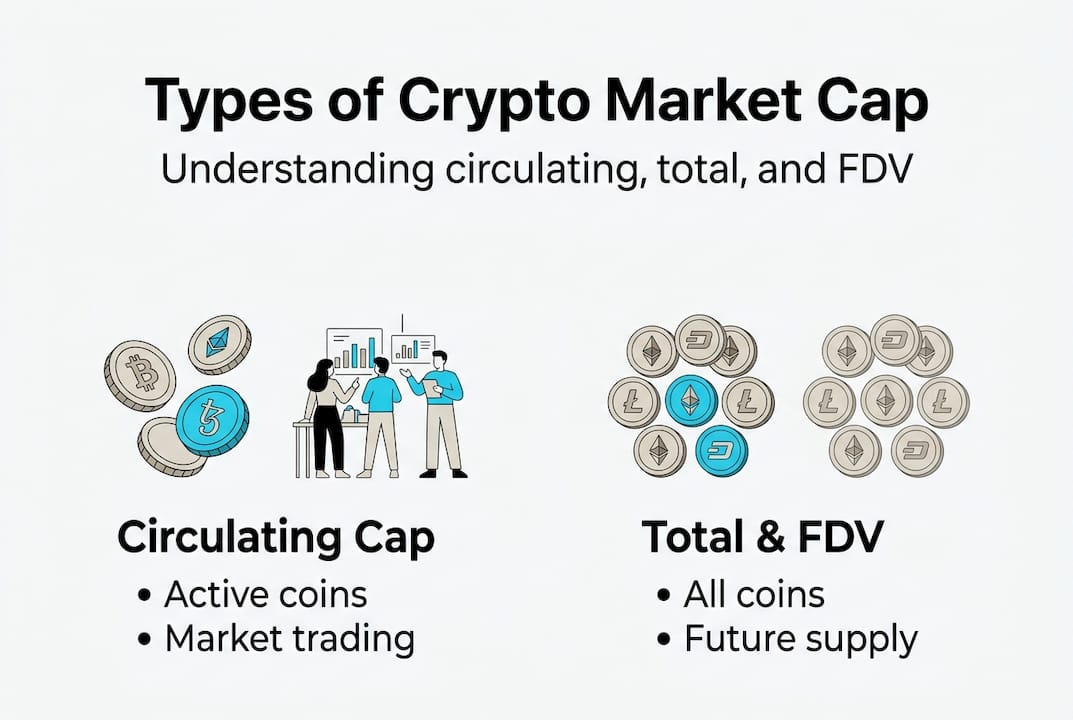
Total Market Cap includes all coins in existence, even those that are locked, staked, or reserved. It paints a broader picture but can overstate the liquid value of a project.
Fully Diluted Valuation (FDV) takes the current price and multiplies it by the maximum possible supply. Circulating Market Cap, Total Market Cap, and FDV differ in how they measure value and risk, and FDV is arguably the most revealing for spotting future dilution risk.
Here's why FDV matters so much: on many newer tokens, FDV can be 10 to 20 times higher than the circulating market cap. That gap represents tokens that will eventually enter circulation, diluting the value of every coin you hold today.
| Metric | What it measures | Best used for |
|---|---|---|
| Circulating Market Cap | Active coins × price | Day-to-day comparisons |
| Total Market Cap | All existing coins × price | Broader project valuation |
| FDV | Max supply × price | Dilution and long-term risk |
- Circulating cap is the default for most trading decisions
- Total cap helps evaluate locked or vesting token pools
- FDV reveals what the project could be worth at full supply
- A low circulating cap with a massive FDV is a red flag for new tokens
Pro Tip: Before buying into any new token launch, check the FDV. If it's 15x the circulating cap, you're essentially paying a premium for a project that will flood the market with new supply over time.
Market cap categories and their significance
Once you understand what market cap measures, the next step is recognizing how it groups cryptocurrencies into meaningful categories. These categories directly shape how you should think about risk, volatility, and portfolio allocation.
Large-cap cryptos carry market caps above $10 billion. Bitcoin and Ethereum are the clearest examples. Large-cap coins like BTC and ETH tend to be more stable, with deeper liquidity and broader institutional adoption. They still move significantly, but rarely vanish overnight.

Mid-cap cryptos sit between $1 billion and $10 billion. These offer a blend of growth potential and relative stability, though they can swing harder than large-caps during market corrections.
Small-cap cryptos fall below $1 billion. This is where large-cap, mid-cap, and small-cap examples diverge most sharply in risk profile. Small-caps can generate enormous returns, but they can also lose 80% of their value in days.
| Category | Market Cap Range | Volatility | Risk Level |
|---|---|---|---|
| Large-cap | > $10B | Moderate | Lower |
| Mid-cap | $1B to $10B | High | Medium |
| Small-cap | < $1B | Very high | Higher |
Understanding crypto risk-reward ratios becomes much easier when you anchor it to market cap categories. Many experienced traders allocate the bulk of their portfolio to large-caps for stability, then use a smaller allocation for mid and small-caps to chase higher upside.
- Large-caps: core portfolio holdings, lower volatility
- Mid-caps: selective growth plays with manageable risk
- Small-caps: speculative positions, size them small
- Always assess best practices for crypto trading before entering small-cap positions
Pro Tip: Small-cap coins often have thin order books. A large buy or sell order can move the price dramatically. Always check trading volume and liquidity before entering a position to avoid slippage eating into your returns.
Crypto vs. stock market cap: key differences and nuances
Market cap exists in equities too, but the mechanics are fundamentally different. Treating them the same way is a mistake that trips up traders who come from traditional finance backgrounds.
In stocks, share counts are relatively fixed and regulated. Companies report earnings, pay dividends, and have audited financials backing their valuations. Crypto is a different animal entirely. Crypto market cap is dynamic and not earnings-backed, unlike stocks, meaning the value is driven by market sentiment, utility, and speculation rather than cash flows.
Here are three major differences every trader should internalize:
- Valuation basis: Stock market cap reflects earnings potential and book value. Crypto market cap reflects speculative demand, network usage, and narrative.
- Trading mechanics: Crypto trades 24 hours a day, 7 days a week. Stocks have set exchange hours with overnight gaps. This means crypto market caps can shift dramatically while you sleep.
- Manipulation risk: Crypto market cap can be skewed by inaccurate supply figures or wash trading that inflates volume numbers. Stock exchanges have stricter reporting requirements.
Small-cap crypto assets can move 50 to 100 percent in a single day, a range that would be extraordinary in even the most volatile stocks.
This is why crypto vs. stock market cap analysis requires a different framework. Using predictive analysis in crypto alongside market cap gives you a much sharper edge than relying on cap figures alone.
Pro Tip: Pair market cap data with on-chain metrics like active addresses and transaction volume. This cross-check helps you spot projects with inflated caps but weak actual usage.
How traders use market cap to inform crypto investing decisions
Knowing what market cap is matters far less than knowing how to apply it. Here's how to actually use it in your research process.
Market cap is your first filter when comparing a new token to an established one. If a new project has a circulating cap already matching Ethereum's, it has almost no room to grow without extraordinary adoption. That context is invaluable before you commit capital.
Combining cap with crypto market indicators like trading volume and on-chain activity sharpens your picture significantly. A coin with a rising market cap and rising volume is a very different signal than a rising cap with falling volume.
Watch for these red flags:
- Micro-cap tokens with suspiciously high reported volume (often wash trading)
- High FDV relative to circulating cap on newly launched tokens
- Rapid market cap increases with no corresponding on-chain activity
- Coins with large locked supply percentages and no clear vesting schedule
Building a research checklist helps. Before entering any position, check the circulating cap, total cap, FDV, 24-hour volume, and on-chain data. Tools like crypto watchlists make this faster by letting you monitor multiple assets simultaneously.
Solid crypto risk management tips always include market cap as a core variable. Pair it with crypto technical analysis and real-time data for crypto to build a layered, evidence-based view before you trade.
Market cap guides stability and risk analysis in crypto trading but should never be the only signal you rely on. It is the starting point, not the finish line.
Our take: why market cap is a great starting point—but not the end
Here's the uncomfortable truth we've seen play out repeatedly: traders treat market cap as a quality stamp. A large cap must mean a safe investment. A small cap must mean a moonshot. Neither assumption holds up under scrutiny.
We've watched traders overpay for tokens with impressive circulating caps while completely ignoring the supply schedule. Six months later, a wave of vesting unlocks floods the market and the price collapses. Market cap looked fine on day one. FDV told the real story.
Market cap works best when it's the first filter in a multi-signal process, not the only one.
The traders who use it well treat market cap as a starting point for categorization, then layer in volume, on-chain data, tokenomics, and fundamental signals before making a move. Understanding the AI crypto investment benefits of combining machine learning signals with market cap analysis is where the real edge lives in 2026.
Conventional wisdom says big cap equals safe. Our experience says big cap equals less likely to go to zero, which is a very different thing. Stay skeptical, stay layered, and use market cap as step one in your process, not your entire process.
Understand market cap—and level up your crypto strategy
Market cap gives you a foundation, but the traders who consistently make better decisions are the ones who go deeper. Understanding circulating supply, FDV, and cap categories is the first step. Applying those insights with real-time signals, volume data, and AI-driven pattern recognition is where strategy actually takes shape.

At Crypto Innovate Labs, our advanced methodology for market cap analysis is built to help you move beyond surface-level metrics. The Crypto Innovate Labs platform combines predictive market signals, on-chain data, and machine learning to give you the full picture, not just the cap figure. Sign up today and start making market cap work harder for your portfolio.
Frequently asked questions
How do I calculate market capitalization for a cryptocurrency?
Market cap is price times circulating supply. Multiply the coin's current price by the number of coins actively in circulation to get the figure.
Why does market cap matter more than price in crypto?
Market cap is a better comparability metric because it shows the total size and relative weight of an asset, something price alone cannot tell you.
What does fully diluted valuation (FDV) reveal that market cap doesn't?
FDV captures future dilution risk from undistributed coins by showing what the project would be worth if every possible token entered circulation right now.
Are small-cap cryptocurrencies riskier than large-cap ones?
Yes. Small-caps show higher risk and volatility, often moving dramatically within a single trading day, while large-caps offer more stability and deeper liquidity.
Can market cap in crypto be manipulated?
Yes. Crypto market cap can be manipulated through fake volume reporting or inaccurate supply data, so always cross-check figures across multiple trusted sources.