
TL;DR:
- AI-driven crypto signals analyze real-time data to provide timely, accurate trading recommendations.
- Using signals effectively requires proper tools, risk management, and integration into a structured strategy.
- Over-reliance without contextual analysis and discipline leads to losses; signals should complement personal judgment.
Missing a 40% price move because your signal came 20 minutes late is one of the most frustrating experiences in crypto trading. Manual methods, lagging indicators, and gut-feel decisions cost traders real money every single day. AI-driven trading signals change that equation by processing thousands of data points in real time, giving you context and direction before the crowd catches on. This guide walks you through what crypto signals are, the tools you need, how to read them correctly, how to integrate them into a complete strategy, and the critical mistakes that quietly drain trading accounts.
Table of Contents
- Understanding crypto trading signals and AI market analysis
- Tools and requirements for using crypto trading signals
- How to read, interpret, and act on crypto trading signals
- Integrating signals into your crypto trading strategy
- Why most traders misuse crypto signals—and how to fix it
- Enhance your trading with Crypto Innovate Labs
- Frequently asked questions
Key Takeaways
| Point | Details |
|---|---|
| AI signals boost accuracy | AI-powered trading signals analyze market trends faster and provide higher accuracy than manual analysis. |
| Use signals with strategy | Trading signals are most effective when integrated into disciplined trading plans and risk management frameworks. |
| Avoid common mistakes | Blindly following signals without verification is risky; always cross-check and prioritize safety. |
| Leverage top tools | Choosing reputable platforms and staying updated enable traders to maximize gains with advanced crypto signals. |
Understanding crypto trading signals and AI market analysis
A crypto trading signal is an alert that tells you when to consider buying or selling a specific asset, based on data-driven analysis. Think of it as a GPS for your trades. Instead of guessing which direction the market is heading, a signal gives you a calculated recommendation grounded in price behavior, volume patterns, and market momentum.
Signals come in three main types:
- Manual signals: Generated by human analysts who study charts and news. Slow, subjective, and limited by analyst capacity.
- Automated signals: Rule-based systems that trigger alerts when predefined conditions are met. Faster, but rigid.
- AI-powered signals: Machine learning models that continuously learn from new data, adapt to changing conditions, and identify patterns humans miss. These are the most sophisticated and increasingly the most reliable.
The key market indicators that fuel signal generation include relative strength index (RSI), moving average convergence divergence (MACD), Bollinger Bands, volume-weighted average price (VWAP), and on-chain metrics like wallet activity and exchange inflows. Each indicator captures a different dimension of market behavior.
Here is a quick comparison of signal types:
| Signal type | Speed | Accuracy | Adaptability | Best for |
|---|---|---|---|---|
| Manual | Slow | Variable | Low | Macro analysis |
| Automated | Fast | Moderate | Low | Rule-based setups |
| AI-powered | Real-time | High | High | Dynamic markets |
AI changes the game by eliminating the bottleneck of human processing speed. A machine learning model can scan hundreds of assets, cross-reference signal generation methodology, and produce a ranked signal list in seconds. According to advanced crypto technical analysis, layering multiple technical indicators within an AI framework significantly improves signal reliability compared to using any single indicator alone. The result is fewer false positives and better-timed entries.
Tools and requirements for using crypto trading signals
With the basics defined, let's look at exactly what you'll need to start using advanced trading signals effectively.
You do not need a supercomputer, but you do need the right setup. Here is what matters:
- A reliable signal service: Choose platforms that are transparent about their technical analysis tools and backtested performance data. Avoid any service that guarantees profits.
- A trading platform with API access: Platforms like Binance, Kraken, or Coinbase Advanced allow you to connect signal services directly and execute trades automatically or semi-automatically.
- Real-time market data feeds: Signals are only as good as the data behind them. Ensure your provider pulls from multiple exchanges to avoid single-source bias.
- A secure device and network: Use two-factor authentication (2FA), a VPN on public networks, and hardware wallets for asset storage. Never share API keys with full withdrawal permissions.
- A portfolio tracker: Tools that aggregate your positions across exchanges give you a live snapshot of exposure, helping you avoid over-concentration in one asset.
Here is a comparison of popular signal service tiers:
| Feature | Free tier | Pro tier | Institutional tier |
|---|---|---|---|
| Signal frequency | 1-3 per day | Unlimited | Custom |
| AI model depth | Basic | Advanced | Full ML pipeline |
| Backtesting access | No | Yes | Yes |
| API integration | No | Yes | Yes |
| Support | Community | Priority | Dedicated |
When setting up your account, follow the methodology overview to understand how signals are constructed before you act on them. Blind trust in any signal service is a fast path to losses.
Pro Tip: Start with paper trading (simulated trades with no real money) for at least two weeks before committing capital to any new signal service. This lets you evaluate signal quality without financial risk.
How to read, interpret, and act on crypto trading signals
Once your tools are set, here is how to make the most of the signals you receive.
Every signal contains core components you must understand before clicking buy or sell:
- Entry price: The recommended price level to open a position.
- Exit target: The price at which you plan to take profit.
- Stop-loss: A predefined price below (or above for shorts) your entry where you exit to limit losses. This is non-negotiable.
- Risk-reward ratio: The relationship between potential profit and potential loss. A 1:3 ratio means risking $1 to potentially earn $3.
Here is a practical workflow for evaluating every signal:
- Check the source: Is the signal from a verified AI model or a human analyst? Know what you are trusting.
- Confirm with one additional indicator: Use RSI or volume to validate the signal direction before acting.
- Assess market context: Is the broader market in a downtrend? Even a strong buy signal can fail in a bear market.
- Set your stop-loss immediately: Before you enter, define your exit for the losing scenario. Review risk-reward ratios to calibrate this correctly.
- Size your position appropriately: Never risk more than 1-2% of your total portfolio on a single trade.
- Log the trade: Record entry, rationale, signal source, and outcome. This data improves your future decisions.
"A signal without a stop-loss is not a strategy. It is a gamble with extra steps."
Distinguishing actionable signals from noise is a skill. High-quality signals include clear entry and exit levels, a defined timeframe, and a stated confidence level. Vague alerts like "Bitcoin looks bullish" are not signals. They are opinions. Predictive analysis techniques show that signals backed by multi-factor AI models consistently outperform single-indicator alerts in volatile conditions.

Pro Tip: If a signal does not include a stop-loss level, add one yourself based on recent support levels before entering the trade.
Integrating signals into your crypto trading strategy
Great signal interpretation unlocks more potential. Here is how you put that into action for consistent gains.
Signals are most powerful when they operate inside a structured strategy, not as isolated events. Here is how to build that structure:
- Define your trading style first: Are you a day trader, swing trader, or position trader? Signals have different relevance depending on your timeframe. A 15-minute signal is irrelevant to a weekly position trader.
- Build targeted watchlists: Organize assets by sector (DeFi, Layer 1s, memecoins) and monitor crypto watchlists for pattern clusters. Signals hitting multiple assets in the same sector often indicate a sector-wide move.
- Layer risk management over every signal: Use position sizing rules, portfolio-level stop-losses, and maximum drawdown limits. Crypto risk management tips recommend never exceeding 10-15% total portfolio exposure to high-volatility assets.
- Set automated alerts: Most platforms allow price and indicator alerts. Combine these with AI signal notifications so you never miss a setup.
- Balance multiple signals: When two or more signals align on the same asset and direction, confidence increases. Conflicting signals are a reason to wait, not to guess.
According to advanced trading best practices, traders who integrate signals into a documented strategy rather than reacting ad hoc see measurably better risk-adjusted returns. The AI crypto benefits extend beyond signal accuracy. AI tools also help optimize entry timing, reduce emotional decision-making, and surface opportunities across markets you are not actively watching.
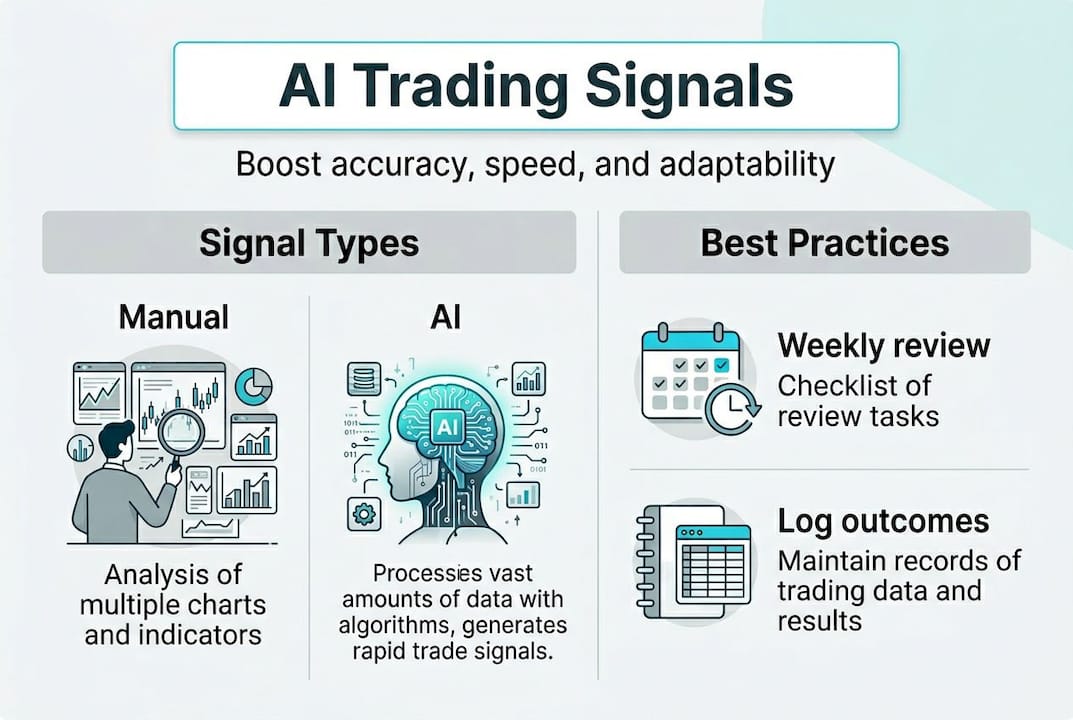
Pro Tip: Review your signal log weekly. Track which signal types and sources produce the best outcomes for your specific trading style. Optimize toward what works, not what sounds impressive.
Explore top trading strategies to find frameworks that pair naturally with AI signal workflows.
Why most traders misuse crypto signals—and how to fix it
Here is the uncomfortable truth: most traders who use signals still lose money. Not because the signals are bad, but because they treat signals as a replacement for thinking rather than a tool to sharpen it.
The most common mistake is over-reliance. A trader receives a buy signal, skips their own analysis, ignores the broader market trend, and enters a position that gets stopped out within hours. The signal was technically correct on a micro timeframe, but the macro context made it a losing trade. Context is everything.
Discipline is the other missing piece. Experienced traders know that risk management insights matter more than any individual signal. A great signal used with poor position sizing still produces poor results. The fix is simple but not easy: treat every signal as a hypothesis, not a guarantee. Verify it, size it correctly, and respect your stop-loss every single time. The traders who consistently profit from signals are not the ones with the best signals. They are the ones with the best process.
Enhance your trading with Crypto Innovate Labs
Ready to apply these techniques with institutional-grade tools? Here is how Crypto Innovate Labs can help.
At Crypto Innovate Labs, we built our platform specifically for traders who want more than generic alerts. Our machine learning models power real-time signals grounded in a transparent proven signal methodology that you can study and trust before you act.
Whether you are building your first signal-based strategy or optimizing an existing one, our signal and analysis marketplace gives you access to curated tools, AI-driven market intelligence, and the context you need to trade with confidence. Explore the marketplace, review our methodology, and start making more informed decisions with every trade.
Frequently asked questions
What are crypto trading signals?
Crypto trading signals are actionable alerts generated from technical analysis or AI-based algorithms, guiding traders on when to buy or sell specific cryptocurrencies. Platforms using layered technical indicators produce more reliable signals than single-source methods.
How can AI improve the quality of trading signals?
AI leverages real-time data processing and pattern recognition to deliver more accurate, timely, and adaptive trading signals compared to manual methods. The AI-driven benefits include faster execution, reduced emotional bias, and continuous model improvement.
Is it safe to rely solely on crypto trading signals?
No, signals should always be used alongside personal analysis and risk management techniques. Sole reliance on signals without context exposes you to losses that safer trading practices are specifically designed to prevent.
What tools and platforms do I need for effective signal use?
You need a reputable signal service, a trading platform with API access, real-time market data, and strong security features. A solid foundation in advanced technical analysis helps you evaluate signal quality before committing capital.