
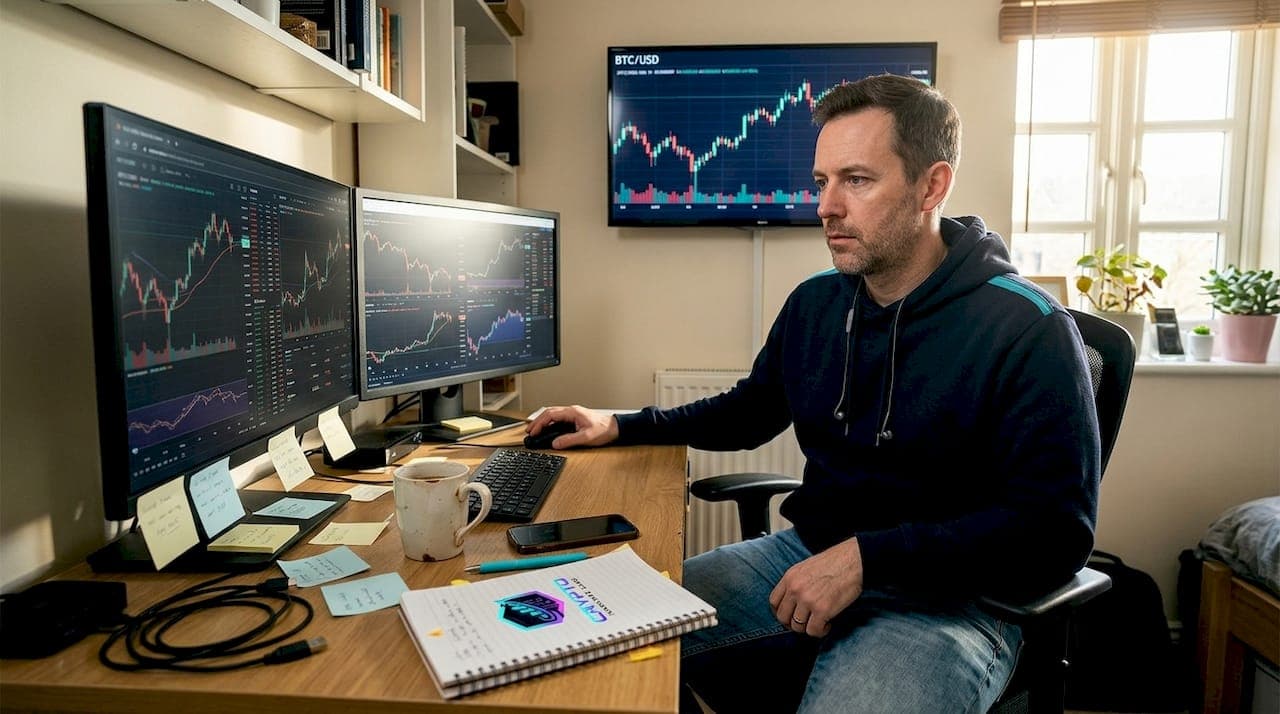
Crypto markets don't reward guesswork. With Bitcoin swinging 20% in a single week and altcoins moving even faster, the gap between traders who use structured, AI-driven strategies and those who rely on gut instinct keeps widening. Dynamic risk parity strategies have demonstrated that diversification and advanced methods outperform naive buy-and-hold approaches, delivering measurably better risk-adjusted returns. In this guide, we break down the criteria for selecting the right strategies, compare proven tactics, and show you how to combine AI signals, quant benchmarks, and disciplined execution to consistently maximize returns.
Table of Contents
- Key criteria for selecting crypto trading strategies
- Diversification and dynamic risk management
- AI-powered trading: Multi-signal and adaptive strategies
- Specialized trading tactics: Grid, pairs, funding arbitrage, and regime detection
- Avoiding common mistakes: FOMO, overtrading, and hybrid approaches
- Why most traders miss the real edge: Hybrid AI and quant synergy
- Next steps: Unlock your trading advantage with Crypto Innovate Labs
- Frequently asked questions
Key Takeaways
| Point | Details |
|---|---|
| Diversify and adapt | Dynamic risk allocation across assets and strategies consistently outperforms passive buy-and-hold. |
| AI-driven edge | Multi-signal AI and reinforcement learning provide adaptive, high-accuracy trading decisions. |
| Strategy selection criteria | Prioritize liquidity, volatility, empirical benchmarks, and regime adaptability when choosing trading methods. |
| Hybrid tactics work | Combining holding and active trading with strict risk management reduces emotional mistakes and enhances returns. |
| Avoid common pitfalls | FOMO, overtrading, and neglecting risk controls are the top causes of losses; mitigation is possible with disciplined practice. |
Key criteria for selecting crypto trading strategies
Not every strategy fits every market condition. Before you commit capital, you need a clear framework for evaluating what actually works versus what sounds good on a forum. The criteria that matter most are liquidity, volatility profile, risk-adjusted returns, and statistical benchmarks like Sharpe ratio and maximum drawdown.
Liquidity determines how cleanly you can enter and exit positions without slippage eating your edge. Volatility profile tells you whether a strategy is designed for trending, ranging, or choppy conditions. Risk-adjusted returns, specifically Sharpe and Sortino ratios, tell you how much return you're earning per unit of risk. These numbers matter far more than raw percentage gains.
AI and ML strategies consistently deliver higher accuracy and adaptability compared to traditional technical analysis, especially in volatile markets. This is because AI models process multiple signal types simultaneously, including price action, order book depth, sentiment data, and on-chain flows, rather than relying on a single lagging indicator.
Key evaluation criteria to apply before selecting any strategy:
- Liquidity: Minimum daily volume thresholds to ensure clean execution
- Volatility regime: Does the strategy perform in trending or ranging markets?
- Backtested Sharpe ratio: Aim for above 1.0 as a baseline
- Maximum drawdown: Know your worst-case scenario before you trade
- Signal source: AI-driven versus traditional technical analysis
- Adaptability: Can the strategy shift when market regimes change?
Regime detection is one of the most underrated criteria. Markets cycle between trending, mean-reverting, and high-volatility states. A strategy that crushes it in a bull trend can destroy your account in a sideways chop. Understanding scalping trading mechanics in crypto, for example, requires recognizing that scalping thrives in liquid, volatile conditions but fails in low-volume environments.
Pro Tip: Before backtesting any strategy, segment your historical data by regime type. Test performance separately in trending, ranging, and high-volatility periods. A strategy that performs well across all three is far more valuable than one that only shines in one condition.
Avoiding common pitfalls starts here. FOMO-driven entries ignore regime context entirely. Over-leverage amplifies losses in the exact moments when volatility spikes and your strategy is least suited to perform.
Diversification and dynamic risk management
Once you have your selection framework, the next step is building a portfolio of strategies rather than betting everything on one approach. This is where diversification and dynamic risk management create a measurable edge.

Dynamic risk parity strategies deliver 3.55% CAGR at just 0.99% volatility with a Sharpe ratio of 1.19, consistently beating passive benchmarks. That combination of low volatility and solid returns is exactly what you want when crypto markets turn unpredictable.
Here's how advanced diversification compares to passive approaches:
| Strategy type | CAGR | Volatility | Sharpe ratio |
|---|---|---|---|
| Dynamic risk parity | 3.55% | 0.99% | 1.19 |
| Passive buy-and-hold | Variable | High | Below 1.0 |
| Pairs trading | Stable | Low | Above 1.0 |
| Single-asset active | High variance | Very high | Inconsistent |
Refer to quant strategy benchmarks from institutional teams managing billions in AUM for independent verification of these figures.
Key benefits of dynamic risk allocation:
- Reduces portfolio drawdown by spreading exposure across uncorrelated strategies
- Automatically rebalances based on volatility signals, not arbitrary calendar dates
- Pairs trading exploits price divergence between correlated assets, generating returns regardless of overall market direction
- Risk parity weights positions by risk contribution, not dollar amount
Pro Tip: Run your strategy portfolio through a correlation matrix monthly. If two strategies show correlation above 0.7, they're not providing true diversification. Replace one with a lower-correlated approach to genuinely reduce your risk exposure.
Dynamic allocation also means adapting when regimes shift. When volatility spikes, reduce position sizes automatically. When trend strength increases, allow momentum strategies more weight. This adaptive logic is what separates institutional-grade trading from retail guesswork.
AI-powered trading: Multi-signal and adaptive strategies
Diversification sets the foundation, but AI-powered strategies offer a real leap in performance by adapting to changing market conditions in real time. The key is combining multiple signal types rather than relying on any single model.
SAC and reinforcement learning models achieve a Sharpe ratio of 2.81 and 152% excess returns, while LSTM combined with ARIMA cuts forecast error by 32.5%. These aren't theoretical numbers. They represent what happens when adaptive AI replaces static rule-based systems.
Top-performing AI strategy types ranked by adaptability:
- Reinforcement learning (RL/SAC): Continuously updates risk exposure based on live market feedback
- LSTM hybrid models: Combines deep learning with statistical forecasting for price prediction
- Sentiment-integrated models: Incorporates social signals, news flow, and on-chain data
- Multi-signal decision engines: Aggregates technical, fundamental, and sentiment signals into one output
"Multi-signal AI approaches achieve 55-65% prediction accuracy, significantly outperforming single-method technical analysis in volatile conditions."
For practical implementation, refer to a structured AI trading bot guide that covers data collection, model training, and live deployment steps.
| AI model type | Key metric | Edge over traditional TA |
|---|---|---|
| SAC/RL | Sharpe 2.81 | Adaptive risk control |
| LSTM+ARIMA | 32.5% RMSE reduction | Better price forecasting |
| Multi-signal engine | 55-65% accuracy | Cross-signal confirmation |
The real power of AI trading isn't any single model. It's the hybrid approach. Combining reinforcement learning for dynamic position sizing with LSTM for directional forecasting and sentiment models for regime context creates a layered decision system that no single indicator can match.
Specialized trading tactics: Grid, pairs, funding arbitrage, and regime detection
Let's detail which specialized trading tactics shine under different market dynamics, from grid bots to regime-adaptive approaches.
Grid trading bots yield 12-34% monthly returns during high-volatility periods, with some configurations achieving an 87.3% win rate and 0.89% average profit per trade. These results come from structured, rules-based execution that removes emotional decision-making entirely.
Specialized tactics by market condition:
- Grid trading: Best in ranging, volatile markets. Automates buy-low/sell-high within defined price bands.
- Pairs trading: Exploits divergence between correlated assets. Performs well regardless of market direction.
- Funding arbitrage: Captures funding rate differentials between perpetual futures and spot. Low drawdown, consistent returns.
- Long-short strategies: Hedges directional exposure. Generates returns in both bull and bear conditions.
- Regime detection: Uses volatility indicators and trend filters to switch between strategy modes automatically.
Empirical benchmarks from $4B AUM teams verify that quant strategies maintain stability across varying market conditions, which is something discretionary trading rarely achieves.
How to implement regime detection effectively:
- Use the Average True Range (ATR) to measure current volatility versus its 30-day average
- Apply a trend filter such as a 200-period moving average to confirm directional bias
- Switch to grid or mean-reversion strategies when trend strength is weak
- Activate momentum or breakout strategies when trend strength is strong
- Review quant strategy results monthly to benchmark your own performance against institutional standards
"Funding arbitrage and long-short strategies consistently produce stable, low-drawdown results even during major market dislocations, making them core components of any advanced trading portfolio."
Avoiding common mistakes: FOMO, overtrading, and hybrid approaches
Advanced tactics boost your toolkit, but avoiding classic mistakes and using hybrid approaches is just as crucial for achieving steady gains. The statistics here are sobering.
Over 90% of day traders lose money, and the primary causes are emotional decision-making, excessive leverage, and overtrading in low-quality setups. Knowing this, the goal isn't to trade more. It's to trade better.
The most common and costly mistakes:
- FOMO entries: Buying into pumps after the move has already happened
- Revenge trading: Increasing position size after a loss to recover quickly
- Over-leverage: Using 10x or higher leverage without a clear volatility-adjusted stop
- Ignoring regime context: Applying a trending strategy in a ranging market
- Overtrading: Taking low-probability setups just to feel active
Long-term investors consistently outperform short-term traders in crypto when measured over multi-year periods. This doesn't mean you should only HODL. It means your active trading should be reserved for high-probability setups with clear edge.
Pro Tip: Define your trade criteria in writing before markets open. If a setup doesn't meet every criterion on your checklist, skip it. Discipline in trade selection is more valuable than any indicator.
"The most effective approach combines a core HODL position for long-term appreciation with a smaller active trading allocation for capturing short-term volatility, giving you exposure to both time horizons without overexposing yourself to daily noise."
Hybrid strategies work because they align with how crypto markets actually behave. Long-term fundamentals drive major price cycles. Short-term volatility creates tactical opportunities. Using both intelligently, rather than choosing one or the other, is how you build consistent, compounding returns.
Why most traders miss the real edge: Hybrid AI and quant synergy
Here's the uncomfortable truth: most traders who lose consistently aren't losing because they picked the wrong indicator. They're losing because they're searching for a single solution in a market that rewards layered, adaptive systems.
The traders chasing the latest bot or the hottest AI signal are making the same mistake as those who chased RSI divergence a decade ago. Single-algorithm solutions have a shelf life. Markets adapt, edges erode, and what worked last quarter may not work next month.
Multi-source AI signals combined with regime detection and empirical quant benchmarks are the actual differentiators between consistent performers and the 90% who wash out. The edge isn't in any one tool. It's in the combination.
We've seen this pattern repeatedly: traders who blend AI signal aggregation with disciplined quant rules and a hybrid holding-trading structure outperform those who rely on any single approach. An AI agent that integrates regime awareness can preserve capital during drawdowns while staying positioned for recovery, something no static bot can do.
Regime identification and cross-signal blending are force multipliers. They don't just improve one strategy. They improve every strategy in your portfolio by ensuring each one is deployed only when conditions favor it. That's the real edge, and it's available to any trader willing to build systems instead of chasing shortcuts.
Next steps: Unlock your trading advantage with Crypto Innovate Labs
You now have a framework for selecting, combining, and executing advanced crypto trading strategies. The next step is putting it into practice with tools built specifically for this level of analysis.

At Crypto Innovate Labs, we've built a machine learning-powered platform that delivers exactly what this guide describes: AI-driven market signals, regime detection tools, multi-signal analysis, and predictive insights designed for traders who are serious about maximizing returns. Whether you're optimizing a quant strategy, monitoring on-chain trends, or building a hybrid trading system, our platform gives you the intelligence layer your trading needs. Explore our tools and start trading with a genuine, data-backed edge.
Frequently asked questions
What are the safest advanced crypto trading strategies?
Funding arbitrage and long-short strategies consistently show low drawdowns and stable returns, verified by institutional quant teams managing billions in assets. These tactics generate returns without requiring strong directional conviction.
How accurate are AI-powered trading signals compared to traditional technical analysis?
Multi-signal AI approaches reach 55-65% prediction accuracy, which significantly outpaces single-method technical analysis in volatile crypto markets. The advantage grows during high-uncertainty periods when traditional indicators lag.
How can traders avoid common emotional mistakes like FOMO?
Combining a core HODL position with a rules-based active trading allocation, supported by hybrid approaches and AI signals, removes most emotional triggers by replacing discretionary decisions with defined criteria.
Do grid bots and pairs trading really outperform passive investing?
Grid bots achieve 12-34% monthly returns during volatile periods, and pairs trading consistently delivers higher risk-adjusted returns than passive buy-and-hold strategies across multiple market cycles.
Why do most day traders lose money and what works instead?
Over 90% of day traders lose due to emotional trading, over-leverage, and poor setup selection. Systematic AI-driven strategies combined with hybrid holding-trading models are the proven alternative for building consistent, long-term returns.