
Microseconds separate profitable crypto trades from missed ones. While that sounds extreme, arbitrage windows last 30-50ms in live markets, closing long before any human can click a button. Most traders focus obsessively on strategy, chart patterns, and indicators while ignoring the single factor that decides whether their edge actually executes: the speed and freshness of their data. This guide breaks down why real-time data is the foundation of modern crypto trading, how latency quietly kills profitability, and what you can do right now to stop leaving money on the table.
Table of Contents
- The role of real-time data in crypto markets
- How latency impacts trading performance and profitability
- AI and real-time analytics: Beyond the human edge
- Handling risk, volatility, and adverse selection in real time
- A trader's perspective: Why most miss the real advantage of real-time data
- Leverage real-time data with Crypto Innovate Labs
- Frequently asked questions
Key Takeaways
| Point | Details |
|---|---|
| Milliseconds matter | Crypto trading profits often depend on action within 50ms, making real-time data critical. |
| Latency affects returns | Lowering latency can dramatically increase filled orders and maximize profitability. |
| AI thrives on live data | AI-driven analytics need real-time feeds for accurate signals and advanced strategies. |
| Manage risk instantly | Real-time data enables faster, safer reactions to volatility and adverse market moves. |
The role of real-time data in crypto markets
Real-time data means receiving market information with zero or near-zero delay, typically under one millisecond from the exchange. Delayed data, by contrast, arrives seconds or even minutes late. In traditional stock markets, a few seconds rarely changes the outcome. In crypto, it can mean the difference between a filled order and a missed trade entirely.
The distinction matters because crypto markets never sleep. They run 24 hours a day, seven days a week, across hundreds of exchanges simultaneously. Price discrepancies between exchanges appear and vanish in fractions of a second. If your data feed lags, you are essentially trading on yesterday's news while the market has already moved.
Here is a direct comparison of what real-time versus delayed data looks like in practice:
| Data type | Latency | Use case | Trader impact |
|---|---|---|---|
| Real-time feed | Under 1ms | HFT, arbitrage, scalping | Captures fleeting opportunities |
| Near real-time | 1-500ms | Algorithmic strategies | Moderate edge, some slippage |
| Delayed feed | 1-60 seconds | Swing trading, research | Misses fast-moving setups |
| Historical only | N/A | Backtesting | No live execution value |
Beyond raw price feeds, live order books and microstructure data reveal what is actually happening beneath the surface. Order book depth shows where large buy and sell walls sit. Sudden shifts in that depth often signal price movements before they appear on a standard chart. Traders using digital assets analytics that incorporate microstructure signals can act on these signals proactively rather than reacting after the fact.
Key advantages of trading with real-time data:
- Spot arbitrage windows before they close across exchanges
- React to large order flow that signals institutional activity
- Avoid stale prices that lead to unfavorable fills
- Monitor liquidation cascades as they develop, not after the damage
- Adjust position sizing based on live volatility readings
"Shifting from delayed to real-time data is not a minor upgrade. It fundamentally changes your role from reactive trader to proactive market participant."
Manual trading caps ROI at 0.5% monthly because human reaction times simply cannot compete with the speed at which opportunities appear and disappear. Real-time data does not just improve your strategy. It is the prerequisite for any strategy to function at its full potential.
How latency impacts trading performance and profitability
Latency is the time delay between a market event occurring and your system receiving and acting on it. Every millisecond of latency is a gap in which a better-positioned competitor can take the trade you were targeting. This is not theoretical. The numbers are concrete.

A well-documented case study shows that reducing latency from 89ms to 42ms increased arbitrage hit rates from 23% to 61%, translating to $180,000 in annual savings. That is a 165% improvement in hit rate from a single infrastructure upgrade. No new strategy. No new indicators. Just faster data.
Here is how latency affects each stage of a typical crypto trade:
| Stage | High latency result | Low latency result |
|---|---|---|
| Signal detection | Opportunity already gone | Signal captured in time |
| Order routing | Stale price submission | Current market price used |
| Order fill | Partial fill or rejection | Full fill at target price |
| Risk check | Delayed stop-loss trigger | Immediate risk response |
The step-by-step process where latency either bridges or widens opportunity gaps works like this:
- Market event occurs (price divergence between two exchanges)
- Data feed transmits the event to your system
- Algorithm processes the signal and calculates the trade
- Order is routed to the exchange
- Exchange confirms the fill
At 89ms total latency, steps 2 through 5 take long enough that the 30-50ms arbitrage window has already closed by step 3. At 42ms, you complete all five steps before the window shuts. The math is unforgiving. Speed is not an advantage. It is the entry fee.
Pro Tip: Use co-location services that place your servers physically close to exchange matching engines. Combined with low-latency APIs, this alone can cut round-trip latency by 40-60% compared to running infrastructure from a standard cloud server.
For most retail traders, the practical takeaway is this: even if you are not running a high-frequency strategy, reducing your data latency improves fill quality, reduces slippage, and makes your stop-losses more reliable. Every trader benefits from faster data, regardless of their time horizon.
AI and real-time analytics: Beyond the human edge
Speed alone is not enough. The real power of real-time data emerges when you combine it with AI systems that can process thousands of signals simultaneously and adapt to changing market conditions without human intervention.
Machine learning models trained on live data streams do something static backtests cannot: they update their understanding of the market as conditions shift. A backtest tells you how a strategy performed in the past. A live AI model tells you what the market is doing right now and adjusts factor weights accordingly. AI-driven analytics can discover factors, backtest, and deploy live signals using minute-level data in a unified pipeline, collapsing what used to take weeks into a continuous, automated loop.
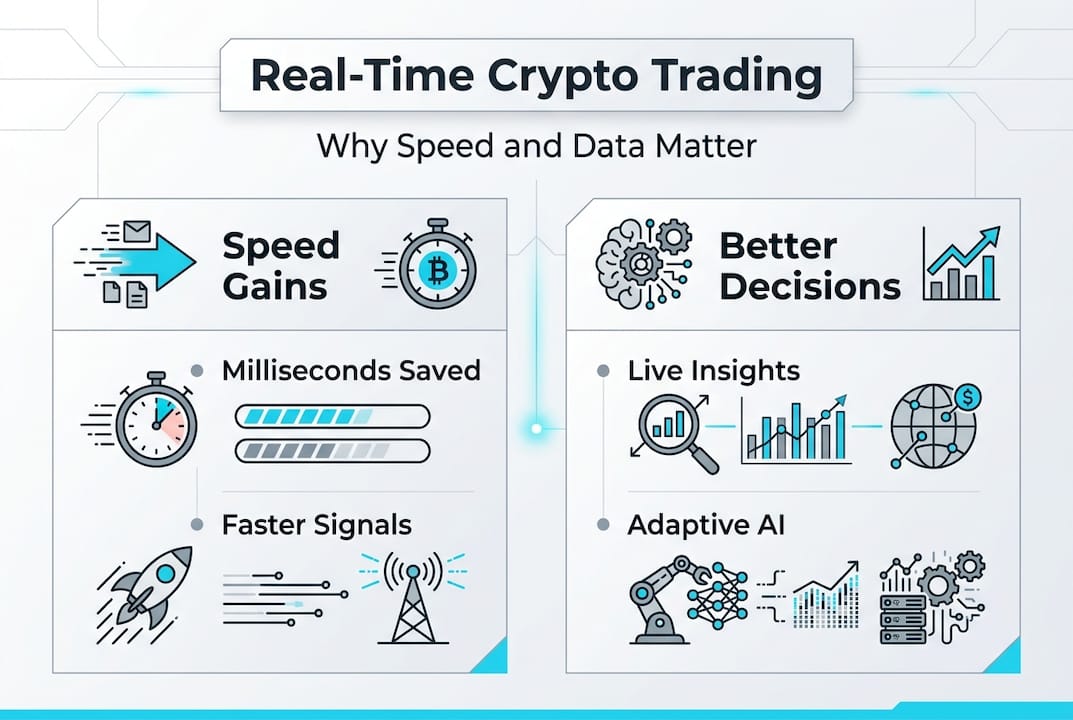
This matters because crypto market regimes change fast. A momentum strategy that works during a bull run can destroy capital in a sideways chop. AI systems fed real-time data detect regime shifts as they happen and can reduce exposure or switch strategies before losses accumulate.
AI-powered real-time trading strategies you can deploy today:
- Sentiment analysis bots that scan live social feeds and news for sudden narrative shifts
- Order flow imbalance models that detect institutional buying or selling pressure in real time
- Cross-exchange spread monitors that flag arbitrage opportunities the moment they open
- Volatility regime classifiers that adjust position sizing based on live market conditions
- Liquidation heatmap trackers that predict where cascading sell-offs are likely to accelerate
The gap between factor discovery and live signals has narrowed dramatically with modern stream-batch processing frameworks. What once required a quant team and months of development is now accessible through platforms that integrate these pipelines directly.
Pro Tip: Do not deploy a live AI model without validating it against a real-time paper trading environment first. Backtests using historical data often overfit. Real-time simulation exposes how the model handles live order book dynamics, slippage, and latency that historical data cannot replicate.
Handling risk, volatility, and adverse selection in real time
Crypto's volatility is both its opportunity and its greatest threat. Bitcoin can move 5% in under a minute during a news event. Altcoins can swing 20% in seconds. Without real-time data, you are managing risk with a blindfold on.
Three risks hit hardest when your data is slow. First, volatility spikes move prices past your intended entry or exit before your order reaches the exchange. Second, slippage occurs when the price you see and the price you get diverge because the market moved between your signal and your fill. Third, adverse selection means you consistently get filled on the bad side of a trade because smarter, faster participants take the good fills first.
Real-time data addresses all three directly. During high volatility, smart order routing with under 50ms latency boosts fill rates by 2.6 times compared to slower execution. That is not a marginal improvement. It is the difference between a functioning risk management system and one that fails exactly when you need it most.
Actionable steps to minimize these risks using real-time data:
- Set dynamic stop-losses that adjust based on live volatility readings rather than fixed price levels
- Monitor live order book depth to avoid placing large orders into thin liquidity
- Use real-time spread tracking to detect when adverse selection risk is elevated
- Route orders through smart execution systems that select the best available price across multiple venues simultaneously
- Track funding rates and open interest live to anticipate forced liquidations before they cascade
"Sub-50ms latency is not just a performance metric. It is a risk management tool. The faster your system responds, the less damage a sudden volatility event can do to your open positions."
The traders who survive long-term in crypto are not necessarily the ones with the best entry signals. They are the ones whose risk systems respond fast enough to protect capital when conditions change without warning.
A trader's perspective: Why most miss the real advantage of real-time data
Here is something most trading education gets backwards: traders spend 90% of their time optimizing strategy and 10% on infrastructure. The actual performance split in live markets is closer to the opposite.
We have seen traders with genuinely strong alpha signals consistently underperform because their data pipeline added 200ms of unnecessary latency. The signal was right. The timing was wrong. By the time the order hit the exchange, the opportunity had already been taken by a co-located algorithm running on a faster feed.
The uncomfortable truth is that in 2026, strategy differentiation is narrowing. More traders have access to the same indicators, the same on-chain data, and the same analytical frameworks. What separates the top performers is not a secret indicator. It is millisecond-level infrastructure advantages compounding over thousands of trades.
Our prediction: as AI trading becomes more democratized, the next major split between winners and losers will not be driven by who has the smartest model. It will be driven by who has the fastest, most reliable real-time data pipeline feeding that model. Speed is the new alpha.
Leverage real-time data with Crypto Innovate Labs
Understanding the theory is one thing. Having the infrastructure to act on it is another. At Crypto Innovate Labs, we built our platform specifically to close that gap for serious traders and investors.
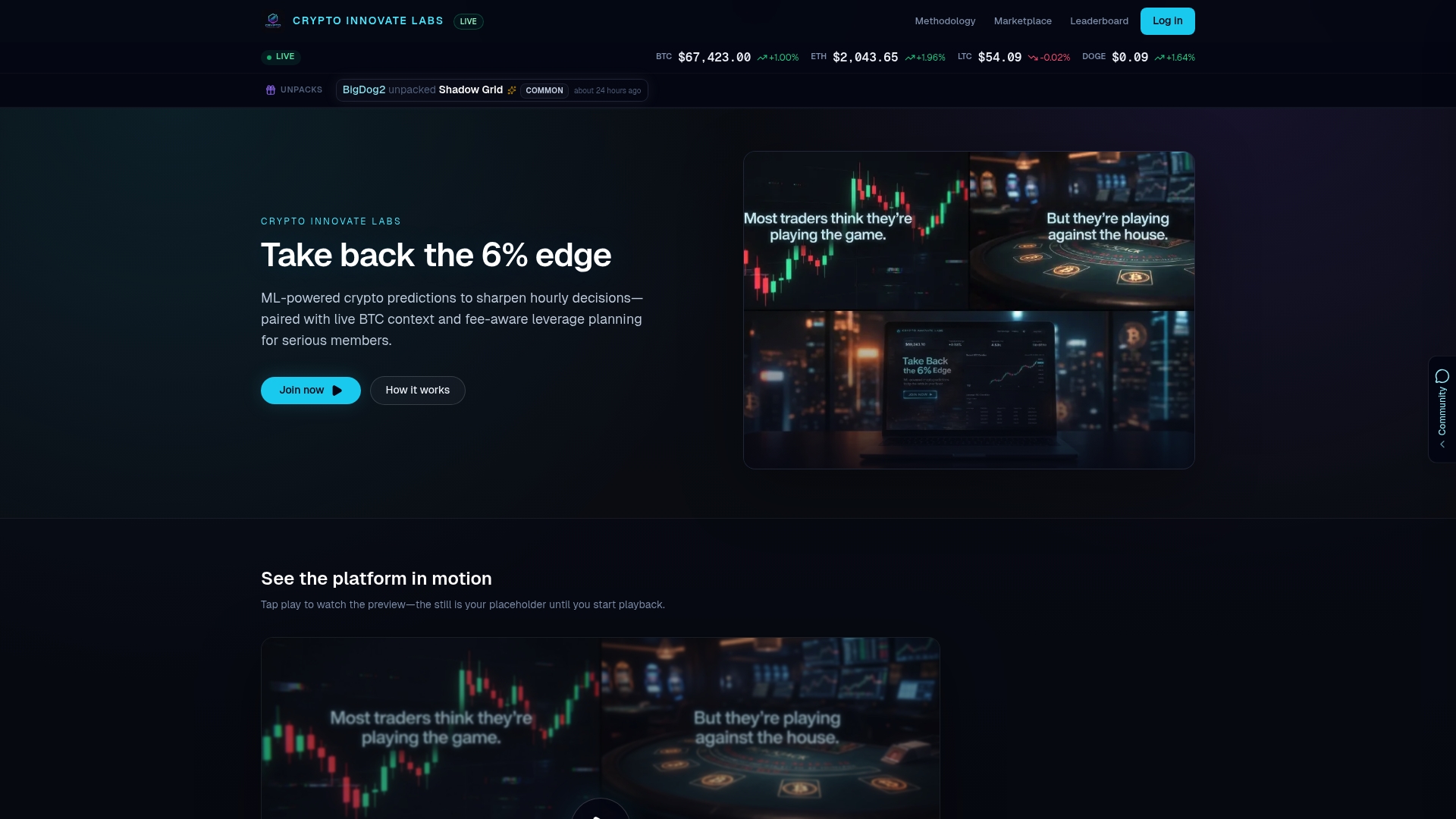
Our machine learning-powered platform delivers low-latency, real-time market intelligence including predictive signals, live trend monitoring, and AI-driven analysis designed for traders who cannot afford to be a step behind. Whether you are looking to automate strategies, monitor market direction, or simply get better data faster, our advanced crypto data solutions give you the edge that delayed feeds and manual research simply cannot provide. The market does not wait. Neither should your data.
Frequently asked questions
Why is real-time data more important in crypto than in stocks?
Crypto markets run 24/7 with extreme volatility and minimal regulation, meaning crypto arbitrage windows last 30-50ms, far shorter than typical equity opportunities, making real-time data non-negotiable for competitive trading.
How does latency affect my trade profits?
Even small delays reduce your ability to fill profitable orders at target prices. Reducing latency from 89ms to 42ms increased arbitrage hit rates from 23% to 61%, showing how directly speed connects to returns.
Can AI trading bots work without real-time data?
AI bots depend on live feeds for pattern recognition and signal execution. AI relies on live feeds to adapt to current conditions, making historical-only data a significant limitation for any automated strategy.
Does real-time data help manage volatility and slippage?
Yes. Real-time updates let your system respond instantly to price swings. Smart order routing boosted fill rates 2.6x during high volatility, directly reducing the damage from slippage and adverse selection.