
TL;DR:
- Predictive crypto tools leverage AI to analyze hundreds of assets simultaneously, providing faster and more accurate signals than manual trading. They enhance market coverage, pattern recognition, and risk management, especially during volatile periods, but require human oversight to avoid regime shifts and unreliable signals. Combining these tools with disciplined strategy and continuous system updates offers traders a significant competitive edge in fast-paced markets.
Crypto markets move at a pace that makes manual analysis feel like bringing a calculator to a high-frequency trading floor. Price action shifts within seconds, sentiment flips overnight, and the sheer number of tradable assets makes comprehensive coverage nearly impossible for a single trader. AI-powered tools scan hundreds of pairs and process vast datasets faster than any human can, and that raw capability gap is growing. In this article, we break down the specific advantages predictive crypto tools offer, where they fall short, and how to combine them with your own judgment to build a genuinely stronger trading strategy.
Table of Contents
- What sets predictive crypto tools apart
- The speed and scale advantage
- Precision, backtest performance, and emotional control
- Advanced analytics: Sentiment, on-chain data, and hybrid models
- Knowing the limits: Risk factors and human oversight
- A trader's reality check: Our perspective on predictive tools
- Put predictive insights to work in your trading
- Frequently asked questions
Key Takeaways
| Point | Details |
|---|---|
| Rapid market analysis | Predictive crypto tools can scan and assess hundreds of assets much faster than manual analysis. |
| Consistent performance | Emotion-free AI tools help deliver steadier results and better risk control compared to discretionary trading. |
| Backed by data | Empirical tests show predictive tools often outperform human trading in both ROI and risk-adjusted returns. |
| 24/7 market coverage | Automated systems monitor markets round the clock and can seize opportunities any time, day or night. |
| Requires human judgment | Best results come from pairing AI models with thoughtful human oversight and market awareness. |
What sets predictive crypto tools apart
Traditional trading relies on a single analyst watching a handful of charts, drawing trendlines, and making calls based on experience and gut feel. That approach works until the market decides to move five assets simultaneously at 3 AM. Predictive crypto tools exist precisely to eliminate that bottleneck.
At their core, these tools use machine learning algorithms to process price history, volume data, order book depth, and technical indicators across hundreds of markets at once. The output is not just a raw data dump. It is an actionable signal with a confidence level attached, telling you whether a breakout is likely, how strong the momentum is, and which direction the price is likely to move. You can learn more about smarter crypto trading with predictive analysis to see how these tools fit into a full trading workflow.
The key differentiators compared to manual trading come down to a few core capabilities:
- Scale: AI can simultaneously monitor Bitcoin, Ethereum, and hundreds of altcoins without losing focus
- Pattern recognition: Complex formations like head and shoulders, bull flags, and RSI divergences are identified automatically
- Confidence scoring: Each signal includes a probability estimate so you can rank opportunities
- Consistency: The algorithm applies the same rules every time, with zero emotional drift
- Speed: Signals fire in milliseconds, not minutes
AI enables pattern recognition at scale, identifying breakouts, divergences, and candlestick patterns across 500-plus pairs with confidence scores. That is a capability ceiling a human analyst simply cannot reach, no matter how experienced they are.
| Feature | Manual trading | Predictive AI tools |
|---|---|---|
| Pairs monitored | 5 to 20 | 500 or more |
| Analysis speed | Minutes | Milliseconds |
| Emotional influence | High | None |
| 24/7 coverage | No | Yes |
| Pattern detection accuracy | Variable | 55 to 80-plus percent |
| Signal confidence scoring | Rare | Standard |
Pro Tip: Think of AI-powered trading advantages as a force multiplier for your existing strategy. The tool handles scale and speed while you focus on risk sizing, portfolio construction, and strategic decisions that require market context.
The speed and scale advantage
Among all the advantages predictive tools deliver, raw speed and coverage are the most immediately visible. A human trader waking up to check markets at 8 AM has already missed whatever happened between midnight and dawn. An AI-driven system running 24/7 never has that problem.

Speed matters in crypto for a specific reason. Unlike equity markets with defined trading hours, crypto trades continuously across global exchanges. A whale moving funds on-chain, a regulatory announcement out of Asia, or a sudden liquidity shift on a major exchange can trigger cascading price action within minutes. By the time a manual trader processes the news and acts, the opportunity or the risk has already moved.
Automated execution minimizes slippage and captures opportunities that humans miss during off-hours or high-volatility windows. Slippage, the gap between the price you want and the price you get, compounds over dozens or hundreds of trades. For active traders, reducing average slippage by even half a percent per trade has a meaningful impact on annual returns.
Here is a practical breakdown of where speed and scale create edge:
- Late-night breakouts: Many significant moves happen during low-liquidity Asian trading hours when most Western traders are offline
- News response: Sentiment-shifting headlines can be processed and acted on within seconds by AI systems
- Multi-pair correlation plays: When Bitcoin breaks resistance, correlated altcoins often follow; AI tracks all of them simultaneously
- Order book analysis: Real-time monitoring of bid-ask spreads and large orders reveals institutional activity as it happens
AI and predictive signals become especially powerful during volatile stretches when the market moves too fast for manual reaction. The system is already positioned before the average trader finishes reading the news alert. Beyond that, monitoring trend signals for smart trading in real time means you are not just reacting to moves but anticipating them.
Precision, backtest performance, and emotional control
Speed gets you into the game. Accuracy and discipline determine whether you stay profitable over time. This is where predictive tools show their deepest value for serious traders.
Backtesting (running a trading algorithm against historical price data to evaluate its performance) is the standard way to evaluate a system before committing real capital. The numbers from rigorous backtests are compelling. One study found AI outperformed by 89.7% compared to a human trader's loss of 12.3% over a six-month period, with a C-LSTM model delivering ROI gains up to 45% and a Sharpe ratio of 1.58 versus 0.72 for a buy-and-hold approach. The Sharpe ratio measures return per unit of risk, so a higher number means better risk-adjusted performance, not just higher gains.
Pattern-specific accuracy is also measurable. Specific chart patterns exceed 80% win rates, such as the Inverse Head and Shoulders formation, while general directional accuracy runs between 55% and 65%. That might not sound spectacular, but at 60% accuracy with a favorable risk-reward ratio, a systematic trader consistently comes out ahead over hundreds of trades.
Here is how a predictive system typically processes a trade from signal to execution:
- Pattern detection: The algorithm scans for predefined formations or statistical anomalies across all monitored pairs
- Confirmation check: Secondary indicators (volume, RSI, MACD, on-chain flow) are checked to filter false signals
- Signal scoring: A confidence percentage is assigned based on historical performance of similar setups
- Trade execution: If the signal clears the threshold, the trade is placed automatically at the best available price
- Risk management: Stop-loss and take-profit levels are set algorithmically based on volatility parameters
- Position monitoring: The system watches the trade continuously and adjusts exits based on new data
"Reducing emotional bias leads to consistent performance and better risk management over time." This is not just motivational advice. It is a structural feature of algorithmic trading. AI eliminates emotional bias at the execution layer, preventing revenge trading, panic selling, and the overconfidence that typically follows a winning streak.
Connecting risk management with AI is one of the clearest AI benefits for traders who have ever blown up an account by ignoring a stop-loss. Reviewing best practices for maximizing returns shows how discipline at the system level replaces the willpower you should not have to rely on in live markets.
Advanced analytics: Sentiment, on-chain data, and hybrid models
Price charts only tell part of the story. The most sophisticated predictive tools have moved well beyond technical analysis to incorporate layers of data that most manual traders never access.
Sentiment analysis draws from social media platforms, news feeds, forums, and even developer activity on GitHub to quantify market mood. The key finding is that sentiment leads price by 1 to 3 days, expressed as quantified bullish or bearish indices. That is a meaningful lead time. If you can measure growing bearish sentiment before it shows up in price, you have a real positioning advantage.
On-chain data adds another dimension. Unlike equity markets where institutional flows are largely opaque, blockchain transactions are public. AI tools that monitor wallet flows, exchange inflows and outflows, large transaction alerts, and miner behavior can confirm or challenge what price charts are showing. For example, when large wallets start moving coins to exchanges, that often signals incoming selling pressure, even if the price has not moved yet.
Crypto sentiment indicators and on-chain signals work best when they agree with each other and with the technical picture. Disagreement between layers is actually useful too, because it flags low-conviction setups where you should reduce size or stay out.
Hybrid AI models take this further by combining multiple data streams into a single predictive framework. Hybrid methodologies like LSTM and CNN-LSTM incorporate Fibonacci retracements, on-chain data, sentiment, and XGBoost time-series forecasting into a unified model that outperforms any single-variable approach. LSTM (Long Short-Term Memory) is a type of neural network designed to recognize patterns in sequential data like price series. CNN-LSTM hybrids add image-pattern recognition on top of that, essentially letting the model "see" chart formations the way a human analyst would.
Key applications of hybrid analytics in practice:
- Early trend detection: Combining momentum indicators with sentiment scores catches trend shifts before they are obvious
- False signal filtering: On-chain data can rule out a bullish breakout caused purely by wash trading
- Volatility forecasting: Hybrid models predict periods of high or low volatility, helping you size positions appropriately
- Correlation mapping: When multiple assets send aligned signals, conviction in the trade increases
Pro Tip: Use tools that combine price patterns, sentiment, and on-chain inputs together. A single-source signal is fragile. When predicting crypto prices with AI across multiple data layers, your edge is more durable because it does not evaporate when one data source goes noisy.
Knowing the limits: Risk factors and human oversight
Predictive tools are powerful, but treating them as infallible autopilot is one of the most common and expensive mistakes traders make. Every algorithm has conditions under which it breaks down, and knowing those conditions is as important as knowing the tool's strengths.
The most common failure mode is the regime shift. A regime shift occurs when market behavior fundamentally changes, such as a transition from a trending bull market to a sideways consolidation or a sudden bear market triggered by a macro event. Algorithms trained on data from one regime can produce wildly wrong signals in another. Machine learning models fail in regime shifts and black swan events, and overfitting (where a model performs brilliantly on historical data but poorly in live markets) remains a persistent challenge. Transaction costs also erode small edges quickly in high-frequency strategies.
Additional risks traders should actively manage:
- Model opacity: Some AI tools are black boxes that cannot explain why they generated a signal, making it hard to evaluate quality
- Data quality issues: Garbage in, garbage out. Tools fed bad or incomplete data produce unreliable signals
- Overfitting: A model with too many parameters fits historical noise, not real patterns
- Latency risk: Even milliseconds of delay in execution can eliminate the edge on a fast-moving signal
- Single-source dependency: Relying entirely on one tool without cross-referencing creates blind spots
"Best used as decision support, not autopilot. Interpretability is crucial, and regime-aware models consistently outperform." This captures the right mental model for AI forecasts in crypto. The tool informs the decision. You make the decision.
Human oversight means maintaining a clear set of conditions under which you override or ignore signals. If you see breaking news that your tool has not yet incorporated, that is a moment for human judgment to take precedence. If the market is behaving in a way that looks structurally unlike anything in recent history, your override threshold should drop significantly.
A trader's reality check: Our perspective on predictive tools
Here is the uncomfortable truth about predictive crypto tools that most reviews skip: the technology is genuinely impressive, but most traders who buy these tools underperform because they misuse them, not because the tools are bad.
The most common mistake is binary thinking. Traders either distrust the AI and ignore its signals at every inconvenient moment, or they trust it completely and shut off their own judgment entirely. Both extremes lead to poor outcomes. The traders who actually win with these systems treat the AI signal as one high-quality input in a broader decision framework.
Pure algorithmic trading without any human layer struggles during novel market conditions. Pure manual trading without any algorithmic support is too slow and too emotionally inconsistent to compete at scale. The hybrid approach, where AI handles coverage, speed, and pattern detection while you handle strategy, context, and risk parameters, consistently produces better results than either extreme.
The other underappreciated failure mode is neglecting to update the system. Markets evolve. A model optimized on 2023-2024 data may not reflect 2026 market dynamics. Traders who review their advanced crypto trading practices quarterly and recalibrate their tool inputs regularly outperform those who set it up once and walk away. Treat your predictive system like a living part of your strategy, not a finished product.
The traders we most respect are not the ones who found the perfect algorithm. They are the ones who built a disciplined process around a good algorithm and stayed accountable to it through changing markets.
Put predictive insights to work in your trading
If this article has clarified where predictive tools create real edge and where they need careful oversight, the next step is finding a platform that handles both the sophistication and the transparency you need.
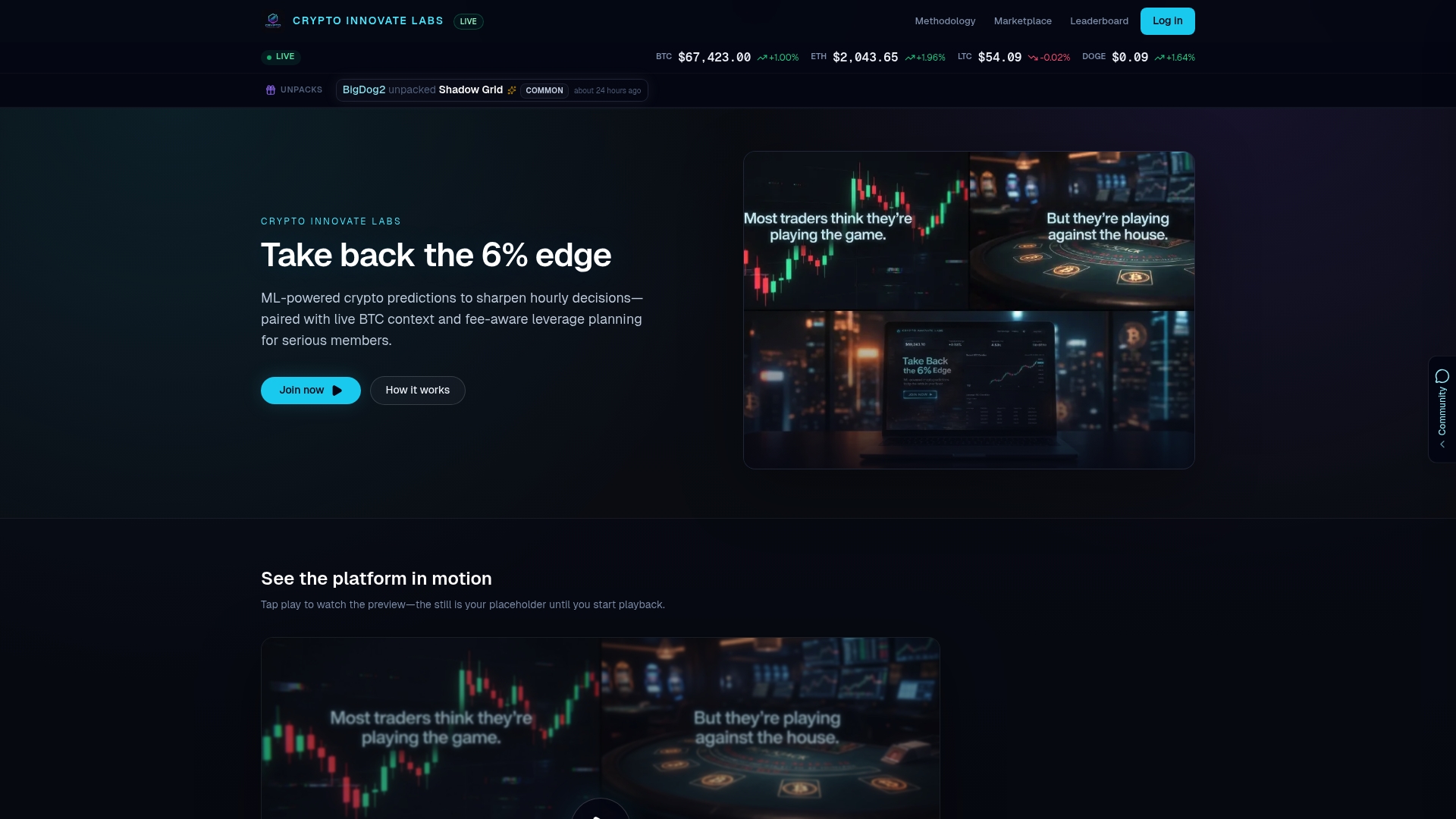
Crypto Innovate Labs is built precisely for traders and investors who want AI-driven insights without sacrificing clarity on how those signals are generated. Our Crypto Innovate Labs methodology is documented and transparent, so you understand what the model is doing and why, not just what it is telling you to do. Whether you are refining an existing strategy or building a new one from scratch, you can explore Crypto Innovate Labs to access predictive signals, market intelligence, and analytical tools designed for the realities of 2026 crypto markets. Smarter tools, used well, make a measurable difference.
Frequently asked questions
What is the main advantage of using predictive crypto tools over manual trading?
Predictive crypto tools identify patterns at scale across 500-plus pairs with confidence scores, delivering actionable signals at a speed and coverage level no human analyst can match.
Are predictive AI models in crypto trading always reliable?
No. Machine learning models break down during regime shifts and black swan events, which is why human oversight and contextual judgment remain essential alongside any predictive system.
How accurate are predictive crypto tools on average?
Directional accuracy typically runs 55 to 65%, and specific high-confidence patterns like Inverse Head and Shoulders can exceed 80% win rates, though actual results vary across tools and market conditions.
What types of data do predictive crypto tools analyze?
Modern tools use hybrid AI methodologies that process price charts, on-chain blockchain flows, Fibonacci levels, sentiment data, and news feeds simultaneously to generate trading signals.
How does sentiment analysis enhance predictive crypto tools?
Sentiment leads price by 1 to 3 days when quantified from social media and news, giving traders a measurable lead time to position before price moves reflect the shift in market mood.