

TL;DR:
- Machine learning and AI significantly improve crypto price predictions over traditional methods.
- Effective models require reliable data, on-chain analytics, and continuous refinement, with awareness of market unpredictability.
- Consistent success depends on avoiding overfitting, updating strategies regularly, and incorporating macroeconomic and sentiment insights.
Trying to predict where Bitcoin or Ethereum will move next feels like reading smoke signals in a windstorm. Most traders rely on chart patterns and gut instinct, only to watch the market do the exact opposite. The frustration is real, and it's expensive. Traditional technical analysis alone leaves too many gaps, especially in a market where sentiment can shift in minutes. That's why machine learning and AI-driven analysis are changing the game. Backtesting shows ML strategies outperform buy-and-hold approaches across multiple metrics. This guide walks you through the tools, steps, and critical mistakes to avoid so you can build a sharper, more informed trading edge.
Table of Contents
- What you need to predict crypto prices with AI
- Step-by-step: Building an AI-driven crypto prediction process
- Avoiding common pitfalls: What most crypto prediction guides miss
- Verifying results and iterating your prediction strategy
- Why there's no AI crystal ball, but constant evolution wins
- Take your crypto prediction skills further with expert support
- Frequently asked questions
Key Takeaways
| Point | Details |
|---|---|
| AI boosts prediction accuracy | Machine learning strategies often outperform basic methods but require careful deployment. |
| No foolproof models | Crypto’s volatility ensures that even advanced AI can’t guarantee results. |
| Backtesting is essential | Testing your approach on historical data and updating models regularly helps minimize risk. |
| Macro and fundamentals still matter | AI insights should be combined with market awareness and risk management for lasting success. |
What you need to predict crypto prices with AI
With the challenges clear, let's focus on what you need to get started in AI-powered prediction. The good news is that the barrier to entry is lower than most traders assume. The hard part is assembling the right combination of data, tools, and context.
Every solid AI prediction setup starts with three core ingredients: reliable historical price data, on-chain analytics, and open-source modeling tools. Miss any one of these and your model is essentially flying blind.
Here's a quick breakdown of the essential toolkit:
- Historical price data: OHLCV (open, high, low, close, volume) data from exchanges like Binance or Coinbase, ideally at multiple timeframes
- On-chain analytics: Platforms like Glassnode and Santiment provide on-chain insights such as wallet activity, exchange inflows, and token holder behavior
- Modeling frameworks: Python remains the standard, with TensorFlow and PyTorch powering most deep learning models
- Sentiment data: Social media volume, news feeds, and developer activity scores from sources like LunarCrush or Santiment
- Macro context: Interest rate decisions, regulatory news, and Bitcoin dominance shifts all affect model accuracy
| Data type | Source example | Why it matters |
|---|---|---|
| Price and volume | Binance API, CoinGecko | Core input for any price model |
| On-chain metrics | Glassnode, Santiment | Reveals holder behavior and network health |
| Social sentiment | LunarCrush, Santiment | Early signal for momentum shifts |
| Macro indicators | FRED, TradingEconomics | Contextualizes external market forces |
Understanding the AI crypto benefits over traditional methods helps you prioritize which data streams matter most. Volume and liquidity tell you how much the market cares about a move. Sentiment tells you why. Together, they give your model richer inputs than price alone ever could.
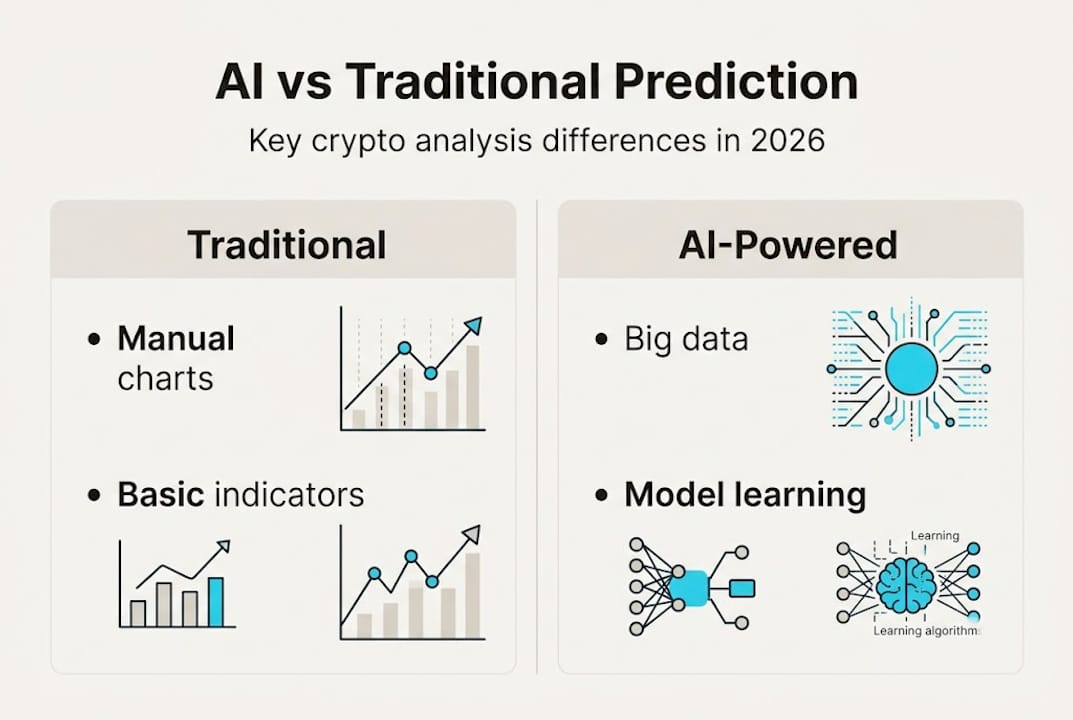
Also, don't underestimate the role of key market indicators like funding rates, open interest, and the fear and greed index. These are often overlooked in beginner setups but carry significant predictive weight.
Pro Tip: Subscribe to real-time data feeds rather than batch downloads. Stale data creates analysis lag that can cost you entries and exits at critical price levels.
Step-by-step: Building an AI-driven crypto prediction process
Once your tools and data are ready, it's time to build your prediction workflow. This doesn't require a PhD in data science. It does require discipline and a structured approach.
- Collect and store data: Pull historical OHLCV data alongside on-chain and sentiment metrics. Store everything in a consistent format, ideally a time-series database.
- Clean and engineer features: Remove outliers, fill gaps, and create derived features like rolling averages, RSI, and volume momentum. Feature quality directly impacts model performance.
- Select your model: Start with simpler models like Support Vector Regression (SVR) or gradient boosting before scaling to LSTMs or transformer-based architectures.
- Train and test: Split your data into training, validation, and test sets. Never let your model see the test set during training.
- Interpret outputs: Focus on confidence intervals and probability ranges, not just point predictions. A model saying "65% chance of upward movement" is more useful than a single price target.
The payoff for doing this right is significant. ML strategies show 304% vs 127% cumulative returns compared to buy-and-hold in backtests, with meaningfully lower drawdowns.
| Method | Cumulative return | Max drawdown | Signal complexity |
|---|---|---|---|
| Buy-and-hold | ~127% | High | Low |
| AI/ML-driven | ~304% | Lower | High |
For deeper context on applying these outputs to live trades, predictive analysis for trading covers how to translate model signals into actionable decisions. Pairing that with solid technical analysis methods creates a hybrid approach most retail traders never bother to build.

Pro Tip: Use k-fold cross-validation and always test on out-of-sample data before trusting any model. A strategy that only works on data it was trained on is not a strategy. It's memorization.
Avoiding common pitfalls: What most crypto prediction guides miss
As you execute your AI prediction workflows, it's vital to avoid critical errors that trip up even advanced traders. Most guides focus on what to do. Few spend enough time on what not to do.
Here are the most dangerous traps in AI-driven crypto prediction:
- Overfitting to historical data: Your model nails the past but fails in live markets. This is the single most common failure mode.
- Ignoring black swan events: Sudden exchange collapses, regulatory crackdowns, or macro shocks can invalidate months of model training overnight.
- Confirmation bias amplification: If you feed your model only data that confirms a bullish or bearish view, it will reflect that bias back at you with false confidence.
- Single-model dependency: Relying on one algorithm for all market conditions is like using one tool for every job. Diversify your signal sources.
- Treating backtests as guarantees: Past performance in a backtest is not a promise of future results, especially in a market as structurally evolving as crypto.
The crypto unpredictability challenges are well-documented. As one research summary puts it:
"Even the best ML strategies offer only a modest empirical edge in practice, and no model eliminates the fundamental unpredictability of crypto markets."
This is not a reason to abandon AI tools. It's a reason to use them with clear eyes. Understanding your own trading psychology biases is just as important as model tuning. A well-calibrated trader using a decent model will consistently outperform an overconfident trader using a great one.
Pairing your prediction workflow with disciplined risk management with AI is what separates traders who survive drawdowns from those who don't.
Verifying results and iterating your prediction strategy
After you've made your predictions, measuring and refining is crucial for sustainable trading gains. A model that isn't regularly tested and updated will decay in performance as market conditions shift.
Here's a simple iteration loop you can follow:
- Backtest with historical data: Run your model against data it hasn't seen. Record every metric, not just returns.
- Benchmark against a baseline: Compare your model's performance to a simple buy-and-hold or moving average crossover strategy.
- Adjust features and parameters: If performance lags, revisit your feature set. Are you missing new on-chain signals? Has market structure changed?
- Retest and paper trade: Before committing capital, run the updated model in paper trading mode for at least 30 days.
Signs your model needs immediate attention:
- Error rates are rising over consecutive weeks
- Performance is inconsistent across different market regimes (bull vs. bear)
- False positive rates on buy signals are climbing
- The model's predictions correlate too closely with a single input variable
Backtesting frameworks reveal not just returns but critical risk metrics like maximum drawdown, Sharpe ratio, and win rate. Use all of them.
| Metric | What it measures | Target range |
|---|---|---|
| Accuracy | Directional prediction correctness | >55% |
| Max drawdown | Worst peak-to-trough loss | <20% |
| Sharpe ratio | Return per unit of risk | >1.5 |
| False positive rate | Wrong buy signals | <30% |
For broader context on what separates good models from great ones, advanced trading best practices and crypto trading signals are worth studying alongside your iteration process.
Why there's no AI crystal ball, but constant evolution wins
Let's step back and share a hard-won lesson from years at the bleeding edge of crypto and AI. The traders who burn out fastest are the ones who treat their first working model as a finished product. They optimize it obsessively for one market condition, then watch it collapse when conditions change.
The uncomfortable truth is that crypto markets are structurally adversarial. Every edge you find eventually gets priced in as more participants adopt similar tools. That's not a flaw in AI-driven trading. It's the nature of any competitive market.
"Machine learning can sharpen your edge, but it won't replace fundamentals or experience."
The importance of macro awareness cannot be overstated. AI enhances, but does not eliminate, the need for fundamental research and macroeconomic context. A model trained entirely on price data will miss the regulatory shift that moves the market 40% in a week.
What actually works long-term is a commitment to continuous improvement: updating your feature set quarterly, stress-testing models against new regimes, and staying curious about what the market is telling you beyond the numbers. Keeping up with real-time data as a core habit, not an afterthought, is what keeps your edge alive. Humility and adaptability beat any single algorithm, every time.
Take your crypto prediction skills further with expert support
Hungry to put these strategies into practice or supercharge your research? Building and maintaining an AI-driven prediction workflow takes time, quality data, and constant refinement. That's exactly what we've built at Crypto Innovate Labs.

Our crypto prediction methodology is grounded in the same principles covered in this guide, combining on-chain data, sentiment analysis, and machine learning to generate actionable signals. If you want to skip the months of model-building and access professionally developed tools directly, explore our AI-driven trading tools in the marketplace. Whether you're refining your own models or looking for ready-to-use signals, we have the infrastructure to support your next move.
Frequently asked questions
Can AI really predict crypto prices accurately?
AI can improve prediction accuracy over traditional methods, but AI strategies offer only modest empirical edge in practice due to the fundamental unpredictability of crypto markets. No model guarantees consistent results.
Which platforms provide the best data for crypto price prediction models?
Glassnode and Santiment are top choices, offering on-chain metrics and social sentiment data that are essential for building robust prediction models.
How do you know if your AI crypto model is overfitted?
An overfitted model performs well on historical data but breaks down on new, unseen data. Always use cross-validation and out-of-sample testing to confirm your model generalizes beyond its training set.
What's the main advantage of using ML for crypto price prediction?
ML models can identify complex, non-linear patterns across multiple data streams simultaneously. In backtests, ML strategies outperform buy-and-hold in both cumulative returns and risk-adjusted drawdowns.