

TL;DR:
- Most crypto traders make FOMO-driven decisions that harm their overall strategy.
- Crypto's 24/7 market and social influence amplify psychological stressors more than traditional markets.
- Building disciplined systems like checklists and rules is essential to manage biases and improve trading outcomes.
84% of crypto traders make FOMO-driven decisions, and 63% say those decisions hurt their strategy. That number should stop you cold. Most traders spend months mastering chart patterns and entry signals, then blow their accounts not because their analysis was wrong, but because their emotions overrode their plan. Crypto trading psychology is the invisible layer underneath every trade you make. It shapes when you enter, when you exit, and whether you stick to your rules when the market moves against you. This article breaks down the core biases that cost traders real money, shows you what those biases look like in practice, and gives you a concrete framework to trade with more discipline and less regret.
Table of Contents
- Why trading psychology matters in crypto markets
- Core psychological biases affecting crypto traders
- Real-world consequences: How bias impacts crypto trading results
- Practical strategies: Building a resilient trading mindset
- The uncomfortable truth: Why mindset beats intelligence in crypto trading
- Take your trading mindset to the next level
- Frequently asked questions
Key Takeaways
| Point | Details |
|---|---|
| Biases drive losses | Common biases like FOMO and overconfidence cause most trading mistakes and long-term losses. |
| Crypto amplifies psychology | The 24/7 nature and volatility of crypto heighten emotional reactions, requiring stronger discipline. |
| Systems beat willpower | Using structured checklists and routines is more effective for managing bias than relying on raw intelligence or motivation. |
| Process adherence wins | Traders who follow consistent processes outperform those who chase outcomes or trade from emotion. |
Why trading psychology matters in crypto markets
Crypto is not just another asset class with a different ticker. Its structure creates psychological pressure that stocks and forex simply do not replicate at the same intensity. The market never closes. Price can move 20% in an hour. Social media feeds you a constant stream of calls, predictions, and hype. Every one of these factors is a psychological stressor, and they compound fast.
Traditional markets have built-in circuit breakers and trading hours that force natural breaks. Crypto removes those guardrails entirely. You can act on an impulse at 3 a.m. on a Sunday, and the market will let you. That freedom is also a trap. Crypto-specific amplifiers like 24/7 access and social feeds demand a tighter level of discipline than traditional markets ever required.
Here is a direct comparison of the psychological demands across market types:
| Factor | Crypto | Stocks | Forex |
|---|---|---|---|
| Trading hours | 24/7, no breaks | Set hours, weekdays | Near 24/5 |
| Volatility level | Extreme | Moderate | Moderate to high |
| Social media influence | Very high | Moderate | Low to moderate |
| Emotional recovery time | Minimal | Overnight resets | Weekend resets |
| Leverage accessibility | Very easy | Restricted | Moderate |
The table makes one thing clear: crypto stacks multiple psychological stressors simultaneously. Retail traders face this without the risk management infrastructure that institutional desks rely on.
Key psychological challenges unique to crypto traders include:
- No forced pause between sessions to reset emotionally
- Constant exposure to price action and social sentiment
- Easy access to high leverage without experience requirements
- Peer pressure from online communities amplifying FOMO
- Lack of regulatory guardrails that protect against impulsive decisions
"Education reduces but does not eliminate bias. The structure of the crypto market means that even informed traders face constant psychological pressure that requires active management."
This is why crypto risk management tips are not just about position sizing. They are about building a system that protects you from yourself when the market gets loud.
Core psychological biases affecting crypto traders
With crypto's psychological intensity clear, let's spotlight the most common biases and how they shape decisions.
Biases are not personality flaws. They are predictable patterns in how the human brain processes risk, reward, and uncertainty. In crypto, they get amplified to a degree that makes them genuinely dangerous to your capital.
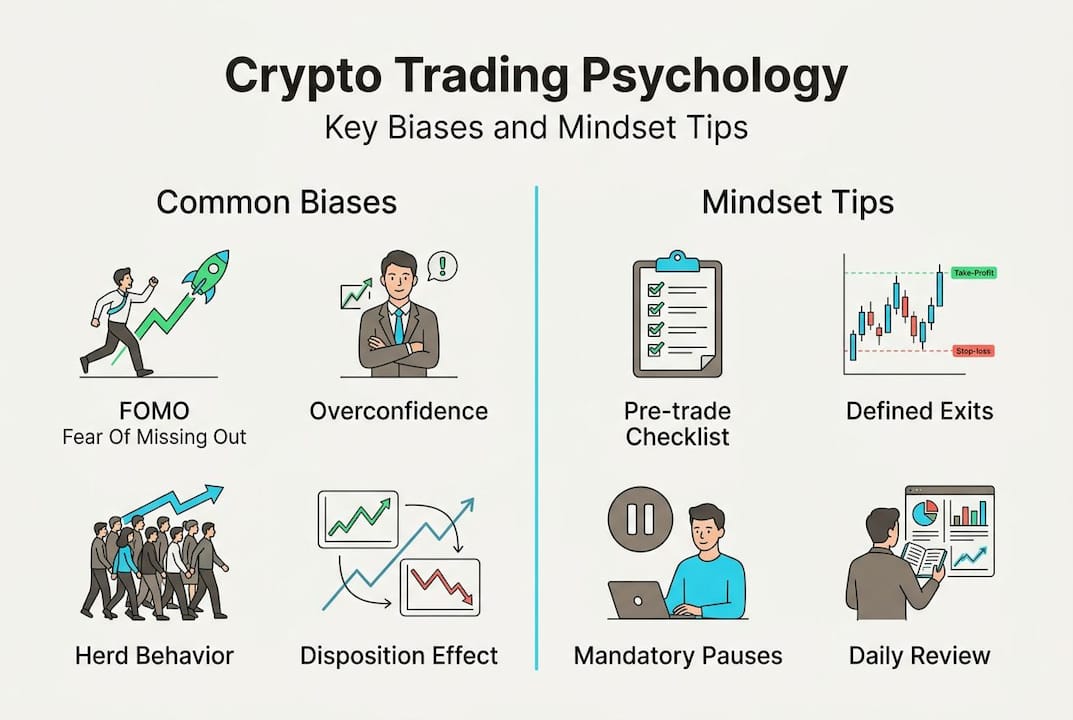
Here are the four biases that do the most damage:
- FOMO (Fear of Missing Out): You see a coin up 40% and buy at the top. The fear of being left out overrides your entry criteria. Over 90% of day traders lose money long-term, and FOMO-driven decisions negatively impact 63% of strategies.
- Overconfidence bias: After a winning streak, you increase position sizes and ignore risk signals. Overconfidence after gains drives higher trading volume, increases Bitcoin volatility, and leaves 82% of wallets net negative after 90 days.
- Disposition effect: You hold losing trades hoping they recover while cutting winners early to lock in small gains. This is the opposite of what profitable trading requires.
- Revenge trading: After a loss, you immediately re-enter a larger position to recover. Emotion replaces process, and the losses compound.
Here is how these biases behave differently in crypto versus traditional markets:
| Bias | In crypto | In stocks/forex |
|---|---|---|
| FOMO | Triggered hourly by social feeds | Triggered by quarterly earnings |
| Overconfidence | Amplified by bull market cycles | Tempered by slower price action |
| Disposition effect | Worsened by extreme volatility | Partially offset by market hours |
| Revenge trading | Enabled by 24/7 access | Limited by session close |
Pro Tip: Build a pre-trade checklist that forces you to confirm your setup meets your criteria before executing. Predictive analysis for crypto trading can give you objective signals to anchor your checklist to, reducing the influence of emotional reasoning.
Understanding crypto risk-reward ratios also helps counter the disposition effect by setting clear exit targets before you enter a trade, removing the in-the-moment emotional decision entirely.
Real-world consequences: How bias impacts crypto trading results
Understanding biases is crucial, but seeing their real-world costs makes the lesson stick.
Bias does not just cause bad trades. It causes cascading sequences of bad trades, each one emotionally charged by the last. Futures trading is where this pattern is most destructive. A liquidation event does not just cost money. It triggers a psychological trauma response that distorts every decision that follows.
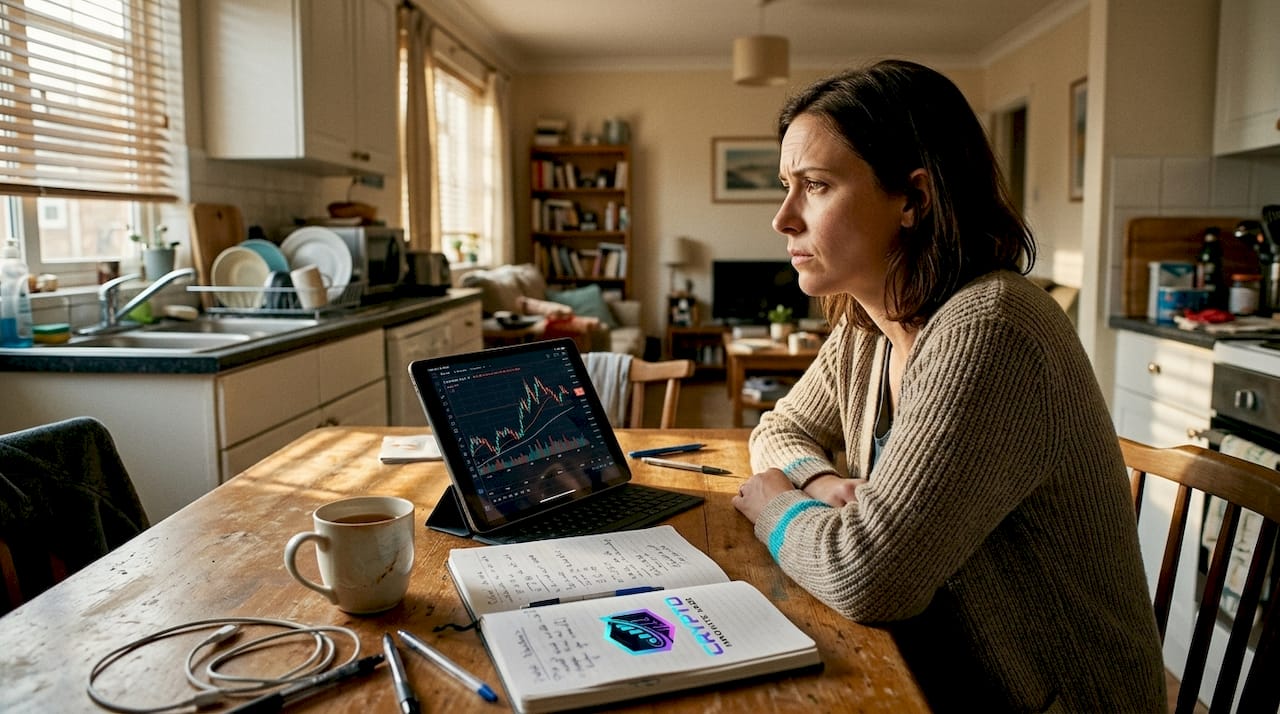
Revenge trading underperforms by 31% compared to neutral re-entry trades. High-conviction positions are closed at a loss 34% more often when the trader entered emotionally rather than systematically. These are not small margins. They represent the difference between a sustainable trading practice and one that drains your account over time.
Here are the most common loss scenarios and the psychological roots behind them:
- Chasing a breakout after FOMO: Entering late into a move, buying high, then panic-selling on the first pullback
- Overloading after a win streak: Increasing size based on confidence rather than setup quality, leading to outsized losses when the streak ends
- Holding a loser through key levels: The disposition effect keeps you in a trade that has already invalidated your thesis
- Revenge trading after liquidation: Entering immediately after a loss with a larger size to recover, compounding the damage
- Ignoring stop-losses during high conviction: Believing so strongly in a trade that you override your own risk rules
Pro Tip: After any losing trade, enforce a mandatory 30-minute pause before re-entering the market. This single habit interrupts the revenge trading cycle and forces a process reset. Advanced crypto trading best practices consistently reinforce this kind of structured pause as a core discipline tool.
Using crypto watchlists to pre-define your trade candidates also removes the temptation to chase random moves, keeping your focus on setups you have already evaluated with a clear head. Pairing this with crypto trading strategies that have defined rules reduces the number of judgment calls you make under pressure.
Practical strategies: Building a resilient trading mindset
Recognizing the risks, now it's time to focus on what works. Practical mindset tools for performance are not about becoming emotionless. They are about building systems that make good decisions easier and bad decisions harder.
Process adherence over outcome chasing is the empirical benchmark that separates consistently profitable traders from the majority. You cannot control whether a trade wins. You can control whether you followed your process.
Here are the core steps for building a disciplined trading mindset:
- Use a pre-trade checklist: Confirm entry criteria, stop-loss level, and position size before every trade. No exceptions.
- Set hard risk limits per session: Define the maximum loss you will accept in a single session and stop trading when you hit it.
- Journal every trade: Record the setup, your emotional state, and the outcome. Patterns in your journal reveal your specific bias triggers.
- Separate process from outcome: A trade that followed your rules perfectly but lost money is still a good trade. A winning trade that broke your rules is a dangerous habit.
- Review weekly, not after every trade: Constant outcome monitoring amplifies emotional swings. Weekly reviews give you data, not noise.
- Limit social media during trading hours: Real-time sentiment feeds are bias accelerators. Reduce exposure during active sessions.
Pro Tip: Counterintuitively, smarter traders are often more vulnerable to certain biases because they are better at rationalizing impulsive decisions. Structured systems protect against this. Pairing your mindset work with crypto technical analysis methods gives you an objective framework that your reasoning has to answer to, not override.
The goal is not to trade without emotion. It is to build a process where emotions inform your awareness without controlling your execution.
The uncomfortable truth: Why mindset beats intelligence in crypto trading
Here is something most trading educators will not say directly: being smart can make you a worse trader. Intelligence gives you the ability to construct convincing narratives around bad decisions. You can talk yourself into holding a losing position, scaling into a FOMO trade, or ignoring your stop-loss with a perfectly logical-sounding argument.
Intelligence increases bias risk because smarter people are more capable of rationalizing emotional decisions after the fact. Systems like checklists outperform willpower precisely because they do not negotiate. They require a yes or no answer before you act.
We have seen this pattern consistently in how traders use our platform. The users who improve fastest are not the ones who learn the most indicators. They are the ones who build the tightest routines. They check signals, confirm their criteria, set their limits, and execute without deviation. Following advanced trading best practices is not about complexity. It is about consistency. Your edge in crypto is not your IQ. It is your ability to follow a process when everything around you is screaming to deviate.
Take your trading mindset to the next level
Mindset work does not happen in isolation. It needs structure, feedback, and the right tools to reinforce the habits you are building.
At Crypto Innovate Labs, we built our platform specifically to give traders the objective signals and market context that reduce emotional decision-making. Our crypto trading methodology is designed to anchor your process in data rather than sentiment, giving your pre-trade checklist something concrete to work from. If you are ready to put the right tools behind your mindset work, explore our crypto marketplace tools to find resources that match your trading style and goals. Better decisions start with better systems.
Frequently asked questions
How does FOMO affect crypto trading results?
FOMO-driven decisions push traders into impulsive entries at market peaks, with 63% of traders reporting a direct negative impact on their overall strategy from chasing price moves.
What is the disposition effect in crypto trading?
The disposition effect is the tendency to hold losing trades too long while selling winners too early, a behavioral pattern that contributes to 82% of wallets ending up net negative after 90 days.
Can education alone prevent psychological trading mistakes?
Education meaningfully reduces bias awareness, but crypto's 24/7 structure means discipline and structured systems are essential to prevent emotional mistakes from overriding what you know.
What strategy is most effective for mastering trading psychology in crypto?
Pre-trade checklists and strict process adherence consistently outperform willpower alone, because systems like checklists remove the negotiation that emotions introduce into real-time decisions.