

TL;DR:
- Retail crypto traders often lose money due to lack of a structured decision framework.
- Understanding personal trading objectives and risk tolerance is essential for effective strategy.
- Using AI tools strategically, combined with disciplined process and verification, can give traders a significant edge.
Most retail crypto traders lose money. Not because the market is rigged, but because they trade without a structured decision framework. One bad entry, one emotional exit, and weeks of gains disappear. The good news is that AI-powered tools are closing the gap between institutional-grade analysis and what you, as a retail trader, can access right now. This guide covers how to set up your trading objectives, choose the right AI tools, execute smarter trades step by step, and avoid the pitfalls that derail even experienced traders. If you want more confident, data-driven decisions, you're in the right place.
Table of Contents
- Understand your crypto trading objectives and risk profile
- Select and evaluate AI-driven crypto decision tools
- Step-by-step process: Making smarter crypto trades using AI
- Common pitfalls and how to verify your decisions
- Why AI is only half the equation: The overlooked trader edge
- Take your crypto decisions further with Crypto Innovate Labs
- Frequently asked questions
Key Takeaways
| Point | Details |
|---|---|
| Clarify your goals | Start every trading plan with your financial objectives and risk profile for smarter decisions. |
| Leverage AI tools | The right AI-driven systems can increase your trade accuracy and ROI compared to manual methods. |
| Follow a proven process | Execute trades step-by-step—choose, set up, validate with analysis, and review outcomes. |
| Verify and improve | Regularly audit your decisions, track results, and adapt to ensure lasting trading success. |
Understand your crypto trading objectives and risk profile
Every smart trade starts before you open a chart. The most overlooked step in crypto trading is defining what you're actually trying to accomplish. Without clear objectives, you're not trading. You're gambling with extra steps.
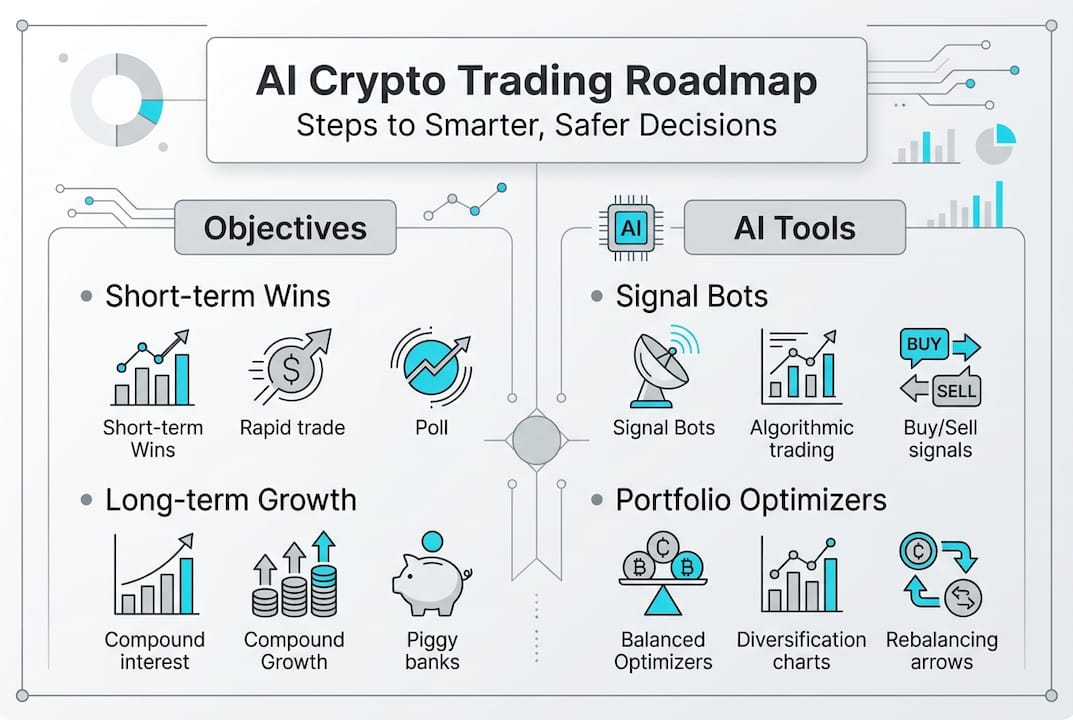
Start by separating your financial goals into two buckets: short-term profit targets and long-term portfolio growth. A trader chasing 20% monthly returns operates completely differently from someone building a five-year position in Bitcoin. Your goal shapes your strategy, your tool selection, and how much volatility you can stomach without making irrational moves.
Risk tolerance is not just a personality trait. It's a measurable parameter. Knowing your risk tolerance means knowing exactly how much capital you can lose on a single trade without it affecting your next decision. Research shows that younger investors show higher risk tolerance in crypto, even when they have less investment experience than older counterparts. That's a dangerous combination if it's not kept in check with clear rules.
Here's how common trader profiles break down:
- Active trader: High-frequency entries and exits, relies on real-time signals, needs fast execution tools
- Passive investor: Long-term holds, values portfolio rebalancing tools and macro trend signals
- Swing trader: Holds positions for days to weeks, uses technical analysis and AI prediction models
- Strategic allocator: Uses AI to identify undervalued assets, lower trade frequency, higher conviction per trade
Each profile demands a different AI toolkit. Matching the wrong tool to your profile is one of the most common and costly mistakes traders make.
Understanding crypto risk-reward ratios before you place a single order gives you a mathematical baseline for every decision. It removes emotion from the equation and replaces it with logic.
Pro Tip: Write down your maximum acceptable loss per trade and per week. Review it before every session. If a signal would push you past that threshold, skip the trade. No AI tool overrides your risk boundaries.
Select and evaluate AI-driven crypto decision tools
With your objectives defined, the next step is matching them to the right technology. The AI tool landscape for crypto is expanding fast, and not all tools are built the same.
The three main categories you'll encounter are signal bots, prediction models, and portfolio optimizers. Signal bots scan market conditions and alert you to entry or exit opportunities. Prediction models use historical data and machine learning to forecast price direction. Portfolio optimizers balance your holdings based on your risk profile and market conditions in real time.
To put this in perspective, here's a comparison of trading approaches:
| Approach | Speed | Accuracy | Best For | Cost |
|---|---|---|---|---|
| Manual trading | Slow | Low | Learning basics | Free |
| Basic algo tools | Medium | Moderate | Rule-based strategies | Low |
| Advanced AI bots (GPT-5, hybrid deep learning) | Fast | High | Volatile markets | Medium-High |
The data backs up the upgrade. AI tools like GPT-5 bots show 15 to 25% outperformance over manual trading in volatile market periods. That's not a marginal edge. That's a structural advantage compounding over time.
When evaluating any AI tool, look for these features:
- Transparency: Can you see why the model is making a call?
- Backtesting capability: Does it let you test against historical data?
- Integration: Does it connect with your existing exchange or wallet?
- Support and updates: Is the model regularly retrained on new data?
- Cost vs. performance: Is the ROI improvement worth the subscription cost?
The AI crypto investment benefits go beyond just speed. They include reducing emotional bias, processing more data points than any human can, and identifying patterns invisible to the naked eye. Combining signal tools with technical analysis with AI gives you a layered decision framework rather than a single point of failure.

Step-by-step process: Making smarter crypto trades using AI
Knowing which tools to use is only half the work. The other half is the process. Here's a repeatable, AI-assisted trade execution workflow you can start using today.
- Define your trade criteria: Set minimum conditions that must be met before a trade is considered. These include price range, volume threshold, market sentiment score, and risk-reward ratio.
- Choose and configure your AI tool: Select the tool that matches your trader profile. Input your parameters: target asset, timeframe, risk limits, and alert preferences.
- Set up alerts and parameters: Use the tool's notification system to get flagged when conditions are met. Don't monitor the screen constantly. Let the system work.
- Validate with technical analysis: Cross-reference the AI signal with manual chart indicators. C-LSTM hybrid CNN models combined with Fibonacci retracement can boost ROI by up to 45% in high-frequency BTC and ETH trend predictions. This combination is your second layer of confirmation.
- Execute the trade: Once signal and technical validation align, place the trade according to your pre-defined position size. No improvising.
- Review performance: After the trade closes, log the result. What did the AI predict? What happened? Why was there a gap, if any?
Here's an example of what AI tool output might look like for a BTC trade:
| Parameter | AI Output |
|---|---|
| Predicted price direction | Bullish (1-hour) |
| Confidence level | 71% |
| Recommended entry | $67,400 |
| Recommended exit (take profit) | $69,800 |
| Stop-loss suggestion | $66,100 |
Using AI trading signals alongside advanced crypto best practices makes your execution process systematic and defensible. You can always explain why you took the trade, which is critical for improving over time. Incorporating predictive analysis for crypto adds another dimension to your signal validation before you commit capital.
Pro Tip: Always use the backtesting feature before deploying any AI tool in a live environment. If the model can't demonstrate positive expectancy on historical data, don't risk real capital on it.
Common pitfalls and how to verify your decisions
Even traders using the best AI tools make avoidable mistakes. The problem is rarely the technology. It's how traders interact with it.
Here are the most common traps to watch for:
- Blind trust in AI: Treating AI output as guaranteed truth. No model is infallible.
- Ignoring risk controls: Letting a high-confidence signal push you into an oversized position.
- Poor data inputs: Garbage in, garbage out. If your parameters are off, the output will be too.
- Overtrading: Using AI signals to justify trading too frequently, driving up fees and emotional fatigue.
- Skipping the review step: Not auditing your trades means you never learn what's working.
Even the most advanced AI trading tools achieve only 55 to 65% directional accuracy in practice. That means they're wrong on roughly one in three calls. Your risk management fills the gap.
Verification is not optional. It's the mechanism that turns a good AI tool into a long-term edge. Build these habits into your routine:
- Audit every trade weekly. Compare predicted vs. actual outcomes.
- Use at least two independent signal sources before entering any significant position.
- Track your win rate, average gain, and average loss separately. These numbers tell a more honest story than total P&L.
Solid crypto risk management tips and an understanding of trading psychology for crypto are what prevent a losing streak from becoming a wipeout. Access to real-time data for trading also matters. Stale signals in fast markets are worse than no signals at all.
Pro Tip: Keep a decision log for every trade. Write down why you took the trade, what signal triggered it, and what the outcome was. After 30 trades, you'll start seeing patterns in your own decision-making that no AI can show you.
Why AI is only half the equation: The overlooked trader edge
Here's something most AI-focused trading content won't tell you: the traders who struggle most with AI tools are not the ones who lack technical knowledge. They're the ones who lack process discipline.
AI is genuinely powerful. It closes information gaps, processes data faster than any human, and removes a significant amount of emotional bias from signal generation. But it cannot set your goals for you. It cannot stop you from overriding a stop-loss at 2 AM because you "feel" the price will recover. It cannot make you review your trades honestly.
The traders who get lasting results from AI are the ones who treat it as one layer of a broader trading strategies for high profits framework. They use AI to narrow their options, but they use personal discipline, structured review cycles, and adaptive learning to act on those options well.
Chasing the newest tool without building repeatable habits is how traders end up cycling through platforms and never improving. The edge is not the tool. The edge is the process you build around it.
Take your crypto decisions further with Crypto Innovate Labs
You now have a working framework for AI-assisted crypto trading: clear objectives, the right tools, a step-by-step execution process, and a verification habit. The next step is putting it into practice with resources built specifically for this kind of structured, intelligence-driven approach.
At Crypto Innovate Labs, we've developed our AI trading methodology around the same principles covered in this guide: data transparency, signal layering, and continuous performance review. Whether you're looking to sharpen your signal stack or explore vetted tools in our AI trading tools marketplace, you'll find everything designed to support traders who take their decisions seriously. Smarter trading starts with smarter tools, backed by a methodology that actually holds up under market pressure.
Frequently asked questions
Are AI crypto trading bots safe to use?
AI bots are generally safe when used on reputable platforms with strong risk controls in place, but no tool guarantees profit and regular monitoring is essential.
What is the most effective AI model for high-frequency crypto trading?
C-LSTM hybrid CNN models combined with Fibonacci retracement analysis have shown the highest ROI improvements, up to 45%, in 1-minute BTC and ETH trend predictions.
How accurate are AI predictions for crypto trading?
AI trading tools deliver directional accuracy of 55 to 65%, which consistently outperforms manual trading in volatile market conditions.
What role does my own risk tolerance play in AI-driven crypto trading?
Your risk appetite determines position sizing, tool selection, and trade frequency. Even the best AI signal is only as useful as the risk framework you build around it, and younger investors with higher risk tolerance especially need structured guardrails to avoid costly overexposure.