

TL;DR:
- AI crypto price prediction models generate probability-based forecasts using deep learning and diverse data inputs.
- Research shows high in-sample accuracy but live trading results often decline due to market changes and model limitations.
- Traders should use AI as a supportive tool with risk management, avoiding blind trust and overfitting pitfalls.
Many traders enter the crypto market believing that AI price prediction tools work like a GPS, punch in the destination and get exact directions. That assumption leads to blown accounts. AI-driven crypto price prediction actually uses deep learning models and dozens of data inputs to calculate probabilities, not guarantees. The gap between those two words costs real money. This article breaks down how AI crypto forecasting works, what the research actually shows about accuracy, where these models break down, and how you can use them as a genuine edge in your trading toolkit.
Table of Contents
- How AI-driven crypto price prediction models work
- How accurate are crypto price predictions? Evidence from research
- The challenges and pitfalls of crypto price forecasting
- How traders can actually use AI crypto predictions
- Why most traders misunderstand crypto price prediction
- Explore smarter AI-driven trading with Crypto Innovate Labs
- Frequently asked questions
Key Takeaways
| Point | Details |
|---|---|
| AI models drive forecasts | Deep learning and statistical models turn crypto market data into actionable predictions but require careful use. |
| Accuracy varies widely | Benchmarks show high backtest results, but live performance often disappoints due to regime shifts and noise. |
| Use as guidance, not gospel | Treat AI predictions as data-informed signals within a strategy, not guarantees of profit. |
| Combine with risk controls | Success comes from pairing AI signals with strong risk management, not leaning on automation alone. |
How AI-driven crypto price prediction models work
With the basics outlined, let's explore what powers these predictions and how they turn data into signals.
Price prediction in crypto is the practice of using quantitative models to estimate where an asset's price is likely to move over a defined timeframe. This is not guesswork dressed up in code. These are statistical systems trained on large datasets, optimized to detect repeating patterns in market behavior. The output is a probability-weighted forecast, not a fixed number carved in stone.
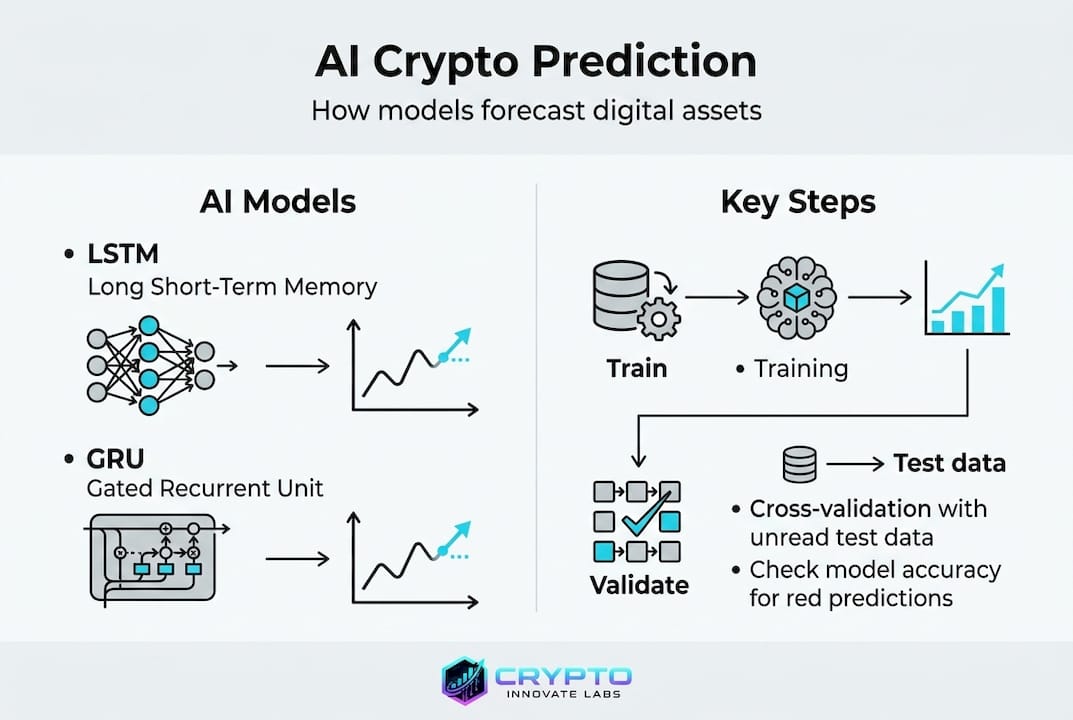
AI-driven crypto price prediction primarily uses deep learning models like LSTM (Long Short-Term Memory), GRU (Gated Recurrent Unit), Bi-LSTM, and Transformers, all integrated with historical price data, technical indicators, trading volume, sentiment analysis from social media and news, and macroeconomic indicators. These models are specifically designed to handle time-series data, meaning they track sequences of values over time and learn which patterns tend to precede specific price movements.
Here is a quick breakdown of the main model types and what makes each one useful:
| Model | Strengths | Common use case |
|---|---|---|
| LSTM | Retains long-term patterns | BTC, ETH long-range forecasts |
| GRU | Faster training, strong accuracy | Multi-coin short-term signals |
| Bi-LSTM | Reads sequences both forward and backward | Volatility detection |
| Transformer | Handles complex, non-sequential data | Sentiment-integrated forecasting |
The input data these models consume matters just as much as the architecture. Technical analysis methods like RSI (Relative Strength Index) and MACD (Moving Average Convergence Divergence) give models information about momentum and trend direction. Sentiment analysis, powered by Natural Language Processing (NLP), scans social media posts, news headlines, and even Reddit threads to gauge market mood. Macroeconomic inputs like interest rates and Bitcoin ETF flows add another layer of context.
The key inputs most serious models rely on include:
- Historical price data (open, high, low, close)
- Trading volume across major exchanges
- Technical indicators (RSI, MACD, moving averages)
- Sentiment scores from social media and news feeds
- On-chain data such as wallet activity and transaction volume
- Macro factors like Federal Reserve policy signals and inflation data
The learning process involves training the model on historical data, testing it against a validation window, and then iterating until error metrics stabilize. Once deployed, AI crypto trading signals generated by these models are refreshed continuously as new market data flows in.
Pro Tip: Always check whether a prediction tool updates its model with recent data. A model trained only on 2021 bull market data will likely mislead you in a sideways or bear market because the patterns it learned no longer apply.
How accurate are crypto price predictions? Evidence from research
Now that you know what drives the models, how well do they actually perform in real trading? Let's review the numbers.
The accuracy question is where most marketing claims and actual research collide. In controlled, academic settings, the numbers look impressive. In live markets, the picture gets messier fast.
Empirical benchmarks show high in-sample accuracy: LSTM models applied to Bitcoin have achieved an R² (coefficient of determination) of 99%, with an MAE (Mean Absolute Error) of just $473, an RMSE (Root Mean Square Error) of $701, and a MAPE (Mean Absolute Percentage Error) of 1.8%. GRU models frequently outperform LSTM and Bi-LSTM across multiple coins including BTC, ETH, LTC, and SOL, posting lower RMSE and MAPE scores.
Those stats deserve context. An R² of 99% sounds almost too good. And it is, partly. In-sample accuracy means the model is being tested on the same data it already trained on, or at least data from a similar market regime. The model has already "seen" the general shape of that period.
"A model that predicts the past with 99% accuracy does not guarantee it will predict tomorrow with the same precision. Markets evolve. Models often don't."
Here is a side-by-side comparison of what research shows versus what live trading tends to produce:
| Metric | Research setting | Live trading reality |
|---|---|---|
| R² | Up to 99% | Drops significantly out-of-sample |
| MAPE | As low as 1.8% | Often 10%+ during high volatility |
| Consistency | Stable in backtests | Breaks down during regime shifts |
| Model rank | GRU often leads | Simple baselines compete well |
The gap between research and live performance is real and well-documented. According to academic vs. practitioner accuracy research, the disconnect happens because markets change their statistical properties over time, a concept called non-stationarity. A bull run market behaves completely differently from a sideways or crash regime, and a model trained on one will struggle in another.
When predictions tend to break down:
- During macroeconomic shocks (e.g., interest rate surprises)
- Following black swan events (exchange collapses, regulatory bans)
- In thin liquidity environments where volume data becomes unreliable
- When market sentiment flips faster than NLP models can retrain
The honest takeaway from the research is that deep learning models are powerful pattern recognizers, but pattern recognition fails when new, unseen patterns emerge. Integrating predictive analysis into your workflow means accepting that high backtest accuracy and high live accuracy are different animals entirely.
The challenges and pitfalls of crypto price forecasting
Strong results in research don't always translate to real profit. Here's why crypto price prediction is a tough game.
When a model looks flawless on paper and then loses money in real trades, one of several structural problems is usually to blame. Models frequently fail in out-of-sample and live trading due to overfitting, non-stationarity, regime shifts, look-ahead bias, ignoring transaction costs, noisy data, and black swan events. Simple baselines like Naive forecasting (predict tomorrow = today's price) often match or beat complex deep learning models under these conditions.
The most common pitfalls, in order of how often they trip up traders:
- Overfitting - The model learns the training data too well, capturing noise instead of signal. It performs brilliantly on historical data and falls apart on anything new.
- Look-ahead bias - The model accidentally incorporates future information during backtesting, making results look better than they could ever be in real time.
- Ignoring transaction fees - A strategy that shows 5% monthly profit before fees may break even or lose money after accounting for spreads, gas fees, and slippage.
- Non-stationarity - Crypto markets shift their statistical behavior regularly. A model calibrated during a low-volatility period will misread a high-volatility regime.
- Survivorship bias - Backtests often use data from coins that are still trading, ignoring the many that went to zero and would have triggered losses.
- Neglecting walk-forward validation - Testing a model on a single historical window hides how it would have performed if retrained repeatedly through time.
"If a trading tool only shows you its best backtest, ask what it looked like when the rules changed. That's where models either prove themselves or fall apart."
Advice worth taking seriously: never trust a price prediction model or service that skips robust walk-forward validation. Walk-forward testing simulates how the model would have actually traded over time, retraining at each step. It is the closest thing to a real market stress test without using actual capital.
Proper risk management tips must sit alongside any prediction model you use. No forecast, no matter how sophisticated, eliminates the need for stop-loss orders, position sizing rules, and defined risk per trade.
Pro Tip: Treat every AI-predicted price level as a hypothesis, not a fact. Your job is to find confirming or disconfirming evidence from multiple sources before acting. A prediction that aligns with strong volume, support levels, and improving sentiment carries much more weight than one standing alone.
How traders can actually use AI crypto predictions
Understanding both power and risk, here's how you can actually use these tools to make smarter trades.

The practical application of AI price forecasting is not about replacing your trading judgment. It is about upgrading your situational awareness so you make decisions with more context. AI predictions offer pattern recognition and probabilities, but they should integrate with risk management and be treated as signals rather than guarantees due to crypto's inherent volatility and unpredictability.
Think of an AI prediction signal the way a pilot thinks about a weather forecast. The pilot does not cancel the flight just because there might be turbulence. They plan for it, adjust the route if needed, and keep hands near the controls. That is exactly the mindset to bring to AI-generated crypto forecasts.
Best practices for applying AI predictions to your trading:
- Set realistic expectations. A model that is right 60% of the time is genuinely useful if your winners are larger than your losers. Do not demand perfection.
- Backtest before committing capital. Run the signal on at least 12 months of out-of-sample data before using it in live trades. Look for consistency, not just overall profit.
- Diversify your tools. Combine AI forecasts with on-chain analysis, macroeconomic context, and traditional charting. Signals that align across multiple methods are stronger.
- Update your models regularly. Market conditions change. A model that was sharp in Q1 may be stale by Q3 if it has not been retrained on recent data.
- Size positions according to signal confidence. High-confidence signals with multiple confirming factors warrant larger positions. Weak or conflicting signals call for smaller exposure.
The advanced trading best practices that consistently separate profitable traders from losing ones come down to discipline and process, not just tool selection. Even the best AI prediction engine cannot save a trader who ignores stop-losses or overexposes on a single trade.
Retail investors specifically benefit from AI crypto investment benefits like faster pattern detection and reduced emotional noise. AI does not panic sell at 3 AM. It does not get overconfident after a winning streak. That alone gives it a useful role in your process.
Pro Tip: Use price prediction outputs as a filter, not a trigger. If the AI signal says BTC is likely to trend up, confirm with volume, market structure, and macro context before entering. One confirming factor is a hint. Three confirming factors is a setup worth trading.
Why most traders misunderstand crypto price prediction
Reflecting on practical use, let's get candid about trader psychology and what most people get wrong.
The biggest mistake we see is binary thinking around AI forecasting. Traders either fully trust the model or completely dismiss it after one bad call. Neither stance reflects how these tools actually work in practice.
Contrasting views from academia and practitioners reveal a persistent pattern: academic papers cite high accuracy numbers while practitioner analyses highlight live failures. The research community and the trading floor are not talking about the same thing. Ensemble models, which combine multiple simpler models rather than relying on a single complex deep learning system, often deliver more reliable live performance precisely because they do not overfit to one set of historical patterns.
The real edge in using AI for crypto trading is not in finding a model that is always right. It is in using AI to reduce the number of bad decisions driven by emotion, overconfidence, or incomplete data. Pairing AI signals with real-time market data creates a feedback loop where you are constantly calibrating your view against what the market is actually doing, not just what you expect it to do.
Simple and hybrid models often beat flashy deep learning architectures in live conditions. That is not an argument against sophistication. It is an argument for robustness. A model that holds up across multiple market regimes is worth far more than one that posts spectacular backtest results but crumbles the moment conditions shift.
Use AI as a decision support tool. Not as an oracle. The moment you stop asking "why is the model signaling this?" and start blindly following the output, you have handed your risk to an algorithm that does not know your position size, your risk tolerance, or your investment horizon.
Explore smarter AI-driven trading with Crypto Innovate Labs
If you're ready to put these insights to use, here's where to learn more and get started.
At Crypto Innovate Labs, we built our platform specifically for traders who want more than hype. Our AI-driven tools deliver predictive market signals grounded in multi-source data, rigorously updated models, and transparent methodology. We know that a signal is only as useful as the context around it.

Explore our AI prediction methodology to see exactly how we train, validate, and deploy our models so you know what you are working with before you trade. Ready to explore live signals and tools? Browse the AI trading tools marketplace to find solutions matched to your trading style, whether you are managing short-term positions or building a longer-term crypto portfolio. Smarter research leads to better decisions. We built Crypto Innovate Labs to make that accessible.
Frequently asked questions
What is price prediction in crypto?
Price prediction in crypto uses AI and statistical models to forecast the future value of cryptocurrencies by analyzing historical data, indicators, and market trends. AI-driven crypto price prediction primarily uses machine learning models with technical indicators and sentiment data to generate forward-looking signals.
How reliable are crypto price predictions?
Predictions can be accurate in backtests, but live results often falter due to market volatility, data shifts, and unexpected events. Models frequently fail in live trading due to overfitting, regime shifts, and ignoring transaction costs, with simple baselines sometimes matching complex deep learning models.
Can retail investors trust AI crypto price prediction tools?
AI tools are helpful for identifying trends but should be combined with sound strategy and risk controls to reduce losses from unpredictable moves. AI predictions offer pattern recognition but require risk management integration to remain consistently useful over time.
Which AI models work best for predicting crypto prices?
GRU and LSTM models are the most researched, with GRU often outperforming others in accuracy for coins like BTC and ETH. GRU often outperforms LSTM and Bi-LSTM with lower error rates across multiple cryptocurrencies including LTC and SOL.