

TL;DR:
- Market sentiment reflects traders' collective emotions and significantly influences crypto price volatility.
- Extreme fear often precedes major rebounds, serving as a contrarian trading signal.
- Using sentiment alongside technical and on-chain data improves trading accuracy and decision-making.
When Bitcoin surged over 150% following the FTX collapse, most traders were paralyzed by fear. The crowd was selling, sentiment trackers were flashing extreme fear, and headlines were predicting crypto's death. Yet extreme fear often precedes dramatic price rebounds, as history proved again after the Terra/Luna implosion. Market sentiment is not just noise. It is one of the most powerful and consistently misread signals available to traders. This guide breaks down what market sentiment is, which forces shape it, how it moves prices, and how you can use it to make smarter, more confident trading decisions.
Table of Contents
- What is market sentiment in crypto?
- Key factors shaping crypto market sentiment
- How market sentiment impacts crypto prices
- Measuring and applying crypto market sentiment
- Why most traders misuse crypto market sentiment
- Level up your trading with expert-driven sentiment analysis
- Frequently asked questions
Key Takeaways
| Point | Details |
|---|---|
| Sentiment defines market mood | Crypto market sentiment reflects the collective attitude of traders and impacts price swings. |
| Extreme fear can mean opportunity | Historical data shows price rebounds often occur after periods of extreme market fear. |
| Use multiple sentiment tools | Combine metrics like Santiment’s ratio, Fear & Greed Index, and social monitoring for accuracy. |
| Don’t follow the herd | Contrarian trading during emotional extremes often delivers better results than crowd-following. |
| Blend with other analyses | Best trading outcomes arise when sentiment is used together with technical and fundamental analysis. |
What is market sentiment in crypto?
Market sentiment is the collective attitude of traders and investors toward a particular asset or the broader crypto market. Think of it as the emotional temperature of the crowd. It does not measure what the price should be based on fundamentals, nor does it track patterns on a chart. Instead, it captures how people feel about where prices are going next.
This distinction matters enormously. In traditional equity markets, sentiment is one input among many, but institutional participants and slower news cycles tend to moderate emotional swings. Crypto is different. The market is largely retail-driven, runs 24/7, and responds instantly to social media, regulatory headlines, and major on-chain events. As a result, sentiment moves faster and hits harder.
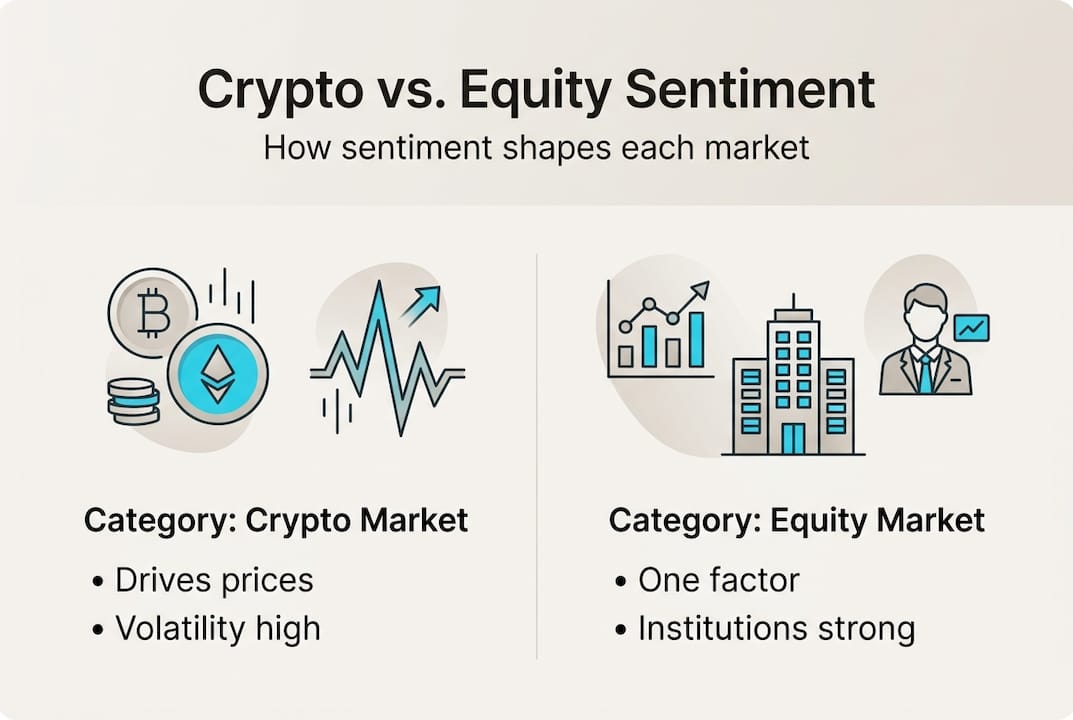
Market sentiment directly impacts price volatility and extreme moves in crypto more than in almost any other asset class. Fear and greed cycles amplify volatility because retail traders often act on emotion rather than analysis. When prices rise, greed brings new buyers in, pushing prices further up. When prices fall, fear accelerates selling, driving prices further down.
Here is what typically drives sentiment shifts in crypto:
- News cycles: Exchange hacks, regulatory crackdowns, ETF approvals, or major institutional purchases all trigger rapid sentiment changes.
- Social media: A single tweet from a prominent figure can flood platforms like X (formerly Twitter) and Reddit with panic or euphoria.
- On-chain data: Large wallet movements, exchange inflows and outflows, and miner behavior signal what sophisticated participants are actually doing.
- Macro events: Interest rate decisions, inflation data, and geopolitical instability spill over into crypto markets and shape how risky traders feel the space is.
"Sentiment is the invisible hand behind many crypto price moves. Ignore it, and you are trading blind to the crowd's next step."
Understanding crypto trading signals alongside sentiment gives you a more complete picture of what the market is actually doing versus what it feels like it is doing. And because crypto is so emotionally driven, recognizing trading psychology in crypto is just as important as reading any technical indicator.
Key factors shaping crypto market sentiment
Sentiment does not form in a vacuum. Specific forces push the crowd from calm to fearful, or from cautious to euphoric. Knowing which levers move sentiment helps you anticipate shifts before they show up in price.
Here are the primary factors that shape crypto market sentiment:
- News cycles and macro events: Exchange hacks, government bans, or ETF approvals cause immediate, large-scale sentiment swings. Positive regulatory clarity in major markets has historically lifted sentiment for weeks.
- Social media volume and tone: When positive mentions on X, Reddit, and Telegram spike, greed tends to follow. Negative viral content spreads panic faster than any traditional news outlet.
- On-chain data signals: Exchange inflows rising sharply often signal impending sell pressure. Large outflows from exchanges suggest holders are moving assets to cold storage, a bullish signal.
- Fear and Greed Indexes: These aggregated indices distill multiple data points into a single number, giving traders a fast read on the market's emotional state.
- Santiment sentiment ratio: This tool measures the ratio of positive to negative crypto mentions across social platforms and has proven useful for timing extremes.
Statistic to know: Events like FTX and Terra/Luna triggered some of the longest streaks of extreme fear since 2018, yet they were followed by recoveries of 150% to 290% in Bitcoin's price. The crowd's worst moments were, statistically, the best entry points.
Tracking key crypto indicators alongside sentiment data allows you to cross-reference emotional signals with objective market data. The combination is far more reliable than either data stream alone.
How market sentiment impacts crypto prices
Sentiment does not just reflect price action. It actively drives it. Understanding this two-way relationship is where sentiment analysis becomes a genuine trading edge.
When sentiment is broadly bullish, buying pressure builds, liquidity tightens, and prices tend to trend upward. As prices rise, more retail traders jump in, reinforcing the bullish narrative. This is the classic fear of missing out (FOMO) loop. Eventually, sentiment reaches extreme greed, and the market becomes dangerously overextended.
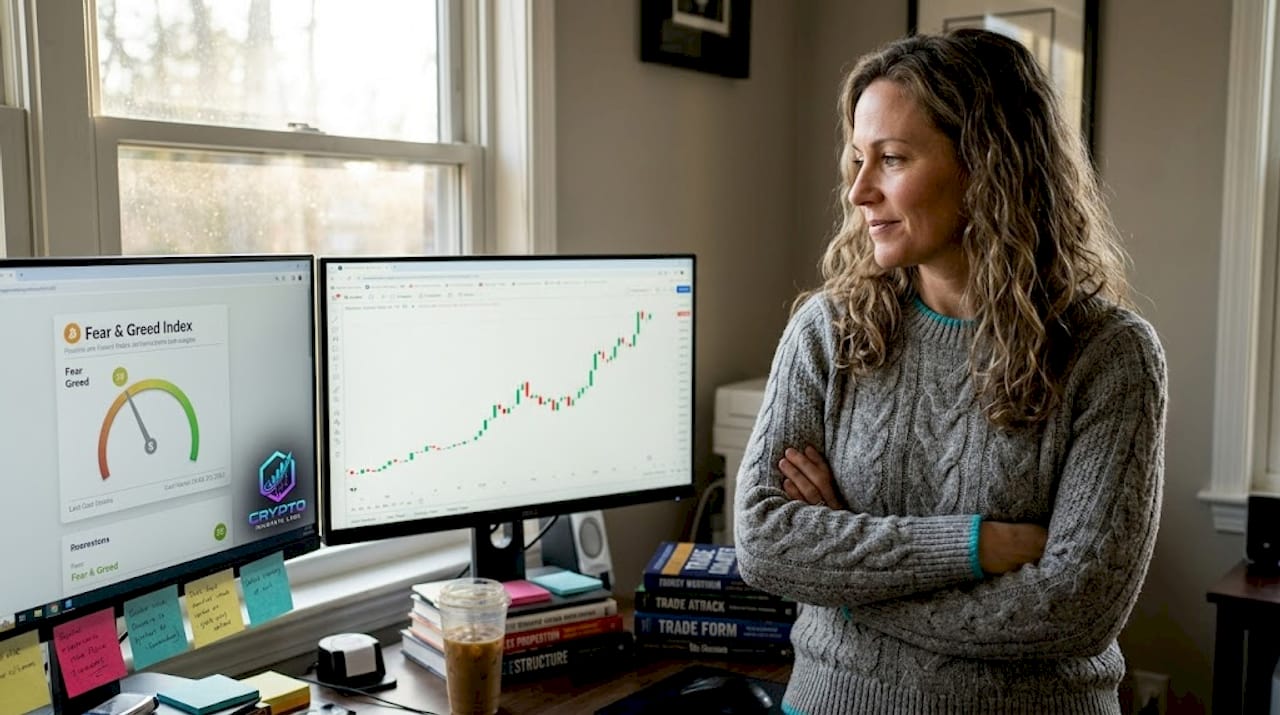
When sentiment turns bearish, the cycle reverses. Selling accelerates, liquidity dries up, and fear feeds more fear until prices reach levels that smart money views as oversold.
The table below illustrates how different sentiment conditions have historically correlated with price outcomes:
| Sentiment signal | Market condition | Typical price outcome |
|---|---|---|
| Extreme fear (index below 20) | Capitulation phase | Often precedes a 50%+ rally |
| Fear (index 20 to 40) | Bearish consolidation | Gradual recovery possible |
| Neutral (index 40 to 60) | Stable, low volatility | Mixed, trend-dependent |
| Greed (index 60 to 80) | Bullish momentum | Continued upside, watch for top |
| Extreme greed (index above 80) | Overextended rally | High risk of sharp correction |
Sentiment-driven volatility was especially pronounced during 2020 to 2022 crashes and the longest streaks of extreme fear since 2018, confirming this pattern across multiple market cycles.
Pro Tip: The most profitable sentiment plays are often contrarian. When the Fear and Greed Index hits extreme fear territory, experienced traders start building watchlists for entries rather than panic-selling. This is not reckless. It is systematic and supported by predictive analysis in trading.
"The market loves to punish the majority. Extreme readings in either direction are invitations to think differently from the crowd."
The feedback loop is real: sentiment shapes price, which shapes new sentiment, which shapes more price action. Pairing sentiment awareness with crypto technical analysis methods and sound crypto risk-reward ratios turns a fuzzy signal into a structured trade thesis.
Measuring and applying crypto market sentiment
Knowing that sentiment matters is one thing. Knowing how to measure and act on it is where theory becomes practice.
The most widely used sentiment tools include:
- Fear and Greed Index (Crypto): Aggregates volatility, market volume, social media, dominance, and trends into a 0 to 100 score. Fast, accessible, and a solid starting point.
- Santiment: Provides social volume, sentiment ratio, on-chain metrics, and developer activity all in one platform.
- Token Metrics: Uses AI-driven analysis to score assets based on sentiment, technicals, and fundamentals together.
- Social listening dashboards: Tools that track keyword volume and tone across X, Reddit, and Telegram in real time.
Here is a snapshot of how sentiment values have mapped to BTC price behavior at historical extremes:
| Fear and Greed value | BTC approximate price context | Outcome over 90 days |
|---|---|---|
| 6 (extreme fear, Nov 2022) | ~$16,000 post-FTX | +85% recovery |
| 8 (extreme fear, May 2022) | ~$28,000 post-Terra/Luna | Volatile, then rally |
| 95 (extreme greed, Nov 2021) | ~$69,000 ATH | Sharp correction followed |
| 78 (greed, Mar 2024) | ~$73,000 pre-halving | Consolidation then pullback |
Santiment's sentiment ratio and fear/greed indices are the key barometers serious traders use to time entries and exits at market extremes.
Pro Tip: Never use sentiment in isolation. Layer it on top of technical structure and on-chain data. If extreme fear aligns with a key support level and declining exchange inflows, you have three signals pointing in the same direction. That is a much stronger case for a position than sentiment alone.
To integrate sentiment into your daily workflow: check the index each morning, compare it to prior readings over the past two weeks, look for divergence between sentiment and price, and note any upcoming catalysts. Exploring sentiment analysis tools and alternative analytics platforms will help you find the right combination of data sources for your trading style.
Why most traders misuse crypto market sentiment
Here is the uncomfortable reality: most traders treat sentiment as a confirmation tool rather than a contrarian one. When prices are rising and greed is high, they buy because sentiment confirms what they already feel. When prices are crashing and fear is everywhere, they sell because sentiment mirrors their own panic.
This is exactly backwards. By the time sentiment reaches an extreme, the move is usually nearly over. The crowd has already acted. The real edge comes from positioning ahead of the reversal, not chasing it.
Another common mistake is assuming sentiment is always timely. Sentiment lags. Social media reacts to price, not the other way around. On-chain data and institutional flow data tend to be more leading. The best traders we have observed combine emotional extremes with hard data before committing to a trade.
Sentiment works best as a filter, not a trigger. Think of it as a weather forecast. It tells you the conditions are favorable or dangerous. It does not tell you exactly when to pull the umbrella out. Developing that timing takes practice, and reviewing advanced best practices for crypto trading will sharpen your ability to act at the right moment rather than the most emotional one.
Level up your trading with expert-driven sentiment analysis
Reading about sentiment is a starting point. Acting on it consistently, without getting pulled into emotional extremes yourself, requires the right tools and data infrastructure.
At Crypto Innovate Labs, we built our platform specifically for traders who want more than gut feel. Our proven sentiment-driven methodology combines machine learning models, real-time social monitoring, and on-chain analytics to surface actionable signals before the crowd catches on. If you are ready to move from watching sentiment to trading with it, explore the full Crypto Innovate Labs platform and see how AI-powered market intelligence can give your strategy a sharper edge.
Frequently asked questions
How can I measure market sentiment in crypto?
You can track market sentiment using Fear and Greed Indexes, Santiment's sentiment ratio, and social media analytics dashboards that monitor platform-wide tone and volume in real time.
Does extreme fear in crypto always mean the price will go up?
Not always, but historically, extreme fear markers often led to 150% to 290% rebounds in Bitcoin after major events like FTX and Terra/Luna, making them high-probability watch zones for contrarian traders.
What's the difference between bullish and bearish sentiment?
Bullish sentiment reflects optimism and expectation of price increases, while bearish sentiment shows pessimism and expected declines. Sentiment cycles between these extremes drive much of crypto's volatility.
Can I make trading decisions based only on sentiment?
Sentiment is important but incomplete on its own. Sentiment signals work best when combined with technical indicators and on-chain fundamentals to confirm trade setups and reduce false positives.