

TL;DR:
- AI-driven analysis offers systematic, emotion-free decision-making in fast-moving crypto markets.
- Building a disciplined process with quality data and clear rules is essential for long-term success.
- Continuous evaluation and regime awareness prevent model breakdowns and maintain trading edge.
You're watching Bitcoin drop 8% in 40 minutes. Your gut says buy the dip, your news feed is screaming collapse, and your finger hovers over the order button. Most traders in that moment make the same expensive mistake: they react instead of respond. The difference between those two words is where trading accounts are won and lost. AI-driven analysis and predictive market signals exist precisely to close that gap, giving you a systematic framework to act on data rather than panic, noise, or hope.
Table of Contents
- Why smart decision-making matters in crypto trading
- Tools and prerequisites for effective AI-powered trading
- Step-by-step process for improving decision making in crypto trading
- Avoiding common mistakes and troubleshooting your approach
- Why disciplined process beats raw intuition in crypto trading
- Take your trading to the next level with Crypto Innovate Labs
- Frequently asked questions
Key Takeaways
| Point | Details |
|---|---|
| AI improves decisions | Data-driven signals and models help reduce human bias and reactive mistakes in crypto trading. |
| Tools matter | Access to high-quality data feeds and reliable AI platforms is essential for effective decision-making. |
| Process beats intuition | Consistent, structured routines outperform spur-of-the-moment intuition in complex, fast-moving markets. |
| Avoid common mistakes | Regularly review your strategies and risk limits to prevent model overfitting and regime-related errors. |
Why smart decision-making matters in crypto trading
The crypto market doesn't sleep, and it doesn't forgive hesitation or impulsiveness equally. A single emotional trade executed at the wrong moment can erase weeks of disciplined gains. Understanding the real cost of poor decision quality is the first step toward fixing it.
Common trading psychology biases like loss aversion, confirmation bias, and recency bias are particularly dangerous in crypto because the market amplifies their consequences. When BTC swings 15% in a day, a trader operating on gut feel is essentially navigating by feeling the walls in a dark room. They might make it across once, even twice. But they'll trip eventually, and the fall is usually brutal.
Here is what separates traders who survive long term from those who don't:
- Data-driven entry and exit signals that reduce guesswork
- Predefined risk parameters that remove in-the-moment emotional override
- Systematic review cycles that catch model drift and strategy decay before they become losses
- Context awareness that accounts for volume, volatility regime, and macro triggers
Traditional intuition-driven trading worked reasonably well in slower, less interconnected markets. Crypto operates at a fundamentally different speed and with far more correlated information flows. A tweet, a regulatory headline, or a whale wallet move can reshape market structure in minutes. Human cognition simply cannot process those signals at the necessary speed and volume.
This is where machine learning changes the game. Empirical research shows that C-LSTM models boost HFT ROI by 17 to 43% when combined with Fibonacci levels on 1-minute BTC/ETH data. That kind of edge is not the result of a lucky guess. It comes from processing thousands of data points simultaneously and identifying repeating patterns that human analysts would miss or misinterpret.
"The edge in modern crypto trading is not found in better information alone. It lives in the speed and consistency with which you act on that information systematically."
Explore top crypto trading strategies that pair well with AI analysis to see how systematic approaches have outperformed reactive ones across multiple market cycles.
Tools and prerequisites for effective AI-powered trading
Getting started with AI-powered trading sounds intimidating, but the barrier to entry has dropped significantly over the last two years. Knowing what tools you actually need versus what is marketing fluff saves you time and money.
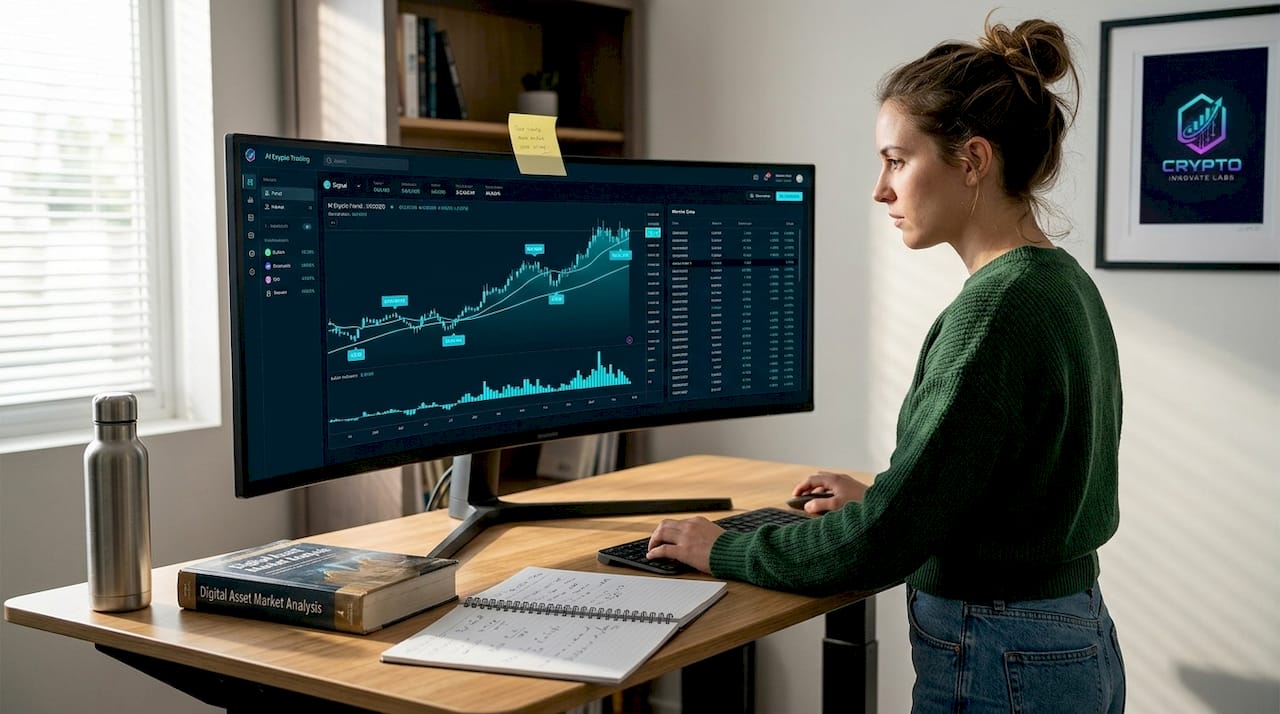
At its core, you need four components working together: reliable data, a model or signal service, an execution layer, and a risk management framework. Missing any one of these creates a weak link that undermines the others.
Essential tools at a glance
| Tool category | Examples | What it does |
|---|---|---|
| Market data feeds | CoinAPI, Kaiko, Binance WebSocket | Provides real-time OHLCV and order book data |
| Signal platforms | Crypto Innovate Labs, TradingView | Generates buy/sell signals from ML models |
| Execution layer | Exchange APIs, trading bots | Automates or semi-automates order placement |
| Backtesting frameworks | Backtrader, QuantConnect | Tests strategies against historical data |
| Risk management tools | Position sizing calculators, alerts | Controls exposure and drawdown |
Your real-time data quality is the foundation everything else sits on. Garbage data produces garbage signals regardless of how sophisticated your model is. Always verify data completeness, timestamp accuracy, and latency before building or subscribing to any signal system.
On the knowledge side, you don't need a PhD in machine learning. But you do need a working understanding of:
- Basic statistics including mean, standard deviation, and correlation
- API connectivity so you can pull data and place orders programmatically
- Backtesting principles to evaluate whether a signal is genuinely predictive or just overfit to past data
- Position sizing math to ensure no single signal can blow up your account
Research into SVR hybrid models shows they outperform RF and LSTM approaches on BTC, ETH, XRP, and LTC during moderate volatility periods from 2018 to 2020, which suggests that no single model dominates across all conditions. Flexibility in your tool stack matters.
Pro Tip: Start with one exchange's API and one data feed before adding complexity. Traders who try to connect five platforms simultaneously at the start almost always encounter conflicting data or execution delays that corrupt their results and create false confidence in bad signals.
The predictive analysis guide we've put together walks through how to evaluate signal quality before committing real capital, which is an essential checkpoint that most beginners skip entirely.
Step-by-step process for improving decision making in crypto trading
Theory without execution is just noise. Here is a repeatable process you can apply right now to start making more structured, evidence-backed trading decisions.
-
Define your trading objective clearly. Are you day trading BTC on a 15-minute chart, or swing trading altcoins over days? Your time horizon determines which signals and models are relevant. A model trained on daily closes is useless for a scalping strategy.
-
Source and clean your data. Pull at least 12 to 24 months of OHLCV data for your target assets. Remove anomalies like exchange outages, test for missing bars, and normalize price data where needed. This step alone takes most serious traders several hours the first time.
-
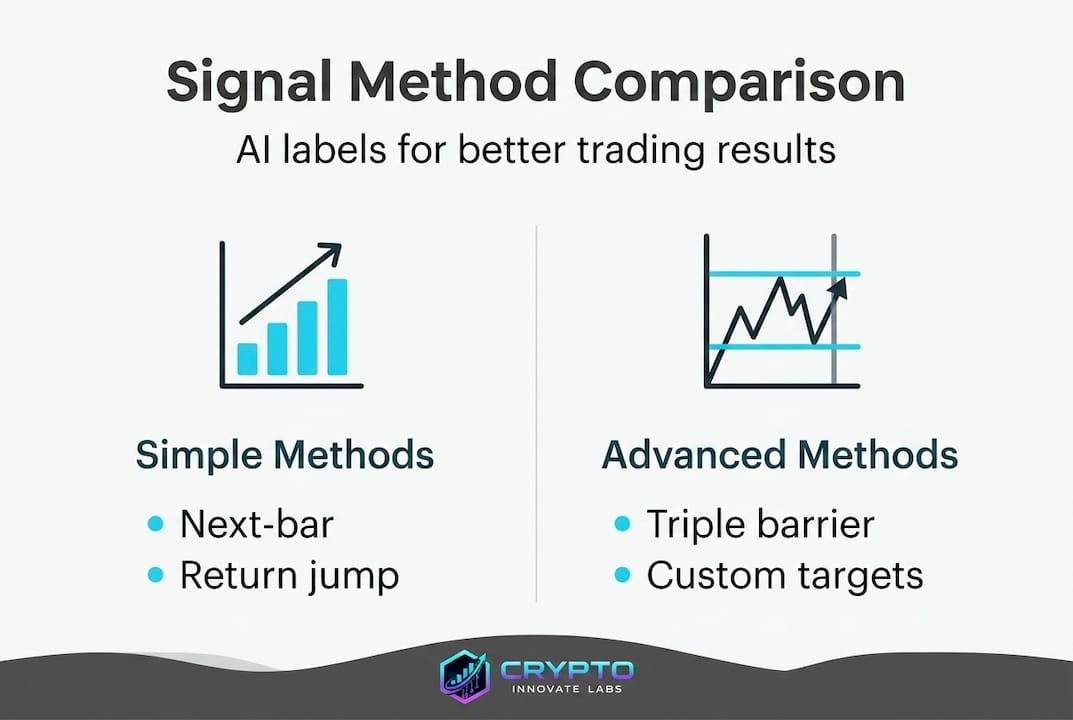
Choose your signal labeling method. This is where most traders leave performance on the table. Classic "next-bar" labeling (will the next candle be up or down?) sounds intuitive but creates misleading training data. Triple barrier labeling uses time limits, volatility bounds, and profit targets simultaneously to generate more realistic signal labels that protect against adverse swings in live trading.
-
Select and configure your model or signal source. Whether you build your own ML model or subscribe to a signal service, document the logic behind every signal type. If you can't explain why a signal fires, you can't diagnose it when it stops working.
-
Backtest rigorously with realistic assumptions. Include trading fees, slippage estimates, and realistic position sizing. A strategy that returns 200% without fees might return 60% after them, which can still be excellent but needs to reflect reality.
-
Paper trade before going live. Run your signal-based strategy in a simulated environment for at least two to four weeks. Track every signal, win rate, average gain, and average loss. Look for patterns in when signals fail.
-
Go live with small position sizes. Start at 25% to 30% of your intended position size. This gives you real market feedback without catastrophic exposure while you identify edge cases your backtest didn't cover.
-
Review and refine weekly. Set a fixed time each week to evaluate signal performance, check for model drift, and compare your results against a passive benchmark like holding BTC. Adjust parameters only when you have statistically meaningful evidence to do so, not after two bad days.
Signal labeling comparison
| Method | How it works | Weakness |
|---|---|---|
| Next-bar labeling | Predict if next candle is up or down | Ignores stop-outs and drawdown reality |
| Triple barrier | Time, profit, and volatility barriers combined | More complex to implement initially |
| Fixed threshold | Signal when price crosses a set percentage move | Sensitive to regime changes |
Learning to master trading signals separates traders who use AI as a crutch from those who use it as a genuine edge multiplier.
Pro Tip: When a signal produces three or more consecutive losses, don't immediately retrain your model. Check whether market volatility or volume has shifted dramatically. Most signal failures are regime changes in disguise, and retraining on recent data during a regime shift often makes things worse, not better.
The AI trading benefits for systematic traders go well beyond pure signal generation. They include faster pattern recognition, emotion-free execution triggers, and the ability to monitor dozens of assets simultaneously without fatigue. The advanced trading best practices that top-performing traders follow almost always include at least one systematic AI component alongside disciplined manual review.
Avoiding common mistakes and troubleshooting your approach
Even well-designed AI trading systems break down. The good news is that most failures are predictable and preventable if you know what to watch for.
The most common mistakes include:
- Overfitting your model to historical data so it performs brilliantly in backtests but fails in live markets because it memorized noise rather than learned real patterns
- Ignoring model confidence scores and treating every signal as equally strong regardless of underlying uncertainty
- Failing to account for liquidity when signals fire on low-cap altcoins where a $10,000 order can move the price meaningfully
- Neglecting drawdown limits because a winning streak created overconfidence in position sizing
- Not logging every trade with rationale which makes it nearly impossible to diagnose failures objectively later
- Skipping regime detection so your trend-following strategy continues firing signals during a sideways, mean-reverting market where it was never designed to operate
Research shows that GRU portfolio models improve mean excess return over naive strategies, but the improvement loses statistical significance when measured against capped benchmark portfolios. That result carries a critical lesson: relative outperformance in controlled tests does not guarantee absolute outperformance in every real-world condition. A model that beats a naive strategy during trending markets may still underperform a simple index during consolidation.
Solid risk management practices are not optional extras you add once your strategy is profitable. They are the architecture that keeps you in the game long enough for the strategy to work. Without them, even a genuinely predictive model can bankrupt an account during a normal drawdown period.
Study technical analysis methods that complement your AI signals so you have a human-readable sanity check before executing large positions.
"Market regimes change without warning. A model trained on bull-market data will often produce catastrophic signals during a structural bear market or a liquidity crisis. Always know the conditions under which your model was tested."
The most dangerous mindset in AI-assisted trading is assuming that because a model worked for six months, it will work indefinitely. Markets are adaptive systems. When enough participants use similar signals, the edge those signals represent gets arbitraged away. Staying ahead means continuous evaluation, not set-and-forget automation.
Why disciplined process beats raw intuition in crypto trading
Here's an uncomfortable truth that most trading content avoids: the majority of traders who blow up their accounts are not stupid. Many are sharp, experienced, and genuinely knowledgeable about crypto. What they lack is process consistency, and that gap is what destroys otherwise capable traders.
There is a persistent myth in retail trading culture that elite traders have some kind of special intuition, a pattern recognition superpower that lets them feel the market. In rare cases over short time horizons, that may be partially true. But across thousands of trades and multiple market cycles? The data does not support gut-feel supremacy. What it supports, consistently, is that traders who follow structured, evidence-backed processes with defined rules for entry, exit, position sizing, and review outperform those who operate on instinct.
AI-driven strategies make this easier to implement because they externalize the decision logic. Instead of asking yourself "does this feel right?", you're asking "does this signal meet the criteria we defined and tested?" That shift from subjective to objective is more powerful than any specific model architecture.
But here's the part that most AI trading content glosses over: the model is only 40% of the edge. The other 60% comes from the discipline to follow its signals when your emotions say otherwise, the rigor to review its performance honestly, and the humility to pause it when market conditions change. AI without disciplined process is just expensive noise.
Sustainable trading success is built on structure. Not luck, not hot tips, not the fastest model. Structure. The traders we see consistently perform well over time are the ones who treat their trading operation like a business: documented decisions, measured outcomes, regular audits, and clear rules for when to stop. If you take one thing from this guide, let it be that. Build the process first. The edge follows.
Take your trading to the next level with Crypto Innovate Labs
Putting this framework into practice requires more than theory. You need reliable signals, quality data, and a platform built specifically for the way active crypto traders work.
At Crypto Innovate Labs, we built our platform around exactly the principles covered in this guide. Our AI trading methodology combines machine learning models with disciplined risk frameworks so you're not just getting signals, you're getting context, confidence levels, and actionable market intelligence. For traders ready to apply systematic approaches across multiple assets, our trading signals marketplace gives you access to curated, backtested strategies designed for real market conditions. Whether you're refining an existing system or starting from scratch, the Crypto Innovate Labs platform is built to support smarter, more structured decision-making at every stage of your trading growth.
Frequently asked questions
What is the main benefit of using AI-driven signals for crypto trading?
AI signals reduce emotional decision-making by providing objective, data-driven analysis and timely alerts. Backtests show C-LSTM models boost HFT ROI by 17 to 43% on 1-minute BTC/ETH data, illustrating the concrete performance gap between systematic and reactive approaches.
How can I start integrating predictive analysis into my trading routine?
Begin with clean, reliable data feeds and set clear performance benchmarks before deploying any strategy with real capital. Pre-built tools lower the entry barrier, but documenting your signal logic from day one is what makes your system improvable over time.
What is triple barrier labeling and why does it matter?
Triple barrier labeling uses time limits, volatility boundaries, and profit targets together to create more realistic and robust trading signals. Research confirms that triple barrier methods outperform next-bar labeling by protecting against adverse market swings in backtested deep learning models.
Is model performance guaranteed in all market conditions?
No, and any platform or service that claims otherwise should be treated with serious skepticism. Studies show GRU portfolios improve returns over naive benchmarks but lose significance against capped benchmarks, which means regular review and regime awareness are non-negotiable parts of your process.