

TL;DR:
- Crypto market cycles follow four predictable phases: accumulation, markup, distribution, and markdown.
- Emotional reactions often lead traders to buy during euphoria and sell during fear, causing losses.
- Using cycle indicators and disciplined strategies can improve timing and reduce emotional trading mistakes.
Most traders don't lose money because they pick bad coins. They lose because they react emotionally to market moves that have played out the same way, dozens of times before. The patterns are visible, documented, and predictable in structure. Crypto market cycles follow predictable phases driven by investor psychology, cycling from fear to greed and back again. Understanding these phases doesn't just improve your timing. It rewires how you think about price action, risk, and opportunity across every market condition.
Table of Contents
- Understanding crypto market cycles: The four phases
- Why following cycles beats emotional trading
- Key indicators and signals for tracking crypto cycles
- Strategy in action: Applying cycle insights to real trades
- Why most traders ignore cycles—and how you can get ahead
- Ready to gain an edge? Get expert tools for every crypto cycle
- Frequently asked questions
Key Takeaways
| Point | Details |
|---|---|
| Cycles drive crypto psychology | Emotions like fear and greed follow four core phases and shape price action. |
| Cycle signals are actionable | Indicators and metrics help pinpoint where we are and aid smart decision-making. |
| Following cycles beats gut feel | Traders who use cycle strategies outperform those who react emotionally. |
| Risk is ever-present | Overleveraging, ignoring macro factors, and FOMO all threaten cycle-based plans. |
| Discipline and tools boost results | A structured approach and the right analytics offer a real trading advantage. |
Understanding crypto market cycles: The four phases
Every sustained bull run and brutal bear market you've lived through follows the same structural blueprint. Four phases. Four distinct psychological states. And most retail traders enter at exactly the wrong moment in each one.
The cycle starts with accumulation. Prices are low, sentiment is bleak, and the news is full of "crypto is dead" headlines. This is where smart money quietly buys. Retail investors? They're either still in panic mode from the previous crash or they've completely tuned out. Volume is low, price action is choppy, and nothing seems to be happening. But something is.
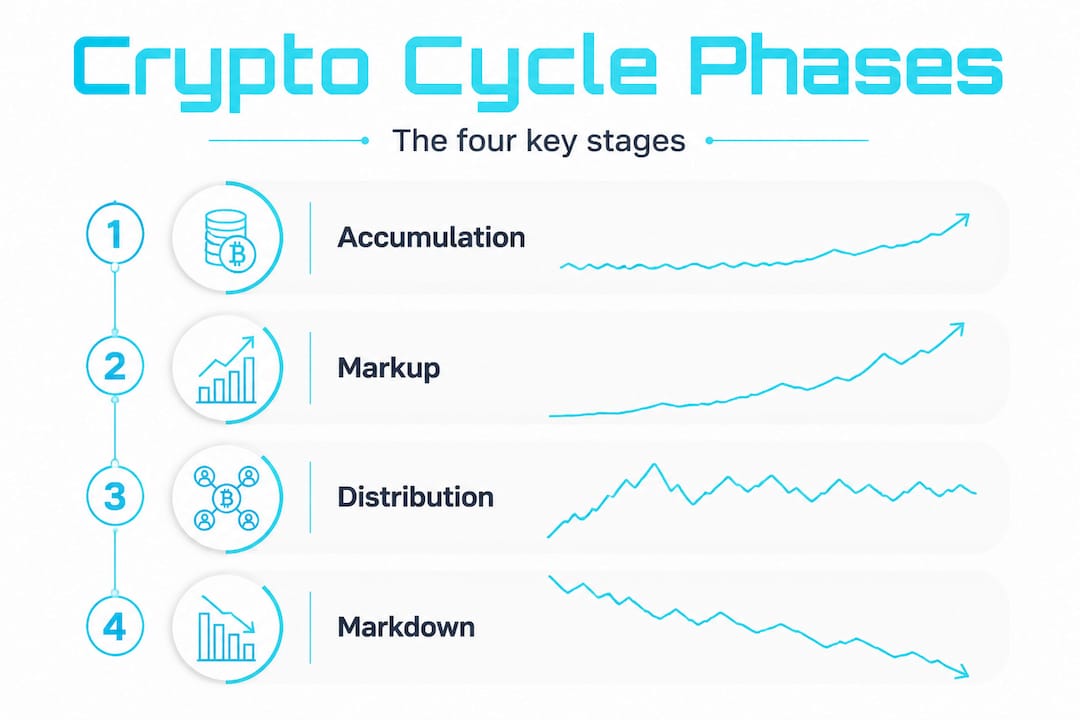
Then comes markup. Optimism creeps in. Early movers start seeing gains. As prices rise, more participants jump in, driven by FOMO. This phase is the longest and the most profitable for those who accumulated early. Media coverage turns positive. New investors flood the market. The word "bull run" starts trending.
Distribution follows. Euphoria peaks. Prices are parabolic. Everyone is a genius. Social media is full of price predictions that make even seasoned traders raise an eyebrow. But beneath the surface, smart money is exiting positions, selling into the excitement retail buyers are providing. Volume stays high, but the character of buying shifts.
Finally, markdown arrives. Prices collapse. Panic selling accelerates. Margin calls trigger cascades. Those who bought near the top hold, hoping for a recovery, while early accumulators watch from the sidelines with capital intact. Then the cycle resets.
"Markets are never wrong—opinions often are." This quote from legendary trader Jesse Livermore still rings true in crypto. The cycle doesn't care about your feelings. It moves on its own logic.
Here's a quick summary of each phase:
| Phase | Market Mood | Who's Buying | Who's Selling |
|---|---|---|---|
| Accumulation | Fear / Despair | Smart money, institutions | Retail (panic) |
| Markup | Optimism / FOMO | Retail investors, funds | Early accumulators (partial) |
| Distribution | Euphoria / Greed | Late retail | Smart money exits |
| Markdown | Panic / Capitulation | Few contrarians | Overleveraged traders |
These cycles repeat across different timeframes. On the macro level, Bitcoin's four-year halving cycle is the most studied. But shorter cycles, playing out over weeks or months, operate within the larger structure. Understanding predictive analysis for trading across multiple timeframes gives you both the big picture and the tactical edge.
Key behavioral patterns to watch in each phase:
- Accumulation: Low volatility, thin trading volumes, negative sentiment in forums and media
- Markup: Rising volumes, breakout confirmations, increasing Google search trends for crypto
- Distribution: High volatility, divergence between price highs and momentum indicators
- Markdown: Volume spikes on drops, cascading liquidations, fear dominating sentiment data
Tracking crypto trading psychology alongside these phases transforms raw price data into a readable narrative.
Why following cycles beats emotional trading
Here's the uncomfortable truth: most traders underperform the market because they let their emotions set their strategy. Buying when everything feels exciting and selling when everything feels terrifying is the single most reliable way to destroy a portfolio over time.
The research backs this up. Active strategies outperform buy-and-hold by capturing bull gains and limiting bear drawdowns, with positive alpha in 10 out of 13 analyzed market windows when anchored to halving cycles. That's a substantial edge, and it doesn't require predicting the future. It requires reading the present clearly.
Compare the two approaches directly:
| Approach | Entry Timing | Exit Timing | Drawdown Exposure | Emotional Load |
|---|---|---|---|---|
| Emotional trading | Buys at euphoria | Sells in panic | Very high | Extreme |
| Cycle-aware trading | Buys in fear | Sells in greed | Managed | Moderate |
The numbers tell a consistent story. Traders who allocate capital during accumulation phases and reduce exposure during distribution consistently capture more upside while limiting their downside. The mechanics aren't complicated. The discipline is.
The four most common emotional mistakes cycle-aware traders avoid:
- Chasing green candles during markup with no exit plan, leading to getting caught in distribution
- Selling out of fear during accumulation when prices dip further before recovering
- Overleveraging during euphoria, the phase where overleveraging and FOMO are most destructive
- Ignoring macro conditions like interest rate changes that can accelerate a markdown or delay a markup
Pro Tip: If you feel an overwhelming urge to buy because "this time is different," you're probably in distribution. Run through your cycle checklist before executing any trade based on emotion alone.
Practical risk mitigation strategies tied to cycles include:
- Dollar-cost averaging (DCA) during accumulation phases to build positions without trying to nail the exact bottom
- Partial profit-taking in stages during markup, not waiting for the absolute peak
- Diversification across asset classes that don't move in lockstep with Bitcoin during volatile periods
- Pre-written trading plans that define entry triggers, exit targets, and position sizes before emotions get involved
Following advanced trading best practices consistently and applying crypto risk management tips across your strategy protects you from the single biggest threat in this market: yourself.
Key indicators and signals for tracking crypto cycles
Knowing that cycles exist is one thing. Knowing where you are in one, right now, requires measurable signals. Fortunately, crypto markets generate a rich stream of on-chain and sentiment data that institutional players monitor closely. Retail traders now have access to the same information.
The most actionable indicators include:
- Fear & Greed Index: A score from 0 (extreme fear) to 100 (extreme greed). Values below 25 often mark accumulation zones. Values above 75 align with distribution territory.
- BTC dominance: When Bitcoin's market share rises, capital is rotating to safety, often a sign of early accumulation or markdown. When dominance falls, alt season and late markup are usually underway.
- MVRV (Market Value to Realized Value): Compares the current market cap to the price at which all coins last moved. Readings above 3.5 to 4 historically signal overheating. Below 1 signals major undervaluation.
- Coin turnover rate: Tracks the proportion of supply that has moved recently. High turnover during peaks suggests distribution.
- MCTC (Market Cap to Thermocap): A ratio comparing market cap to total miner revenue. Extremes in this ratio have historically aligned with cycle tops and bottoms.
Accumulate in fear, distribute in greed using the Fear & Greed Index as your compass, and watch BTC dominance to time altcoin allocation relative to Bitcoin's cycle position. These two data points alone provide a strong starting framework.

| Indicator | Low Reading Signal | High Reading Signal |
|---|---|---|
| Fear & Greed Index | Accumulation (buy zone) | Distribution (caution zone) |
| BTC Dominance | Alt season (markup) | Risk-off / markdown |
| MVRV Ratio | Undervalued (accumulate) | Overvalued (distribute) |
| Coin Turnover | Low activity (quiet phase) | High activity (distribution) |
The 2024 to 2028 cycle introduced a notable edge case. Bitcoin hit pre-halving all-time highs driven by the approval and inflows of spot Bitcoin ETFs. This is historically unusual, and it shifted traditional cycle timing. In this environment, monitoring MVRV below 4, coin turnover below 60%, and MCTC below 10 helped identify the market as still in an intermediate stage rather than at a final peak. ETF-driven demand created new buyers who don't sell the way long-time hodlers do, which means the old playbook needs recalibration.
Pro Tip: Set automated alerts in your tracking tools for key indicator thresholds. When the Fear & Greed Index drops below 20, that's your signal to review your accumulation targets. Don't wait to act manually during a fast-moving market.
For deeper signal tracking and pattern recognition, exploring crypto market indicators and building a foundation in technical analysis for cycles will sharpen your read of these metrics across different market conditions.
Strategy in action: Applying cycle insights to real trades
Theory becomes edge when you apply it systematically. Here's a realistic walkthrough of how cycle awareness shapes a real trading approach from entry to exit.
Step-by-step cycle-aware trading process:
-
Identify the phase. Check your indicator dashboard. Is MVRV below 1.5? Is Fear & Greed under 25? Is BTC dominance rising? If multiple signals point to accumulation, treat it as an opportunity window, not a danger zone.
-
Set a position sizing rule. During accumulation, allocate a defined percentage of your capital, not everything at once. Use DCA over several weeks to build in case the bottom extends further.
-
Define your markup exit targets. Before the market heats up, write down the levels at which you'll take partial profits. 25% at a 2x, another 25% at a 3x, and so on. Make it mechanical.
-
Monitor distribution signals actively. When MVRV crosses above 3.5 and Fear & Greed consistently prints above 80, start executing your distribution plan, regardless of headlines saying prices will go higher.
-
Stay patient during markdown. Your job in markdown is not to trade back in immediately. Wait for capitulation signals. High volume spikes on down days, social media screaming that crypto is finished, and MVRV approaching 1 all suggest the next accumulation phase is near.
-
Review and adjust. After each cycle or major phase transition, evaluate your decisions. Where did emotions override your plan? What signals were clearest? Refine your process before the next entry.
Two contrasting scenarios to illustrate the difference:
Accumulation scenario: It's early 2023. Bitcoin has dropped over 70% from its all-time high. Fear & Greed is at 15. MVRV is sitting at 0.8. You begin DCA weekly over three months. By late 2023, markup begins. By 2024, your position is up significantly and you're executing your pre-written distribution plan. No emotion required.
Euphoria scenario: It's late 2021. Everyone in your group chat is talking about 10x altcoins. Fear & Greed is at 95. MVRV is above 4. You feel pressure to get in. If you had a cycle-aware plan in place, this is the moment you hold back, not pile in. Active strategies limit bear drawdowns precisely because they set exit conditions before the emotion of the moment takes over.
Pro Tip: Build a simple dashboard that aggregates your top three to four cycle indicators in one place. Review it weekly, not daily, to avoid reacting to short-term noise. Consistent signal monitoring beats obsessive chart watching every time.
For more frameworks on executing these ideas, explore top trading strategies for profit, check out crypto trading signals for automated alerts, and make sure you're working with real-time trading data to support your decisions.
Why most traders ignore cycles—and how you can get ahead
Here's something we've observed consistently: traders who understand cycles intellectually still abandon them emotionally. They know the model. They've seen the data. Then a headline drops, a Discord channel erupts, and the plan goes out the window.
The reason isn't ignorance. It's that cycles require you to act against the crowd at exactly the moment when the crowd feels most confident. Buying during accumulation feels wrong because sentiment is terrible. Selling during distribution feels wrong because everyone around you is celebrating gains. Humans are wired for social conformity, and markets exploit that wiring without mercy.
The uncomfortable truth about overleveraging and emotional FOMO is that they peak precisely when the cycle is most dangerous. The euphoria phase generates the most compelling narratives, new technology breakthroughs, institutional adoption announcements, influencer predictions of 10x from here. These narratives aren't always wrong. They're just poorly timed for someone entering a position late.
What separates cycle-disciplined traders from the crowd is a simple mindset shift: accepting that being early feels like being wrong. When you accumulate and prices keep falling, that's not failure. That's the phase working as expected. The trader who can sit with that discomfort, add to positions on deeper dips, and wait without panic is the trader who outperforms.
A practical mental model we recommend is what we call "phase anchoring." Before making any trade, ask yourself: what phase does my indicator data suggest we're in? Then ask: does this trade make sense for that phase? If your answer to the second question is no, don't make the trade. That single filter eliminates a large percentage of the worst timing decisions most traders make.
Studying trading psychology in crypto alongside your technical knowledge is not optional. It's how you make the framework actually work when markets get loud.
Ready to gain an edge? Get expert tools for every crypto cycle
You now have the architecture of crypto market cycles, the behavioral traps to avoid, the indicators to track, and a step-by-step process to execute. That knowledge alone puts you ahead of most participants in the market.

At Crypto Innovate Labs, we've built tools specifically designed to support cycle-aware trading at every phase. Our AI-powered platform helps you monitor the exact indicators discussed here, from MVRV and Fear & Greed to BTC dominance and coin turnover, and delivers predictive signals calibrated to historical cycle patterns. Explore our unique cycle methodology to see how machine learning enhances the cycle analysis framework. Then browse crypto tools and strategies built to give you smarter context, cleaner signals, and more confident entries and exits across every phase of the market.
Frequently asked questions
How do I identify which phase of the crypto market cycle we're in?
Look for key indicators like price action, BTC dominance, the Fear & Greed Index, and on-chain metrics such as MVRV and coin turnover to determine the market phase, watching for readings like MVRV below 4 and coin turnover below 60% to confirm an intermediate stage rather than a cycle peak.
Can following cycles help me avoid major losses?
Yes, because following cycle phases helps you time entries during accumulation and exits during distribution, directly reducing the risk of buying tops or panic-selling bottoms.
What mistakes should I avoid when using market cycles?
Beware of overleveraging during euphoria and ignoring macroeconomic signals like interest rate shifts, and always execute from a pre-written plan with defined position sizes and exit targets.
Are cycle-based strategies better than buy-and-hold in crypto?
Active cycle-based strategies have delivered positive alpha in 10 out of 13 historical windows compared to buy-and-hold, primarily by maximizing gains during bull markets and reducing exposure before significant bear market drawdowns.