

TL;DR:
- Institutional adoption and AI-driven trading dominate crypto market behavior in 2026.
- Trend following now requires multi-factor analysis combining macro signals, on-chain data, and AI insights.
- Rigid reliance on traditional indicators increases risk; adaptive, data-driven strategies are essential.
Relying on last cycle's price charts and gut instinct in 2026 is the fastest way to leave money on the table. The crypto market has been fundamentally restructured by institutional capital, macro sensitivity, and AI-driven trading algorithms that move faster than any human can manually track. Institutional adoption now shapes market liquidity and behavior in ways that make trend tracking not just useful but essential. This guide breaks down exactly what modern trend following looks like, why it matters for your portfolio, and how to use AI-powered tools to stay ahead of the signals that move markets.
Table of Contents
- The evolving crypto landscape: Institutions, AI, and macro drivers
- What counts as a crypto trend in 2026? Frameworks and examples
- Why following crypto trends is vital: Opportunities, risks, and real ROI
- How to leverage AI and data to follow trends successfully
- A contrarian view: Why trend following isn't magic—and what most miss
- Unlock deeper crypto insights with advanced trend tools
- Frequently asked questions
Key Takeaways
| Point | Details |
|---|---|
| Institutional impact reshapes trends | Crypto trends are now influenced by large-scale institutional actions and global market dynamics. |
| AI sharpens competitive edge | Artificial intelligence enables traders to identify actionable trends sooner and with greater confidence. |
| Risk inaction leads to missed gains | Missing trend signals can mean lost profits and unexpected risks, especially in volatile environments. |
| Frameworks, not guesses | Following structured, multi-factor trends outperforms gut feel or legacy approaches in 2026. |
| Continuous adaptation is key | Successful traders adapt their trend strategies as market conditions shift and new data emerges. |
The evolving crypto landscape: Institutions, AI, and macro drivers
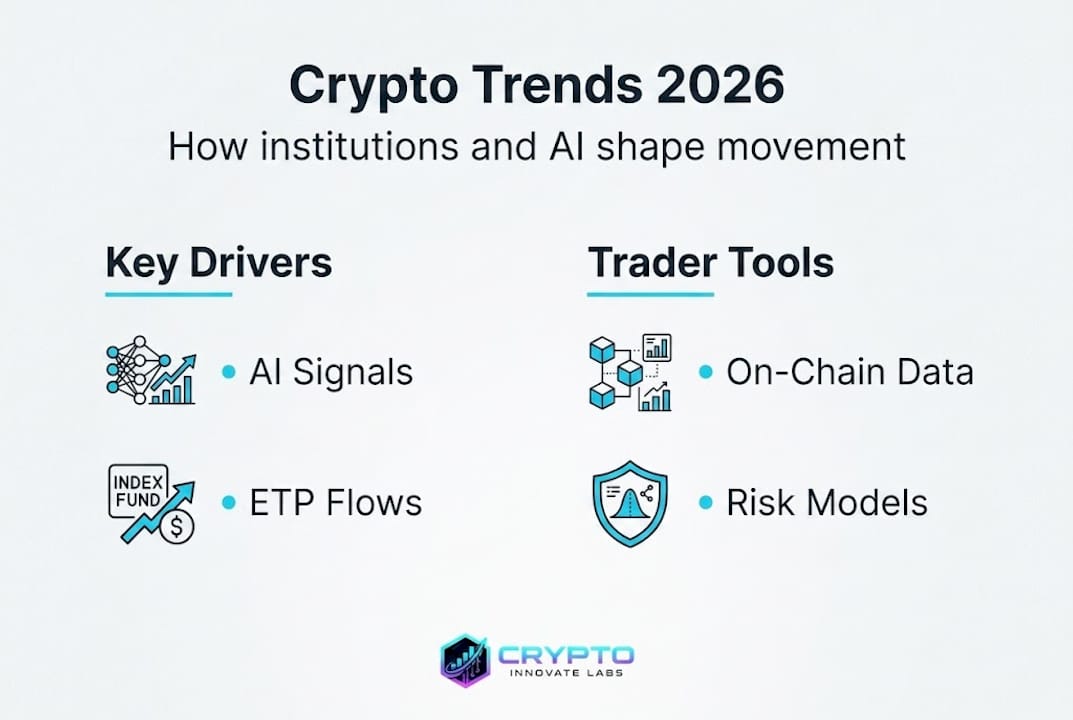
The crypto market you traded five years ago barely resembles what exists today. Institutional participation has crossed a threshold where it now dominates liquidity in major pairs, pulling Bitcoin and Ethereum into tighter correlation with traditional risk assets like equities and Treasury yields. That creates a new layer of complexity every serious trader needs to account for.
Consider the scale: $87B in global crypto ETP inflows since 2024, yet less than 0.5% of U.S. advised wealth is allocated to crypto. That gap is enormous. It signals that institutional adoption is still in its early innings, which means the macro sensitivity and liquidity dynamics we see today will only intensify as that allocation grows.
| Factor | Pre-2024 impact | 2026 impact |
|---|---|---|
| Institutional ETP flows | Minimal | Dominant liquidity driver |
| AI trading algorithms | Emerging | Core price discovery tool |
| Macro correlation | Loose | Tight (rate cycles, DXY) |
| On-chain data signals | Niche | Mainstream trend indicator |
| Regulatory clarity | Fragmented | Increasingly codified |
AI-based trading systems have changed how trends form and accelerate. These algorithms don't wait for a weekly candle to close. They process sentiment data, order book depth, on-chain flows, and macroeconomic signals in milliseconds, identifying trend inflection points before human analysts even notice the setup. Understanding the real-time data benefits of these systems is now a baseline requirement, not a competitive edge.
The key macro and AI factors now defining trend significance include:
- Federal Reserve rate cycle positioning and dollar strength (DXY)
- Global risk appetite measured by equity volatility indices
- Bitcoin ETF net flow data as an institutional sentiment proxy
- AI pattern recognition on cross-asset correlation shifts
- On-chain active addresses and stablecoin supply changes
- Regulatory developments across major jurisdictions
"The market no longer rewards those who simply read charts. In 2026, trend intelligence means processing macro signals, institutional flows, and AI-generated insights simultaneously."
What counts as a crypto trend in 2026? Frameworks and examples
A trend in 2026 is not just price moving in one direction for a few weeks. That definition is dangerously incomplete. Today, a meaningful trend encompasses sectoral rotation, liquidity migration, on-chain behavioral shifts, and narrative cycles driven by regulatory or technological catalysts.
There's genuine tension in the market right now. Optimistic and bearish viewpoints contrast sharply on whether current crypto trends can sustain themselves under institutional and macro pressure. That disagreement itself is a signal worth tracking.
| Framework | Traditional approach | 2026 AI-driven approach |
|---|---|---|
| Trend identification | Price moving averages (MA50, MA200) | Multi-factor AI models (price, flow, sentiment) |
| Validation | Volume confirmation | On-chain + derivatives + macro alignment |
| Duration | Fixed timeframes (daily, weekly) | Adaptive, context-sensitive windows |
| Risk signals | Support/resistance levels | Regulatory alerts + liquidity stress models |
| Entry triggers | Crossover signals | Probabilistic inflection point scores |
Here's a practical process for spotting and validating a meaningful trend:
- Identify the catalyst. Is the move driven by macro news, on-chain data, an ETF flow surge, or a regulatory development? Source matters.
- Check cross-asset confirmation. Does the trend align with broader risk-on or risk-off conditions? Isolated moves are often noise.
- Validate with on-chain data. Rising active addresses, growing stablecoin deployment, or increasing exchange outflows strengthen conviction.
- Apply key market indicators to filter signal from noise. Combine funding rates, open interest, and derivatives positioning.
- Review AI signal outputs. Cross-reference your analysis with machine learning models that flag statistical anomalies in price behavior.
- Size accordingly. Trend strength should directly inform position size, not just entry timing.
For traders who also use technical analysis methods, the key update is treating those tools as one layer of a multi-factor system, not as standalone decision makers.

Pro Tip: Never validate a trend using only price-based indicators. If your on-chain data, macro context, and AI signal all point the same direction, your conviction level earns the right to go up. If they diverge, treat the trade as speculative.
Why following crypto trends is vital: Opportunities, risks, and real ROI
The performance gap between traders who actively track trends and those who react to price moves after the fact is measurable. Trend followers capture the bulk of a move. Reactive traders buy the top and panic at the bottom. The difference isn't intelligence. It's process.
The main benefits of disciplined trend following in 2026 include:
- Earlier entries into sectoral rotations (DeFi, Layer 2, RWA tokenization) before retail momentum builds
- Cleaner exits using deteriorating trend signals rather than emotional decision making
- Better risk sizing because position confidence is grounded in data, not gut feel
- Faster regime recognition when macro conditions shift and previous trends reverse
- Reduced drawdown by catching distribution phases before full reversals materialize
The risk of ignoring trends is not theoretical. Macro shocks and regulatory reversals can suddenly limit industry growth, and traders who miss those signals absorb the full downside without warning. A single surprise rate decision or a major jurisdiction's enforcement action can erase weeks of gains in hours.
"Missing a trend signal isn't just a missed opportunity—it's often a risk management failure in disguise."
The trading strategies for profits that work in 2026 consistently combine trend awareness with defined stop logic. The two are inseparable in a market this sensitive to external shocks.
Pro Tip: Pair every trend-based position with a pre-defined invalidation level tied to your signal model. If the AI signal reverses or the macro catalyst changes, your exit criterion is already set. This removes emotion from the most dangerous moment: when a winning trade starts going wrong. Explore AI risk management tips to build this process systematically.
How to leverage AI and data to follow trends successfully
Knowing that AI matters is not the same as knowing how to use it. Here's a step-by-step process for building an AI-powered trend monitoring setup that actually improves your decision making.
- Choose a multi-signal platform. Single-indicator tools are insufficient. Look for platforms that combine price data, on-chain analytics, sentiment scoring, and macro feeds into unified signals.
- Set up sector watchlists. Track assets by narrative category (Layer 1, DeFi, AI tokens, RWA) using trading watchlists to catch rotation before it becomes obvious.
- Configure real-time alerts. AI tools should flag statistically significant deviations from baseline trend behavior, not just price crosses.
- Calibrate signal weights. Use historical backtesting to understand which signals in your model have performed reliably across different market regimes.
- Review weekly, not just daily. Daily noise can overwhelm signal quality. A weekly review of trend health keeps your analysis at the right altitude.
- Document and iterate. Track which signals led to good decisions and which didn't. Continuous refinement is how you build a real edge.
AI's real advantage is pattern detection—identifying trend inflection points earlier and with fewer false positives than manual systems. But that advantage disappears if you override AI outputs every time they conflict with your personal bias.
Essential data feeds and resources for modern trend tracking:
- On-chain analytics platforms (active addresses, exchange flows, SOPR)
- Derivatives data (funding rates, open interest, options skew)
- Macro dashboards (DXY, Fed funds futures, global M2)
- AI-powered market analysis signal feeds
- Sentiment aggregators (social volume, news scoring)
Understanding AI investment advantages goes beyond tool selection. It's about building a workflow where AI augments your judgment rather than replacing it. For traders ready to go further, predictive analysis for trading offers a framework for turning probabilistic signals into actionable decisions.
Pro Tip: Avoid chasing the most recent signal. Overfitting to short-term noise is the number one way traders misuse AI tools. Trust the multi-factor model, not the single dramatic data point.
A contrarian view: Why trend following isn't magic—and what most miss
Here's what years of watching traders use trend signals has shown us: the strategy fails not because the signals are wrong, but because traders apply them rigidly in markets that are inherently adaptive.
The phrase "trend is your friend" became popular wisdom, and that's exactly when it became dangerous. When every participant uses the same trend signals, the market adjusts. False breakouts get engineered. Liquidation cascades hit predictable levels. Consensus becomes a contrarian signal.
What advanced traders consistently get wrong is seeking confirmation rather than disconfirmation. They look for evidence that their trend thesis is correct instead of actively looking for evidence it's breaking down. That cognitive bias is expensive.
Our view: treat every trend as time-limited. The duration of trends in 2026 is compressing because AI systems react faster and institutional flows can reverse with policy changes. You need to know your exit before your entry. Reviewing advanced best practices regularly keeps your framework current rather than comfortable. Staying skeptical of your own signals is not a weakness. It's the discipline that separates consistent performers from those who eventually give back their gains.
Unlock deeper crypto insights with advanced trend tools
Ready to take your trend tracking and strategy to the next level? At Crypto Innovate Labs, we built our platform specifically for traders who need more than basic charts to stay ahead. Our AI-powered signals and market intelligence tools process the exact inputs this article covers: on-chain flows, macro correlations, sentiment scoring, and derivatives positioning.
Explore our proven trend methodology to see how we structure AI signals into actionable intelligence. Browse the marketplace for professional-grade tools designed for 2026 market conditions. Crypto Innovate Labs gives you the infrastructure to follow trends with conviction, not guesswork.
Frequently asked questions
Why is institutional adoption making crypto trend tracking more important in 2026?
Institutional money increases market complexity and macro sensitivity, so trends now form and reverse faster and in response to factors that go far beyond simple price action.
What role does AI play in identifying profitable crypto trends in 2026?
AI detects inflection points earlier than manual systems by processing large, multi-dimensional data sets that no human analyst can monitor simultaneously.
How can traders protect themselves from risks like macro shocks or regulatory reversals?
Actively tracking trends and pairing AI-driven risk models with defined invalidation levels helps traders react to sudden shifts before full losses materialize.
What is a common mistake traders make when following crypto trends?
Many traders seek confirmation of their existing thesis rather than disconfirmation, which causes them to hold losing positions long after the trend has reversed.
Are AI-powered crypto tools suitable for beginners?
Most modern AI platforms offer intuitive dashboards with signal explanations, making them accessible to newer traders while still delivering the depth that experienced investors need.