

TL;DR:
- Combining multiple analysis frameworks increases predictive accuracy and trading success.
- Technical, on-chain, fundamental, and AI methods each serve different trading timeframes and goals.
- Hybrid strategies that integrate diverse data sources outperform solo approaches in crypto trading.
Most traders enter the crypto market with instinct, a hot tip, or a single chart pattern they read about once. That approach might work once or twice, but it won't build consistent returns in a market that moves fast, reacts to global events, and is increasingly shaped by algorithmic participants. Choosing the right analysis framework, or better yet, knowing how to layer multiple frameworks together, is one of the clearest separators between traders who grind profits and those who give them back.
Table of Contents
- How to evaluate crypto analysis methods
- Technical analysis: Charting price patterns and signals
- Fundamental analysis: Assessing crypto's real value
- On-chain analysis: The power of blockchain data
- AI and machine learning: Unlocking next-level predictions
- Comparison of analysis types: Which is right for you?
- Why blending analysis types beats specialization
- Boost your trading with expert crypto analysis tools
- Frequently asked questions
Key Takeaways
| Point | Details |
|---|---|
| Analysis criteria matter | Choosing analysis based on clear goals gives you a tangible trading advantage. |
| Blend methods for edge | Combining technical, fundamental, on-chain, and AI/ML types consistently outperforms single-method approaches. |
| AI/ML drives accuracy | Modern AI techniques boost predictive power, especially when used with other analysis tools. |
| On-chain unlocks transparency | Leveraging blockchain data helps you spot market moves and whale activity before prices react. |
| No one-size-fits-all | Adapt your analytical mix to your trading style and market conditions for the best results. |
How to evaluate crypto analysis methods
Before exploring each analysis type, let's clarify what actually makes a method valuable for you.
Not all analysis is created equal, and the worst mistake you can make is picking a method because it's popular rather than because it fits your trading style, timeline, and technical capacity. A great framework for one trader can be noise for another.
Here's what you should measure any method against:
- Objectivity: Does the method rely on hard data, or is it heavily interpretation-based?
- Predictive power: Has it demonstrated real forecasting ability across different market conditions?
- Data transparency: Can you verify the inputs? On-chain data, for example, is publicly auditable.
- Speed: Can you get actionable signals fast enough to matter for your timeframe?
- Skill match: Does it require technical expertise you currently have or can realistically build?
Matching these criteria to your goals matters enormously. A day trader needs speed and precision on entries. A long-term investor needs conviction and the ability to assess whether a project has lasting value. Trying to use long-term fundamental analysis to make short-term trade calls is like using a weather satellite to decide if you need an umbrella right now.
One of the most powerful, yet underused, frameworks is triangulation, which means using two or more analysis types to confirm a signal before you act. Research on ensemble learning shows that combining analysis types consistently outperforms relying on any single method alone. For traders ready to push further, advanced best practices outline how professionals build these layered systems.
Pro Tip: Don't ignore hybrids. Blending technical signals with AI/ML outputs can surface opportunities that neither method alone would catch, especially in sideways or low-volatility markets where classic indicators struggle.
Technical analysis: Charting price patterns and signals
Let's start with technical analysis, the foundation for most active crypto traders.
Technical analysis (TA) uses historical price data, volume, and chart patterns to forecast where price might go next. The core assumption is that market participants behave in repeatable ways, and those patterns leave visible footprints on a chart.
Key tools used in TA include:
- Moving averages (MA): Simple and exponential MAs smooth out price noise and help identify trend direction.
- Relative Strength Index (RSI): Measures momentum and flags overbought or oversold conditions on a 0 to 100 scale.
- Fibonacci retracement: Maps likely support and resistance zones based on key ratios derived from natural mathematical sequences.
- Candlestick patterns: Formations like the engulfing candle, doji, or hammer give visual cues about buyer and seller battles at specific price levels.
- Volume analysis: Confirms whether a price move has real conviction behind it or is likely to reverse.
Technical analysis is best suited for short to medium term traders who are actively managing entries and exits. It gives you the "when" more than the "what." As one widely referenced resource notes, technical analysis for timing is most reliable when paired with other methods rather than used in isolation.
"Technical analysis gives you an edge in timing, but it can't tell you if what you're buying is worth buying. That's why traders who combine charting with machine learning signals tend to build more robust strategies over time." — Common consensus among quantitative trading practitioners
Explore deeper concepts in our technical analysis guide and see how predictive analysis extends TA into forward-looking signal generation.
Pro Tip: Never use a single technical indicator as a decision trigger. Use it as one signal in a stack. For example, an RSI reading below 30 combined with a bullish divergence on volume and a Fibonacci support zone is a far stronger case than any one of those signals alone.
Fundamental analysis: Assessing crypto's real value
While technicals guide you on timing, fundamentals answer the deeper question: is this project worth owning at all?
Fundamental analysis (FA) in crypto means looking at the underlying characteristics of a project to decide whether it has lasting value. Unlike stocks, where you can analyze earnings and cash flow, crypto requires a different set of lenses.
Key factors to assess include:
- Use case and utility: Does this token solve a real problem, or is it speculative narrative?
- Team and development activity: Is the team experienced and publicly accountable? Is the GitHub repository actively updated?
- Tokenomics: How is supply structured? Are there vesting schedules that could create sell pressure?
- Adoption and ecosystem growth: Are real users and developers building on this platform?
- Total Value Locked (TVL): For DeFi protocols, TVL measures how much capital is actively working in the protocol, a direct signal of trust and usage.
- Partnerships and integrations: Meaningful integrations expand the project's real-world reach.
- Regulatory status: Projects navigating compliance proactively tend to have longer runways.
As fundamental analysis research confirms, evaluating intrinsic value through tokenomics, TVL, and team quality is what distinguishes investors who build conviction from those who chase price action.
Callout: Why TVL and market cap matter together. A project with a $2 billion market cap but only $50 million in TVL is likely inflated by hype. A project with a $500 million market cap and $800 million TVL is actually backed by real usage. That ratio tells you a lot about whether the valuation is sustainable.
Fundamental analysis is best for investors with a three to eighteen month horizon who need conviction before putting significant capital to work. For a broader look at how AI enhances this process, our guide on AI crypto investment is worth your time, as is our resource on advanced analysis.
On-chain analysis: The power of blockchain data
Beyond market or project metrics, on-chain analysis adds a completely new dimension: what investors and whales are actually doing with their coins, in real time.

Blockchain data is public. Every transaction, wallet balance change, and smart contract interaction is recorded permanently. On-chain analysis means reading that data to understand market participant behavior before it shows up in price.
Here's a practical workflow for getting started:
- Choose your metrics: Start with active addresses (network usage), exchange inflows/outflows (selling vs. holding behavior), and large wallet movements (whale activity).
- Track exchange flows: When large amounts of Bitcoin or Ethereum move from cold wallets onto exchanges, that's typically a signal of intent to sell. The reverse suggests accumulation.
- Monitor smart contract activity: For DeFi tokens, rising protocol interactions signal growing usage and often precede price appreciation.
- Correlate with price: Look for divergences. If price is falling but active addresses are rising, that's a strong contradiction that often precedes a reversal.
- Watch for whale clustering: Large wallets adding positions at specific price levels often define real support zones that charts alone won't show you.
As on-chain data analysis shows, integrating these metrics with other methods consistently outperforms any isolated approach. For traders who want live signals, our deep look at real-time data in trading explains why speed of data access is itself a trading edge.
Pro Tip: On-chain trends often lead price by days or even weeks. If you see consistent accumulation by large wallets at a support level while retail sentiment is still bearish, you're seeing the setup before the crowd does.
AI and machine learning: Unlocking next-level predictions
As crypto matures, AI-driven analysis is letting smart traders access deeper signals, faster and with more reliability than ever before.
Machine learning in crypto trading goes well beyond basic automation. Modern models analyze thousands of variables simultaneously, including price history, volume, sentiment, on-chain flows, and macro factors, to generate probabilistic forecasts and trading signals.
Key model types you should know:
- LSTM (Long Short-Term Memory): A type of recurrent neural network designed to learn from sequential data like price time series.
- CNN-LSTM hybrids: Combine pattern recognition with sequence learning for stronger results across varied market conditions.
- Gradient Boosting (XGBoost, LightGBM): Ensemble methods that consistently perform well even on structured, tabular datasets.
- Reinforcement learning: Trains trading agents to optimize decisions through repeated interaction with simulated market environments.
| Model type | R2 score (approx.) | ROI improvement | Best for |
|---|---|---|---|
| LSTM | ~0.91 | Baseline | Trend following |
| CNN-LSTM hybrid | ~0.95 | +20 to 30% | Mixed market conditions |
| Gradient Boosting | ~0.98 | +35 to 40% | Structured data, feature-rich setups |
| C-LSTM with Fibonacci | ~0.98 | Up to +45% | Hybrid technical + AI strategies |
Research on AI/ML methods confirms these findings: ensemble methods outperform standalone deep learning models in several benchmarks, and hybrid models combining AI with technical tools like Fibonacci retracement have shown ROI improvements of up to 45%.
For practical applications, our guide to AI market signals breaks down how to interpret model output, and our resource on AI risk management shows how to use machine learning to protect your downside.
Pro Tip: Ensemble methods and hybrid models beat pure deep learning in many real-world crypto scenarios. Combine AI signals with on-chain and technical confirmation for the highest accuracy in live trading conditions.
Comparison of analysis types: Which is right for you?
Having explained each type individually, let's compare them directly so you can decide which to use and when to combine them for maximum impact.
| Analysis type | Best for | Main data inputs | Typical users | Accuracy potential | Signal speed |
|---|---|---|---|---|---|
| Technical | Short-term entries/exits | Price, volume, chart patterns | Active traders | Moderate | Very fast |
| Fundamental | Long-term conviction buys | TVL, tokenomics, team, roadmap | Investors | Moderate to high | Slow |
| On-chain | Detecting accumulation, whale moves | Wallet flows, addresses, smart contracts | Advanced traders | High | Fast |
| AI/ML | Predictive signals, automation | All of the above + sentiment | Quant traders, platforms | Very high (ensemble) | Very fast |
The key insight here is not to pick one row and ignore the rest. As hybrid analysis research clearly shows, combining multiple methods delivers higher predictive power than any single approach. Our breakdown of key crypto market indicators gives you a practical foundation for knowing which signals to stack together.
Why blending analysis types beats specialization
Here's something most articles on crypto analysis won't tell you: the traders who obsess over being "a technical trader" or "a fundamentals guy" are leaving real performance on the table.
Specialization feels safe. It creates identity and a clear process. But in crypto, over-specialization creates blind spots that the market will eventually find and exploit. Technical analysis alone misses the "why" behind a move. Fundamentals alone can't tell you when the market is ready to price in the value you've identified. On-chain data without context can lead to premature conclusions. And AI signals without human judgment can chase noise.
The real edge comes from using what each approach does best. Fundamentals tell you what to own. Technical analysis tells you when to buy or add. On-chain data tells you who is acting and in which direction. AI/ML tells you how likely a particular outcome is, with a probability weighting that human judgment alone can't match.
Statistical research actually reinforces this: in some crypto scenarios, simpler statistical methods beat complex deep learning on univariate price series, while hybridizing multiple approaches consistently boosts results. It's not about the fanciest tool. It's about the right combination.
Consider this: a portfolio strategy that uses fundamental screening to select assets, on-chain accumulation signals to time entry, technical levels to set precise buy zones, and AI ensemble signals to size positions has structural advantages that no single-method approach can replicate. Over a two-year cycle, that kind of integration consistently outperforms siloed strategies in both returns and risk-adjusted metrics.
Our deep resource on advanced analysis methods lays out how to build this kind of integrated workflow in practice.
Build your process around integration, not allegiance. The best traders aren't loyal to a method. They're loyal to results.
Boost your trading with expert crypto analysis tools
Ready to go further? Here's how you can tap into advanced analytics used by leading traders and investment teams.
At Crypto Innovate Labs, we've built a platform that brings together technical signals, real-time on-chain data, and AI-powered predictive models into a single, actionable intelligence layer. You don't have to manually triangulate across five different tools or hope your instincts align with the data. Our platform does the heavy lifting so you can focus on decisions, not data wrangling.
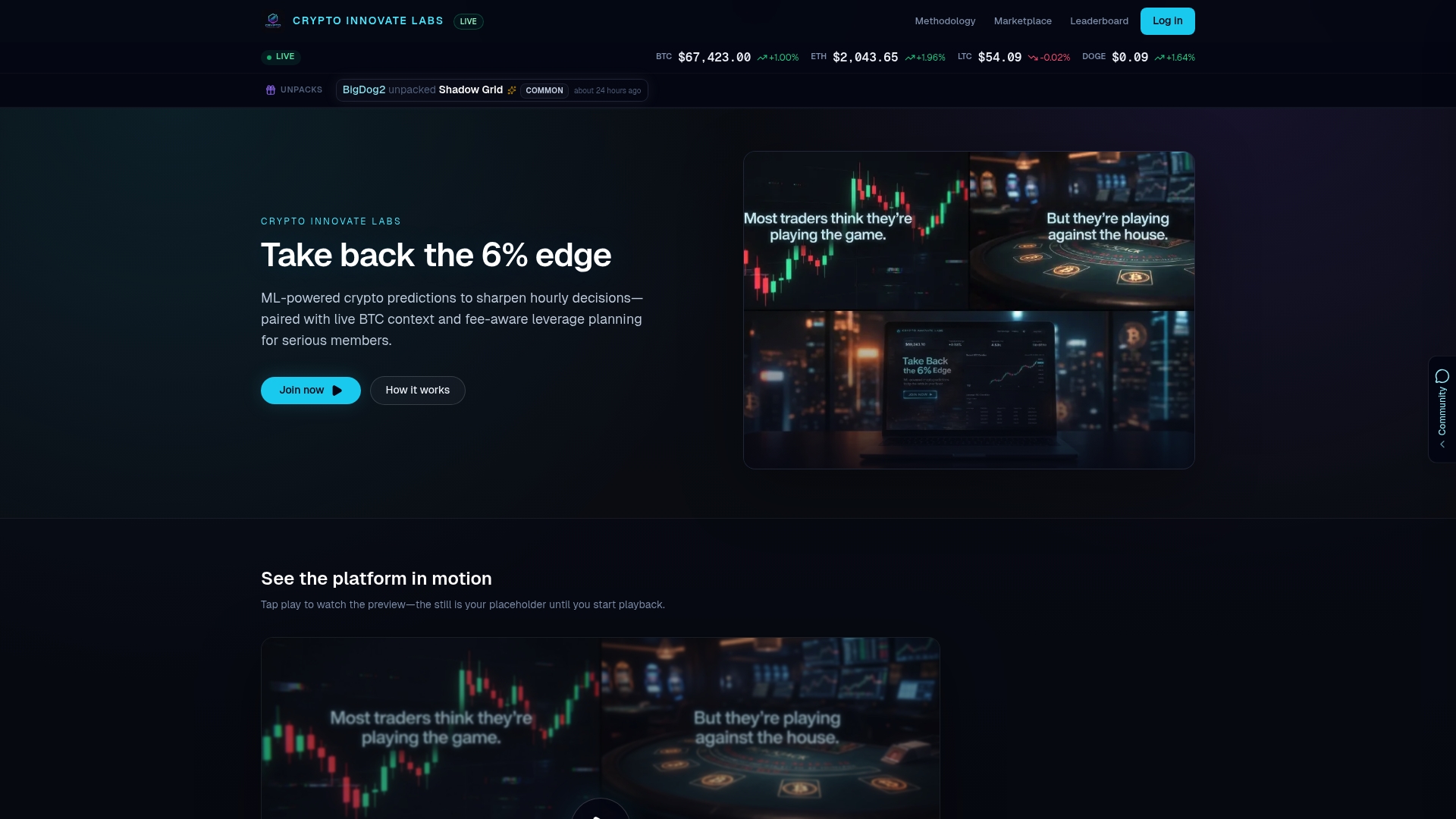
Whether you're a quant building systematic strategies or an active trader looking for smarter market context, our approach is designed to give you an edge that compounds over time. Explore our methodology to see exactly how we combine AI-driven signals with on-chain and technical analysis to surface high-conviction trading opportunities.
Frequently asked questions
What's the difference between technical and fundamental analysis in crypto?
Technical analysis uses price patterns and chart behavior to time trades, while fundamental analysis evaluates a project's real-world value through utility, team quality, and tokenomics. Both answer different questions, making them more powerful when used together.
Are AI/ML-based crypto analysis tools better than classic methods?
AI/ML ensemble models outperform classic or standalone deep learning methods in many benchmarks, especially when combined with technical or on-chain inputs. They aren't a replacement for judgment but a significant amplifier of it.
How do I start using on-chain analysis?
Begin by tracking wallet flows, active addresses, and large exchange transactions using public blockchain explorers. On-chain metrics reveal whale activity and sentiment shifts that often precede price moves by days.
Should I use only one type of analysis for trading?
No. Hybrid approaches yield higher predictive success across real market conditions. Relying on a single method leaves you exposed to its inherent blind spots.
Which analysis type works best for short-term crypto trades?
Technical and on-chain data are the most effective for short-term decisions because they provide fast, actionable signals tied directly to current market behavior and participant activity.