

TL;DR:
- Social signals from online communities significantly influence crypto prices and market psychology.
- Advanced NLP models help filter noise and extract reliable sentiment indicators for trading.
- Proper integration of social sentiment with other data and discipline enhances trading performance.
Crowd-sourced trading signals from social media outperform the CCI30 index and the S&P 500 on risk-adjusted returns. That finding should stop every serious crypto trader in their tracks. For years, most market participants dismissed Twitter rants and Reddit threads as background noise at best and dangerous distractions at worst. But the data tells a very different story. Social signals are now a measurable, quantifiable force that moves prices, shapes market psychology, and can be harnessed for real trading edges. This article breaks down what social signals actually are, how they're measured, how traders apply them, and where they can burn you if you're not careful.
Table of Contents
- What are social signals in crypto and why do they matter?
- How are social signals measured and filtered?
- How social signals impact crypto trading strategies
- Potential pitfalls and psychological traps from social signals
- A smarter approach: How to use social signals with discipline
- Take your crypto insights further with Crypto Innovate Labs
- Frequently asked questions
Key Takeaways
| Point | Details |
|---|---|
| Social signals have real impact | Crowd-based trading recommendations and social sentiment can move crypto prices, especially for smaller coins. |
| Best in bull markets and low-caps | The predictive power of social signals is strongest in bull markets and for mean-reverting, low-cap assets. |
| Rely on context, not hype | Using social sentiment as one input among many—paired with robust analysis—is key to long-term trading success. |
| Beware psychological traps | Influencer reach and herd mentality can lead to overconfidence and risky behavior if not managed carefully. |
What are social signals in crypto and why do they matter?
Social signals in crypto refer to any data generated by online communities that reflects collective sentiment, opinion, or recommendation about a digital asset. Think of them as the aggregated emotional and analytical pulse of the market. They are not the same as insider tips or fundamental research reports. They represent what real people are saying, sharing, and reacting to in real time.
Where do social signals come from?
The major sources are:
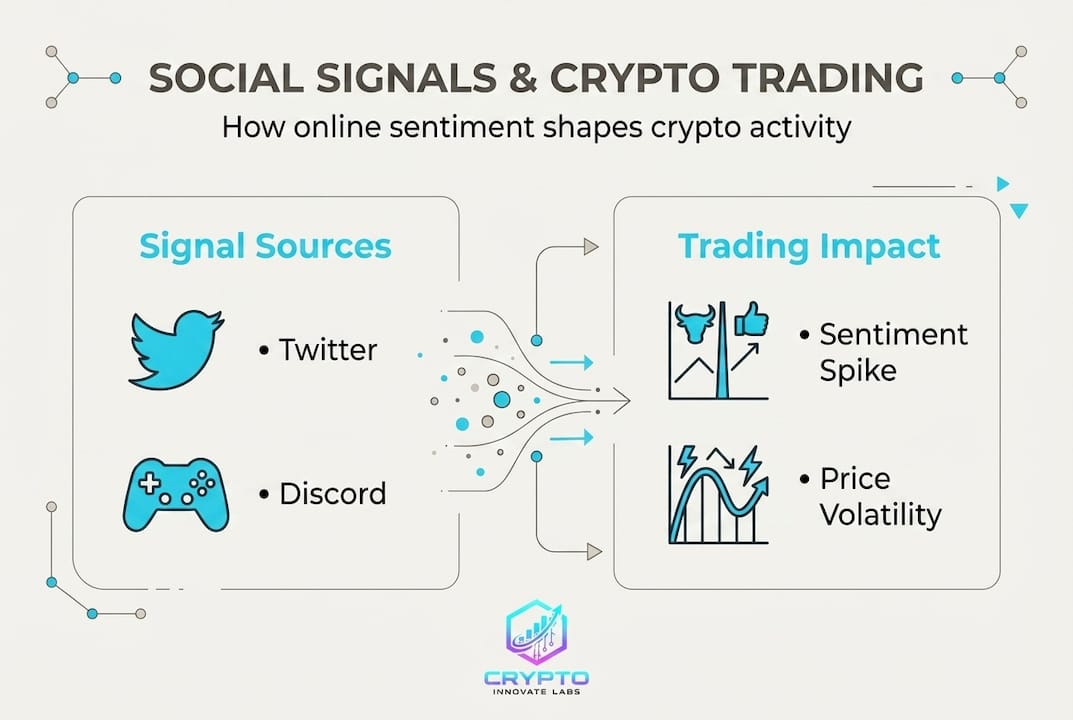
- X (formerly Twitter): High-volume, real-time commentary from retail traders, analysts, and crypto influencers.
- Reddit: Long-form discussions, research posts, and community recommendations on subreddits like r/CryptoCurrency, r/Bitcoin, and dozens of altcoin-specific communities.
- Telegram: Private and semi-private group chats that can move markets for smaller tokens almost instantly.
- Discord: Project-specific servers where community members discuss roadmap updates, partnerships, and speculative price targets.
- Stocktwits: A platform built specifically for financial commentary that bridges traditional and crypto markets.
Each platform carries a different type of signal. Telegram and Discord often surface early sentiment around smaller projects before it reaches wider audiences. Reddit tends to generate more researched opinions that build slowly and sustain longer. X provides the fastest signals but also the most noise.
Why does any of this affect prices? Because crypto, more than almost any other asset class, is sentiment-driven at its core. There are no quarterly earnings reports or dividend announcements to anchor value for most tokens. What drives price is largely what the crowd believes the price should be. When a critical mass of people shifts their sentiment, capital follows. That is the fundamental mechanism behind social signal impact.
Social media sentiment from Twitter, Reddit, Telegram, and Discord strongly correlates with BTC and ETH prices, especially during bull markets. This correlation becomes even more powerful in volatile conditions, when retail traders are actively searching for cues about where to position.
Social signals also affect short-term volatility in a very specific way. A sudden wave of negative posts about a smaller coin, especially if it originates from a high-follower account, can trigger stop-losses, margin calls, and panic selling within hours. The reverse is also true. A coordinated wave of bullish sentiment around an obscure token can create the conditions for a rapid price spike. Understanding the mechanics of crypto market indicators helps contextualize why social data has earned a permanent place in serious market analysis.
Research consistently identifies a 2 to 3 day lag between significant shifts in social sentiment and measurable price movements for major assets like BTC and ETH. This lag creates a window of opportunity for traders who monitor sentiment in advance rather than reacting after the move.
That lag is the key insight. Social signals do not cause an instant price change in most cases. They set the conditions for a move that arrives days later. Traders who understand this dynamic can position ahead of the crowd rather than chasing it.
How are social signals measured and filtered?
With the basics defined, the next step is understanding the techniques used to measure and clean social sentiment for actionable crypto trading signals. Raw social data is essentially useless without sophisticated processing. Volume alone means nothing if the posts are spam, bot-generated, or simply sarcastic.
The core technology behind modern social signal analysis is natural language processing (NLP), a branch of machine learning that teaches models to understand human language. Earlier sentiment models were simple keyword-based systems that tagged "moon" as bullish and "crash" as bearish. Modern approaches are far more sophisticated.
Today's leading models include BERT (Bidirectional Encoder Representations from Transformers) and RoBERTa (a robustly optimized version of BERT). These models capture context, sarcasm, and subtle intent in ways that simple keyword matching cannot. Advanced NLP models like BERT and RoBERTa extract trade signals with over 85% accuracy, and top platforms filter bots while weighting high-influence accounts more heavily.
| Model | Accuracy | Best for | Key strength |
|---|---|---|---|
| BERT | ~83% | General sentiment classification | Bidirectional context understanding |
| RoBERTa | ~87% | Nuanced crypto sentiment | Robustly trained on larger datasets |
| Ensemble models | ~90%+ | Cross-platform signal aggregation | Combines multiple model outputs |
Platforms like Santiment and LunarCrush have built commercial tools around this infrastructure. Santiment tracks on-chain and social metrics simultaneously, giving traders the ability to spot divergences between what people say and what wallets actually do. LunarCrush aggregates social activity across platforms and assigns influence scores to individual accounts, effectively weighting expert voices more than anonymous ones.
Noise filtering is one of the biggest challenges in this space. Bot networks are common in crypto. They artificially inflate engagement metrics, generate misleading volume, and sometimes coordinate to manipulate sentiment around specific tokens. The best platforms address this through account age verification, engagement pattern analysis, and cross-referencing multiple data sources before assigning a signal score.

Pro Tip: Avoid reacting to individual viral tweets, even from big accounts. Use aggregated, filtered sentiment from reputable analytics platforms that have already separated the noise from the genuine crowd signal. Platforms that apply bot filtering and influencer weighting give you data worth acting on. Raw social volume without filtering is more likely to lead you into a trap than a trade.
When you integrate these tools into your workflow, AI crypto trading signals become far more actionable, and predictive analysis for crypto starts to look less like speculation and more like evidence-based decision-making.
How social signals impact crypto trading strategies
Once you understand how social signals are extracted, it's essential to see how they're applied for real-world trading advantages. Knowing that sentiment matters is one thing. Building it into a repeatable trading process is another.
Algorithmic trading systems are often the fastest to react. When a platform like LunarCrush registers a sudden spike in positive mentions for a token, algorithms can execute buy orders in milliseconds. Human traders who try to compete on speed will always lose that race. But humans can compete on interpretation, especially when the signal is complex or contradictory.
The strongest effects from social signals occur in low-cap, mean-reverting assets. Crowd-based trading signals outperform benchmarks most clearly in these environments. The reason is straightforward: large-cap assets like Bitcoin have deeper liquidity, institutional participation, and more diverse information sources, so any single signal is diluted. For a token with a $50 million market cap, a coordinated wave of positive sentiment can represent a genuinely disproportionate demand shock.
Here is a simplified comparison of risk-adjusted performance across strategies:
| Strategy | Sharpe ratio | Benchmark | Notes |
|---|---|---|---|
| Social signal-based strategy | 1.8 to 2.4 | Outperforms both | Best in bull markets, low-cap tokens |
| CCI30 index | 0.9 to 1.2 | Broad crypto index | Diversified but lower risk-adjusted return |
| S&P 500 | 0.7 to 1.0 | Traditional equity | Lower volatility, lower alpha |
These numbers illustrate why institutional and quantitative traders have started taking social sentiment seriously as a systematic input.
How a trader can integrate social signals into their workflow:
- Set up a filtered sentiment dashboard using a platform like Santiment or LunarCrush, focused on the assets you actively trade.
- Establish baseline sentiment levels for each asset so you recognize when current readings are statistically elevated or depressed.
- Look for divergences where sentiment is rising but price has not yet moved, or where price is rising but sentiment is stalling.
- Cross-reference with technical and on-chain data before entering a position. The signal is a trigger for deeper analysis, not a standalone trade thesis.
- Set predefined exit rules that account for sentiment reversal, not just price levels.
The most effective traders treat social signals the way experienced pilots treat weather data: essential input, constantly updated, but never the only factor in a decision. Combining this approach with advanced crypto trading practices and a repertoire of proven crypto trading strategies creates a layered decision framework that is far more robust than any single signal. Access to real-time trading data makes the timing component sharper, particularly when sentiment shifts happen quickly.
Potential pitfalls and psychological traps from social signals
Following the crowd isn't always a winning formula. It's crucial to understand the downsides and psychological risks of chasing social signals.
The most dangerous thing about social signals is not that they're unreliable. It's that they're reliable enough to create overconfidence. When a trading approach works several times in a row, cognitive biases kick in. Traders start to believe they've found a formula that cannot fail. That's when social signals become most dangerous.
Large social audiences can cause overconfidence and excessive risk-taking, which ultimately leads to worse trading performance. The mechanism is subtle but well-documented. When a trader with 500,000 followers posts a bullish thesis, it creates social proof that crowds out independent analysis. People trust the signal not because the underlying logic is sound but because so many other people appear to trust it.
Common traps traders fall into when following social signals:
- Herd behavior: Entering a position simply because everyone else appears to be doing so, without a personal risk assessment.
- FOMO (fear of missing out): Chasing a token after its price has already spiked on positive sentiment, entering at the worst possible moment.
- Overleverage: Taking on excessive position sizes because high sentiment feels like high certainty.
- Trusting follower counts over fundamentals: Assuming a popular influencer's call is well-researched when it often isn't.
- Ignoring the exit: Getting in based on sentiment but having no plan for when the sentiment reverses.
These traps are not signs of stupidity. They are predictable responses to social pressure under uncertainty. Recognizing them in advance is the first step to avoiding them. Solid crypto risk management tips help you stay grounded when social enthusiasm is pulling you toward impulsive decisions.
Pro Tip: Never let social signals be the only reason you enter a trade. Treat them as an alert system that flags opportunities worth investigating, not as trade instructions. Always cross-check with technical analysis, on-chain wallet data, and your broader view of market conditions. The moment you start trading purely on what Twitter says, you've handed your risk management to people who may not care about your portfolio.
Understanding trading psychology in crypto is the real differentiator between traders who use social signals well and those who get burned by them. And applying disciplined crypto risk-reward ratios ensures that even when a social signal trade goes wrong, the loss is manageable rather than catastrophic.
A smarter approach: How to use social signals with discipline
Here is the uncomfortable truth most traders won't say out loud: the majority of people chasing social signals are not trading them. They're reacting to them. There's a fundamental difference. Reacting means you're always last. Trading means you've built a system.
The best use of social signals is as a contrarian filter, not a momentum amplifier. When sentiment reaches extreme levels, whether euphoric or panicked, markets are usually overextended. Extreme fear has historically offered some of the best entry points. Extreme greed has signaled some of the worst. Treating sentiment data as a temperature gauge rather than a direction sign changes everything about how you apply it.
At Crypto Innovate Labs, we've seen consistently that the traders who perform best over time do not have the most sensitive social signal feeds. They have the most disciplined frameworks for integrating those signals with technical, on-chain, and fundamental data. Signal combination is not complicated. It just requires a system and the self-discipline to follow it even when sentiment is screaming at you to do the opposite.
Following advanced trading best practices means resisting the urge to treat any single data source, including social sentiment, as infallible. The traders who last in this market are the ones who stay curious, stay skeptical, and stay systematic.
Take your crypto insights further with Crypto Innovate Labs
If you want to refine your own approach and exploit the quantified edge in social sentiment, Crypto Innovate Labs can help.

At Crypto Innovate Labs, our machine learning platform processes social sentiment alongside technical signals, on-chain metrics, and market structure data to give you a genuinely integrated view of where crypto markets are heading. You get AI-driven alerts, filtered sentiment feeds, and research tools built specifically for traders who want context, not just noise. Explore our advanced analytics methodology to see exactly how we transform raw signal data into actionable intelligence. Ready to put better tools to work? Browse our crypto tools marketplace and find the resources that match your trading style and risk profile.
Frequently asked questions
Do social signals always predict crypto price changes?
Social signals are a strong short-term predictor for some cryptos, but they work best in bull markets and for low-cap assets rather than across all market conditions.
Can relying solely on social signals hurt my trading performance?
Yes. Large social audiences cause overconfidence and often lead to overtrading and worse risk-adjusted outcomes over time.
How fast do social signals affect cryptocurrency prices?
Most price reactions occur with a 2 to 3 day lag after a significant sentiment shift, giving disciplined traders a brief but real window to position ahead of the move.
Are bots and spam a big problem for social signal analysis?
Absolutely. Platforms filter bots and spam to improve accuracy, but raw, unfiltered social data can be dangerously misleading without this processing layer.