
TL;DR:
- Bitcoin's annualized volatility ranges from 45% to 55%, much higher than traditional markets.
- Crypto volatility is driven by speculation, 24/7 trading, low liquidity, leverage, and external shocks.
- Managing volatility involves position sizing, stop-loss placement, and strategic use of tools like DCA and options.
Bitcoin can drop 10% before your morning coffee cools. That single fact separates crypto from virtually every other asset class. Most traders hear "volatility" and picture red portfolios and sleepless nights, but that instinct tells only half the story. Bitcoin's annualized volatility sits between 45% and 55%, dwarfing traditional markets by a wide margin. This guide breaks down what drives those swings, how professional traders measure them, and how you can build a strategy that turns price chaos into calculated opportunity.
Table of Contents
- Understanding crypto volatility: What does it really mean?
- How is crypto volatility measured?
- What causes crypto volatility?
- How to manage and benefit from crypto volatility
- A fresh perspective: Why volatility is crypto's defining challenge—and opportunity
- Ready to put your crypto volatility knowledge into action?
- Frequently asked questions
Key Takeaways
| Point | Details |
|---|---|
| Crypto volatility is extreme | Crypto asset prices often swing more in a day than stocks do in a month, making risk exposure unique. |
| Opportunities for traders | Properly managed, volatility can enable outsized returns and strategies unavailable in calmer markets. |
| Risk management is vital | Tools like DCA, stop-losses, and position sizing help protect your capital from dramatic swings. |
| Volatility works both ways | It can amplify losses as well as gains, so preparation and discipline are as important as market knowledge. |
Understanding crypto volatility: What does it really mean?
Volatility, in its simplest form, is a statistical measure of how much an asset's price moves over time. Technically, it's the standard deviation of returns over a set period. The higher the number, the wider the price swings.
For crypto, those swings are extraordinary. Bitcoin's volatility routinely runs 45% to 55% on an annualized basis, compared to the S&P 500's typical 15% to 20%. That means Bitcoin can move in a single week what the broad stock market might move in an entire quarter. Altcoins are often even more extreme.
Here's why that matters to you as a trader:
- Higher volatility = higher potential returns. A 20% swing creates real profit opportunities that simply don't exist in slower markets.
- Higher volatility = higher risk. The same swing that builds a portfolio in hours can erase it just as fast.
- Volatility is not random noise. It follows patterns, responds to triggers, and can be anticipated with the right tools.
- Active traders and long-term holders experience volatility very differently. Day traders chase it. HODLers absorb it.
The nuanced reality is that crypto's volatility represents both greater risk and, for disciplined traders, the potential for significant reward. The traders who understand this dual nature are the ones who stop reacting emotionally and start building systems.
"Volatility is a feature, not a bug. It's what makes active trading in crypto genuinely worthwhile compared to sitting in index funds." — A sentiment echoed by seasoned crypto market practitioners who understand crypto risk-reward ratios at a structural level.
The key takeaway: volatility is not something to fear or ignore. It's a variable to measure, monitor, and build around. The first step is knowing how to quantify it.
How is crypto volatility measured?
With a grasp of what volatility means, it's important to understand how traders and analysts actually measure it. Two primary methods dominate the conversation: historical (realized) volatility and implied volatility.
Historical volatility looks backward. It calculates the standard deviation of returns over a defined window, typically 7, 30, or 90 days. It tells you how wild the market actually was.
Implied volatility looks forward. It's derived from options pricing and reflects what the market expects future volatility to be. For crypto, platforms like Deribit publish the DVOL index, while the CME offers BVX for Bitcoin futures. These work similarly to the VIX in equity markets.

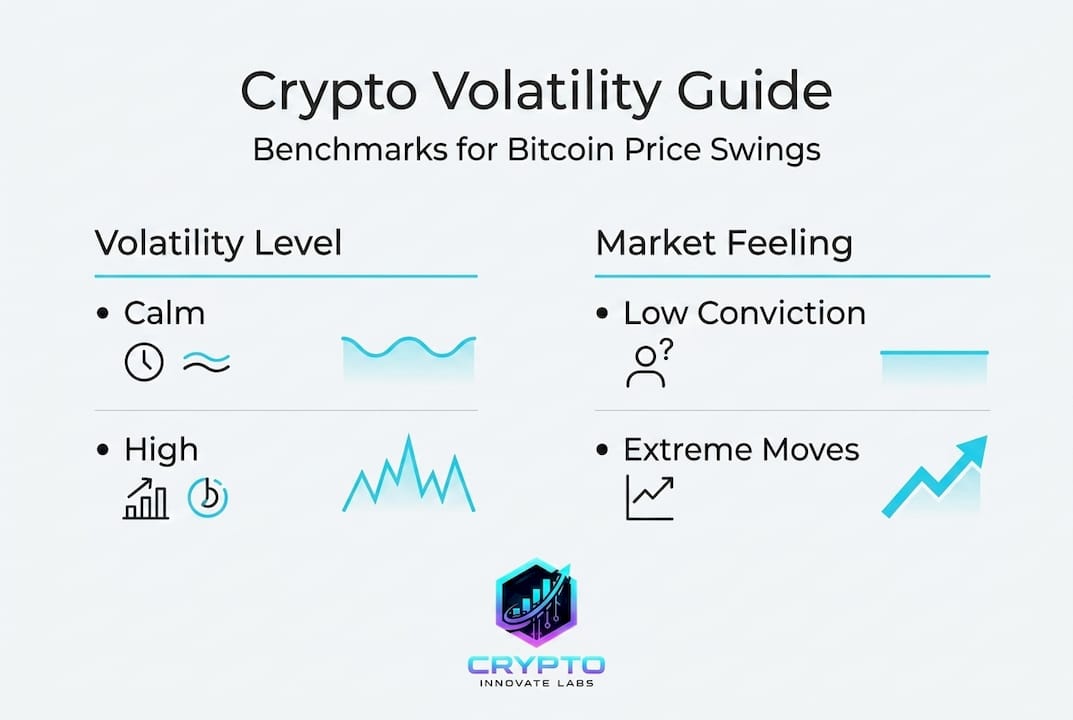
Here's a quick reference for Bitcoin volatility benchmarks traders use in 2026:
| Volatility Level | Annualized Range | Market Feeling |
|---|---|---|
| Calm | Below 30% | Consolidation, low conviction |
| Moderate | 30% to 50% | Normal trending activity |
| High | 50% to 80% | Strong momentum, higher risk |
| Extreme | Above 80% | Capitulation or blow-off tops |
Knowing where Bitcoin's current volatility sits within these benchmarks instantly changes how you size positions and set targets. For real-time data on volatility, you need live feeds rather than lagging weekly reports.
Pro Tip: If you're a short-term trader, focus on 7-day realized volatility to calibrate stop-loss distances. If you're managing a longer-term position, track 30-day realized volatility against the DVOL implied reading. A rising gap between implied and realized often signals that a big move is coming. Pairing this with crypto market indicators gives you much stronger context for timing entries and exits.
What causes crypto volatility?
Knowing how volatility is measured, let's explore what actually drives crypto prices to swing so violently. The causes aren't random. They're structural, behavioral, and often interconnected.
Crypto's volatility is driven by a combination of speculation, 24/7 global trading, low liquidity, leverage, and external shocks. Here's how each one plays out:
- Speculation and herding behavior. Retail investors pile in during bull runs and panic sell during downturns. FOMO and fear drive outsized moves that fundamentals don't justify.
- 24/7 global market access. Unlike stocks, crypto never closes. A regulatory headline dropping at 2 a.m. EST hits an illiquid market with full force, amplifying the reaction.
- Thin liquidity in altcoins. Outside Bitcoin and Ethereum, order books are shallow. A moderately large sell order can drop a coin's price by 15% in minutes.
- Leverage and margin trading. Exchanges routinely offer 10x, 20x, or even 100x leverage. When prices move against leveraged positions, forced liquidations cascade, creating price waterfalls.
- Regulatory and macro shocks. A single government announcement, ETF approval, or central bank statement can move the entire market within seconds.
Stat to know: Negative price jumps in crypto are both more frequent and more severe than in traditional assets, meaning the downside volatility is structurally harder to manage than upside momentum.
The market signals that precede sharp moves are often visible to those tracking on-chain data, funding rates, and open interest. Most retail traders miss them because they're watching price alone.
Pro Tip: Monitor exchange funding rates in real time. Extremely positive funding means the market is overleveraged long. That's often a warning sign that a correction is imminent, not a reason to add more exposure.
How to manage and benefit from crypto volatility
Understanding the causes of volatility, here's how you can protect yourself and even profit from price swings. Effective volatility management isn't about avoiding risk. It's about sizing it correctly and timing your responses well.
Here's a comparison of the most practical strategies for different market conditions:
| Strategy | Best Market Condition | Risk Level |
|---|---|---|
| Dollar-cost averaging (DCA) | All markets, especially bear | Low |
| Stop-loss orders | High volatility, trending | Low to moderate |
| Options hedging | Pre-event, uncertain | Moderate |
| Grid bots | Sideways, ranging markets | Moderate |
| HODLing | Long-term bull conviction | Variable |
Recommended tools include DCA, position sizing between 5% and 15% per trade, stop-losses, HODLing for long-term conviction, options hedging, and volatility-specific strategies like grid trading.
Here's a step-by-step framework for incorporating volatility management into your trading plan:
- Define your volatility tolerance first. Decide before you enter how much of your account you're willing to lose on any single trade. 2% per position is a standard institutional starting point.
- Size positions based on current volatility, not habit. When Bitcoin's realized volatility spikes above 70%, cut position sizes. Larger swings require smaller bets to maintain the same risk exposure.
- Set stop-losses before entering, not after. Place stops at technical levels, not round numbers. The market does not respect emotional price points.
- Use DCA during drawdowns rather than lump-sum entries. Spreading entries reduces the psychological and financial impact of catching a falling knife.
- Review and rebalance weekly. Volatility regimes change fast. What worked in a low-volatility week may be disastrous in a high-volatility one.
Risk management tips from experienced practitioners consistently point to overexposure as the single biggest mistake retail traders make. The second biggest? Abandoning a plan mid-trade because of trading psychology failures under pressure.
Pro Tip: Never allocate more than 15% of your portfolio to any single position, regardless of conviction. Volatility being a feature for traders only holds true with strict risk management in place. Without it, the same volatility becomes your biggest liability. Explore a range of crypto trading strategies to find which approach fits your risk profile best.
A fresh perspective: Why volatility is crypto's defining challenge—and opportunity
Now that you have tools to manage volatility, here's a perspective few traders consider about what makes this market truly different.
Most traders treat volatility as something to survive. The better mental model is treating it as inventory. When volatility is high, opportunity is abundant. When it's low, the market is quiet and fewer edges exist. The traders who "play it safe" by sitting out volatile periods often miss the exact windows that generate the majority of annual returns.
Here's the uncomfortable truth: Sharpe ratios for crypto can reach 1.8 compared to stocks at 0.9, meaning that when you account for the risk taken, crypto has historically outperformed during volatile periods for disciplined participants. The edge isn't avoiding volatility. It's creating asymmetric setups where your upside meaningfully exceeds your defined downside.
Emotional reactions to swings are the real performance killer. A trader who sells panic and buys euphoria will consistently underperform someone who does the opposite with smaller positions. Advanced trading strategies are almost always about controlling emotional responses as much as they are about technical setups.
Volatility is ultimately a test of your preparation and discipline. Those who walk in with a plan, defined limits, and calibrated expectations treat volatility as an engine. Everyone else experiences it as weather.
Ready to put your crypto volatility knowledge into action?
Understanding volatility theory is one thing. Applying it in a live market with real capital is another. At Crypto Innovate Labs, our machine learning platform gives you the tools to monitor volatility regimes, receive AI-driven signals, and back your strategy with real-time market intelligence.

If you want to see exactly how we approach market analysis, the Crypto Innovate Labs methodology page walks through our full signal framework. Ready to put specific strategies to work? Explore our crypto strategy marketplace to find approaches built for different volatility environments. Smarter decisions start with better data, and that's precisely what we're built to provide.
Frequently asked questions
Is high crypto volatility always bad for investors?
No. Volatility drives both losses and outperformance depending on your strategy, with disciplined investors using price swings to accumulate or profit.
How does crypto volatility compare to stocks?
Bitcoin averages 45% to 55% annualized volatility versus the S&P 500's 15% to 20%, making crypto two to three times more volatile than major stock indices.
What is the best way to minimize losses during high volatility?
DCA, position sizing, stop-losses, and options hedging are proven tools. Limiting any single position to 5% to 15% of your portfolio is a practical starting point.
Why are crypto price swings so extreme?
Speculation, leverage, and external events cause more frequent and severe negative jumps in crypto than traditional markets, amplified by thin liquidity and a market that never closes.
Can you profit directly from volatility?
Yes. Strategies like grid bots generate returns of 12% to 34% monthly in high-volatility environments by buying and selling within preset price ranges automatically.