
TL;DR:
- Crypto swing trading captures medium-term price moves over several days to weeks with a focus on risk management.
- It relies on technical analysis tools like moving averages, RSI, and chart patterns to identify high-probability setups.
- Success emphasizes discipline, systematic review, and leveraging AI signals for better timing and decision-making.
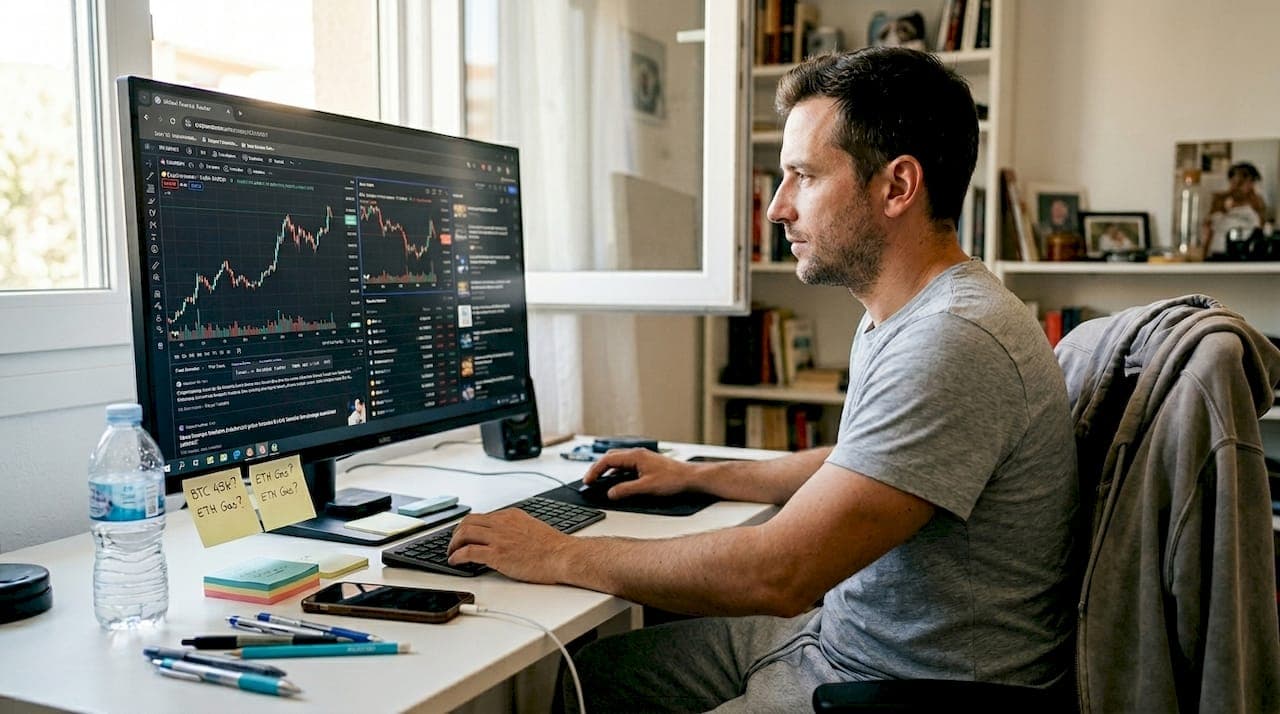
Most crypto traders assume there are only two modes: staring at charts all day or buying and forgetting. That false binary causes a lot of missed opportunities. Swing trading lives between those extremes, targeting price moves over several days to a few weeks rather than seconds or years. It's not passive, but it's also not a second job. When you layer in AI-driven signals and systematic risk control, swing trading becomes one of the most practical strategies for traders who want real returns without burning out. This article breaks down exactly how it works, what tools you need, and how to avoid the traps most guides never mention.
Table of Contents
- Understanding crypto swing trading
- How crypto swing trading works: Tools and tactics
- Swing trading vs other crypto strategies: What sets it apart?
- Common challenges and AI-powered solutions in crypto swing trading
- A realistic perspective: What most crypto swing trading guides miss
- Take your crypto swing trading to the next level
- Frequently asked questions
Key Takeaways
| Point | Details |
|---|---|
| Medium-term opportunity | Crypto swing trading aims to capture price moves over several days to weeks, making it accessible for part-time traders. |
| Core strategy essentials | Success relies on technical analysis tools, disciplined entries and exits, and proper risk management. |
| AI can enhance returns | AI-powered tools can improve signals and automate parts of swing trading, but human oversight and journaling are irreplaceable. |
| Balanced vs other styles | Swing trading offers a balance of risk, effort, and reward compared to day trading or passive HODLing. |
| Mindset and adaptability | Profitable swing traders adapt strategies, review trades, and keep emotions in check for consistent results. |
Understanding crypto swing trading
Let's start with a clean definition. Crypto swing trading is a medium-term trading strategy that aims to capture price swings or movements in cryptocurrency prices over a period of several days to a few weeks. The goal is not to catch every tick. The goal is to identify a high-probability move, ride it, and exit before the trend exhausts itself.
The typical hold time for a swing trade runs from 2 to 14 days. That window is long enough to let meaningful price moves develop, but short enough to avoid the brutal multi-month drawdowns that passive holders endure. Profit targets usually sit in the 10-30% price move range, which is realistic given how volatile most major cryptocurrencies are.
Who is this for? Swing trading is built for traders who:
- Have a full-time job or other commitments and can't monitor charts every hour
- Want more active control than HODLing but less stress than day trading
- Are comfortable reading basic charts and setting conditional orders
- Prefer a strategy grounded in technical structure, not speculation
It's worth noting what swing trading is not. It's not scalping. It's not position trading. It sits in a distinct category within the broader world of crypto trading strategies, and understanding that distinction matters before you put capital at risk.
Here's a quick breakdown of how swing trading compares across key dimensions:
| Dimension | Swing trading | Day trading | HODLing |
|---|---|---|---|
| Hold time | 2-14 days | Minutes to hours | Months to years |
| Profit target | 10-30% per trade | 0.5-5% per trade | 100-1000%+ |
| Time commitment | Low to moderate | Very high | Minimal |
| Stress level | Moderate | High | Low (until crash) |
| Requires TA skills | Yes | Yes | No |
As the Binance swing trading guide points out, the strategy is particularly well-suited to crypto because the asset class naturally produces volatile, multi-day price swings driven by news cycles, on-chain activity, and macro sentiment shifts. That volatility, which scares away casual investors, is actually the fuel swing traders depend on.
"The best swing trades happen at the intersection of a clear trend, a clean pullback, and a defined risk level. Without all three, you're not trading a setup, you're trading a guess."
How crypto swing trading works: Tools and tactics
Knowing what swing trading is only gets you halfway. The real edge comes from knowing how to execute it consistently. The mechanics involve technical analysis using tools like moving averages, RSI, MACD, support and resistance levels, chart patterns such as flags, triangles, and head-and-shoulders formations, and candlesticks to identify entry and exit points.
Here's a practical sequence for setting up a swing trade:
- Identify the trend. Use the 50-day and 200-day moving averages to confirm the broader direction. Only take trades aligned with the dominant trend.
- Wait for a pullback. In an uptrend, price will dip toward a support zone or moving average. That's your entry window, not the breakout itself.
- Confirm with momentum indicators. Check the RSI for oversold conditions and MACD for a bullish crossover before committing.
- Set your stop-loss. Risk no more than 1-2% of your total account per trade. Place your stop just below the key support level.
- Define your take-profit target. Aim for a risk-to-reward ratio of at least 1:2. If your stop risks $100, your target should be at least $200 in potential gain.
- Exit on strength. Don't get greedy near resistance zones. A partial exit locks in profit while letting the rest run.
Your technical analysis guide is only as good as the risk rules you apply to it. Refer to solid crypto risk management tips to build a system that survives losing streaks without wiping out your account.

According to Investopedia's swing trading overview, the discipline of defining risk before entering a trade is what separates consistent swing traders from impulsive ones. That principle holds especially true in crypto, where a single news event can move a coin 20% in either direction within hours.
Pro Tip: Run every trade setup through backtesting before going live. If a setup would have failed repeatedly in past data, reduce your size or skip it. Keep a trading journal that logs your entry reason, outcome, and emotional state. Patterns in your own behavior are often more valuable than any indicator.
For more on building a disciplined process, check out how to maximize trading returns with structured, repeatable approaches.
Swing trading vs other crypto strategies: What sets it apart?
Every trading style has a place, but choosing the wrong one for your personality and schedule is a fast path to losses. Here's how swing trading stacks up against the two most common alternatives.
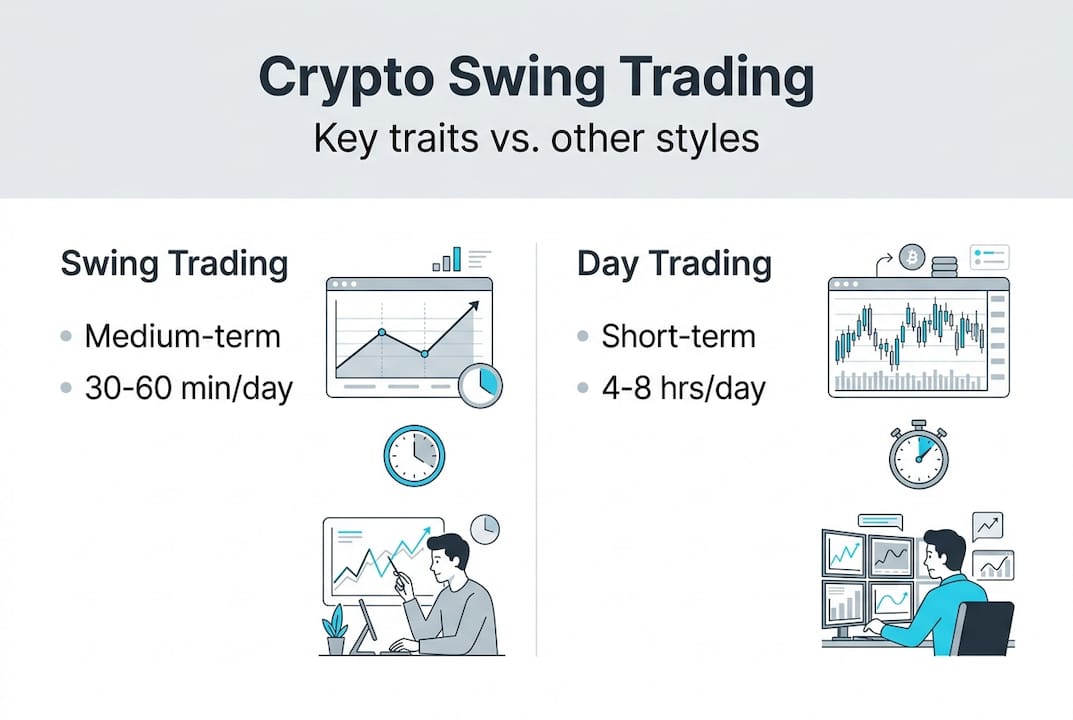
| Factor | Swing trading | Day trading | HODLing |
|---|---|---|---|
| Daily screen time | 30-60 min | 4-8+ hours | Near zero |
| Drawdown exposure | Moderate | Low per session | Very high |
| Emotional stress | Moderate | Very high | Low initially |
| Profit frequency | Weekly | Daily | Annually |
| Skill required | Intermediate | Advanced | Minimal |
As research on swing vs day trading confirms, day trading demands intraday attention, high time commitment, and usually delivers lower profit per individual trade. HODLing, on the other hand, exposes you to full volatility with no active defense. Swing trading balances activity and patience, making it a natural fit for part-time traders.
So who should pick which style? Use crypto trading signals to understand your market context, but use the list below to understand yourself:
- Choose swing trading if you have 30 to 90 minutes per day, can read basic charts, and want active but manageable exposure
- Choose day trading if you have 6+ hours daily, advanced TA skills, and strong emotional discipline
- Choose HODLing if you believe in a project's long-term fundamentals and don't want to actively manage positions
- Avoid day trading if you have a full-time job or struggle with impulsive decisions under pressure
According to Investopedia's swing trading definition, many retail traders who attempt day trading end up losing money faster due to overtrading and emotional decision-making. Swing trading's longer time frames naturally filter out noise and reduce the number of decisions you have to make each day.
Common challenges and AI-powered solutions in crypto swing trading
Now for the part most guides skip. Swing trading in crypto is not just a cleaner version of swing trading in stocks. It comes with specific edge cases that can wreck unprepared traders.
Crypto markets run 24 hours, 7 days a week, which means weekend gaps, sudden volatility spikes from off-hours news, and correlated drawdowns across multiple positions can all happen while you're asleep. Higher volatility suits swings but also increases the chance of a stop being triggered prematurely by a wick rather than a genuine trend reversal.
Other common pitfalls include:
- False breakouts. Price breaks above resistance, triggers your entry, then reverses sharply. Multiple confirmations before entry are essential.
- News risk. A major protocol hack, regulatory announcement, or exchange collapse can invalidate any technical setup instantly.
- Overconfidence in a hot streak. A few wins in a row leads to oversized positions and poor risk management.
- Correlation blindness. Holding five altcoin positions thinking you're diversified, when they all drop together during a Bitcoin correction.
This is where AI crypto benefits become genuinely practical. AI-driven platforms can scan hundreds of assets simultaneously, flag setups that meet your criteria, and send alerts the moment conditions change. That removes the need to stare at screens and reduces emotional, impulsive decisions.
But as Binance's guide emphasizes, AI can enhance via signals and automation, but the core foundation is still technical analysis discipline. AI doesn't replace your system. It amplifies it.
Proper crypto risk-reward ratios are the backbone of any sustainable approach, and trading psychology is where most traders actually break down. Even the best setup fails if you move your stop-loss when the trade goes against you.
Research from crypto strategy analysis consistently shows that systematic, rules-based approaches outperform discretionary trading over the long run. Using real-time data for trading decisions significantly sharpens those rules-based approaches in fast-moving markets.
Pro Tip: Before entering any trade, ask yourself: "Do I have at least two independent signals confirming this setup?" If the answer is no, step back. Journal the trade idea anyway and revisit it. This habit alone eliminates a huge percentage of low-quality entries.
"The market rewards those who wait for alignment, not those who force entries out of impatience."
A realistic perspective: What most crypto swing trading guides miss
Here's the uncomfortable truth we see traders ignore constantly. Most guides focus on the strategy and forget the operator. You can have a technically sound swing trading system and still lose money consistently if your psychology and review habits are weak.
Success in swing trading is built on risk control first, not on finding the perfect entry signal. Traders who obsess over predicting the next big move almost always underperform traders who obsess over limiting losses and staying consistent. Chasing calls from social media or following someone else's alerts without a personal framework is a recipe for confusion and losses.
No strategy works all the time. Markets shift regimes. A setup that performed brilliantly in a trending market will bleed you dry in a choppy, sideways market. Systematic journaling and willingness to adapt are what keep a trader viable across different market conditions.
AI tools like ours help filter noise and sharpen timing, but they don't replace judgment. The traders who get the most out of AI-driven platforms are those who already understand the mechanics, use the tools to confirm rather than replace their thinking, and review their performance weekly. If you want to build that foundation, start by studying top crypto trading strategies with a critical eye and developing your own rules from there.
Take your crypto swing trading to the next level
Swing trading rewards preparation, discipline, and the right data at the right time. You now have the framework. The next step is putting it into practice with tools built for serious traders.
At Crypto Innovate Labs, we build AI-powered market intelligence specifically for traders who want more signal and less noise. Our proven trading methodology combines machine learning models, predictive signals, and real-time market context so your swing trade setups are grounded in data, not guesswork. Explore our crypto marketplace to access tools, research, and resources designed to give you a genuine edge in fast-moving crypto markets. Smarter swing trading starts with better information.
Frequently asked questions
How long do crypto swing trades typically last?
Most crypto swing trades last from 2 to 14 days, depending on price action and trader preference. The hold time is intentionally flexible to allow a trade to develop without overstaying its welcome.
What tools do swing traders use in crypto?
Essential tools include moving averages, RSI, MACD, chart patterns, and candlestick analysis to spot entry and exit points. These indicators work together to build a complete picture of momentum and trend direction.
Is swing trading less risky than day trading in crypto?
Swing trading generally carries lower moment-to-moment stress than day trading, and swing balances activity and patience in a way that suits part-time traders. That said, overnight and weekend exposure means risk is never zero.
Can AI improve the results of swing trading crypto?
Yes. AI enhances via signals and automation, but the core foundation remains technical analysis discipline. Traders who use AI to confirm setups rather than replace their thinking tend to get the best results.