
TL;DR:
- Crypto trading timing benefits from focusing on high-liquidity sessions, especially the London-New York overlap.
- Using multiple signals like RSI, MACD, volume, and AI alerts together improves trade confidence.
- Relying solely on perfect timing is less effective than consistent processes like dollar-cost averaging and disciplined risk management.
Crypto markets never sleep, and that's exactly what makes timing so brutal. A trade placed an hour too late can mean the difference between a 15% gain and a painful loss, yet most traders are still relying on gut instinct or outdated frameworks to decide when to enter and exit. The 24/7 nature of crypto creates both opportunity and chaos, and without a structured approach, even solid strategies fall apart at the execution layer. This guide walks you through how to read market cycles, build a precision timing toolkit, and use AI-driven signals to make more confident, better-timed trades.
Table of Contents
- Understand market cycles and timing fundamentals
- Tools and signals: Setting up your timing toolkit
- Step-by-step: How to time your trade entries and exits
- Common pitfalls and smarter alternatives to timing perfection
- Why timing is overrated: The uncomfortable truth about crypto trading
- Unlock smarter trading with Crypto Innovate Labs
- Frequently asked questions
Key Takeaways
| Point | Details |
|---|---|
| Market timing windows | Trading during London-New York overlap offers the best liquidity for crypto trades. |
| AI signals as aids | AI and technical signals can improve timing but are not 100% reliable. |
| DCA vs. timing | Dollar-cost averaging often outperforms precise market timing for most investors. |
| Avoid perfectionism | Trying to perfectly time markets leads to higher losses and stress. |
| Process over prediction | A disciplined strategy and adaptability win over chasing exact entry and exit points. |
Understand market cycles and timing fundamentals
Every crypto trader hears "buy low, sell high," but few talk about when those highs and lows actually happen with any predictability. Crypto markets run around the clock, but volume and volatility are not evenly distributed across those 24 hours. Understanding where activity concentrates is the first step toward better timing.
Three terms you need to know upfront:
- Market cycle: The recurring pattern of accumulation, uptrend, distribution, and downtrend that assets move through over time.
- Volatility: The speed and size of price movements. High volatility means bigger swings, more risk, and more opportunity.
- Liquidity: How easily you can buy or sell at a stable price. High liquidity means tighter spreads and less slippage.
Slippage, by the way, is what happens when the price you expect and the price you actually get diverge because there aren't enough orders at your target level. In low-liquidity conditions, slippage eats into your returns fast.
So when does liquidity peak? Optimal trading times align with the London-New York session overlap, roughly 13:00 to 17:00 UTC. During this window, two of the world's largest financial centers are both active, institutional volume spikes, and price action becomes both more decisive and more responsive to signals.
Here's how major trading sessions compare:
| Session | UTC Hours | Liquidity Level | Volatility Level |
|---|---|---|---|
| Asian (Tokyo) | 00:00 - 09:00 | Low to Moderate | Low |
| London | 08:00 - 17:00 | High | Moderate to High |
| New York | 13:00 - 22:00 | High | High |
| London-New York overlap | 13:00 - 17:00 | Highest | Highest |
Missing the overlap doesn't mean you can't trade, but it does mean you're working with thinner order books, wider spreads, and noisier signals. For those learning profitable trading strategies, aligning entries with high-liquidity windows is one of the lowest-effort, highest-impact adjustments you can make.
Key timing principles to anchor your process:
- Trade with the dominant session, not against it.
- Avoid major entries in the 22:00 to 00:00 UTC dead zone when volume collapses.
- Monitor session opens for breakout opportunities driven by fresh institutional activity.
- Factor in macro events, central bank announcements, and on-chain data releases that often coincide with New York hours.
Building timing awareness around these cycles gives your technical signals a much stronger foundation to work from.
Tools and signals: Setting up your timing toolkit
Now that you've explored the fundamental market rhythms, let's look at what tools and signals you need to execute precise timing.
Timing without tools is guesswork. The goal here is to layer multiple data sources so that your entries and exits are backed by convergent evidence, not just one indicator flashing green.
Core tools every timing-focused trader needs:
- RSI (Relative Strength Index): Measures whether an asset is overbought or oversold on a scale of 0 to 100. Readings above 70 suggest overbought; below 30 suggests oversold.
- MACD (Moving Average Convergence Divergence): Tracks momentum by comparing two moving averages. Crossovers signal potential trend shifts.
- Order book analysis: Shows real-time buy and sell pressure. Large buy walls near support can confirm timing decisions.
- Volume profile: Reveals where the most trading activity has occurred historically, helping identify high-value price zones.
- AI signal platforms: Aggregate technical, on-chain, and sentiment data into actionable alerts.
AI signals utilize RSI, MACD, on-chain data, and market sentiment to deliver actionable buy/sell direction, each with their own noted pros and cons depending on market conditions.
Manual vs. automated timing setups:
| Setup Type | Strengths | Limitations |
|---|---|---|
| Manual (TA-based) | Full control, flexible | Time-intensive, emotion-prone |
| Semi-automated (alerts) | Balanced, lower workload | Still requires manual confirmation |
| Fully automated (AI bots) | Fast execution, 24/7 coverage | Requires monitoring, algorithm risk |
For most active traders, a semi-automated approach works best. You get the speed of AI-powered trading signals without handing over full control to a system that can't always read context.
Pro Tip: Don't rely on a single indicator. The strongest timing signals appear when RSI, MACD, session timing, and volume all align. When three or more of these key market indicators point in the same direction, your confidence in a trade should rise significantly.
Your timing toolkit checklist:
- RSI and MACD configured on your primary charting platform
- Session clock showing UTC time at all times
- Order book depth feed for your key trading pairs
- AI signal subscription or alert system
- News and sentiment aggregator for macro event tracking
Building this toolkit doesn't have to be expensive. Many platforms offer free versions of these tools. What matters is that you actually use them in a consistent, disciplined way before every trade.
Step-by-step: How to time your trade entries and exits
With an arsenal of tools at your disposal, here's how you can apply them in a structured, repeatable process for both entries and exits.
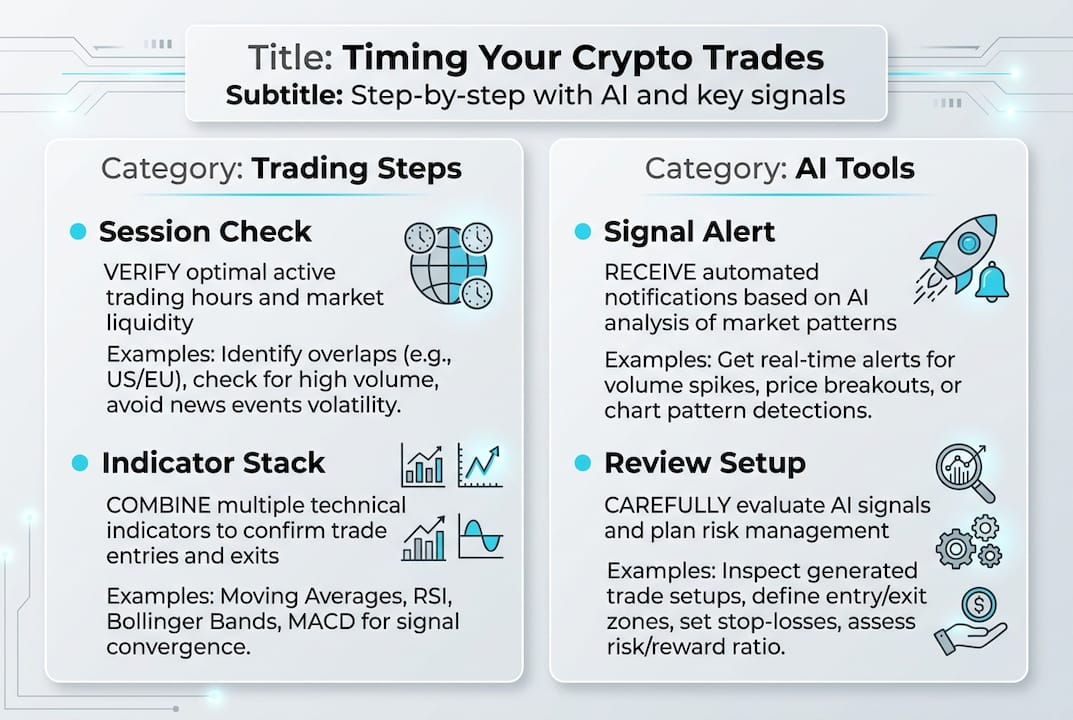
Step 1: Pre-trade session check. Before you even look at a chart, confirm which session is active and whether you're inside a high-liquidity window. If you're outside the London-New York overlap, raise your evidence bar before entering.

Step 2: Run your indicator stack. Check RSI for overbought or oversold conditions, review the MACD for momentum direction, and scan volume for confirmation. Look for agreement, not contradiction, across your indicators.
Step 3: Layer in your AI signal. If your platform has issued a directional signal for your target asset, cross-reference it with your manual TA. Agreement between AI output and your own read is a strong green light.
Step 4: Identify your SL/TP levels. Before entering, define your stop-loss (SL) and take-profit (TP) levels. Base SL on the nearest significant support or resistance zone. Set TP at a realistic target informed by recent volatility, not wishful thinking.
Step 5: Execute and document. Place the trade. Record your entry rationale, the signals that aligned, and the session context. This log becomes your feedback system over time.
Critical note on AI accuracy: AI predictive signals offer 55 to 65% directional accuracy on average, but limitations include overfitting to historical data and vulnerability to black swan events. Never treat any signal as a guarantee.
A practical example: You spot Bitcoin showing RSI near 38 during the London open. MACD is crossing bullish. Your AI platform issues a buy alert. You're inside the London session and approaching the New York overlap. This is a high-confidence setup. You enter with a SL below the recent swing low and a TP at the next resistance zone.
For a deeper look at how to apply predictive analysis techniques, the key is repeating this process consistently, not just when conditions feel perfect.
Pro Tip: Avoid trading the first 15 minutes of any session open. Price action is often erratic as orders flood in. Let the market settle, then act on the confirmed direction.
Common pitfalls and smarter alternatives to timing perfection
Even when your process is sound, it's important to understand the limits and pitfalls of trade timing, and what to do instead.
The most dangerous belief in crypto trading is that you can consistently call exact tops and bottoms. Spoiler: you can't, and neither can any algorithm. Perfectly timing the market is impossible, and research shows that dollar-cost averaging (DCA) has outperformed market timing while reducing volatility and drawdown over multiple years.
Strategy performance comparison:
| Strategy | Consistency | Stress Level | Suited For |
|---|---|---|---|
| Perfect timing | Very low | Very high | Almost nobody |
| Lump-sum investing | Moderate | Low | Long-term holders |
| DCA | High | Low | Most traders/investors |
| Signal-assisted timing | Moderate to high | Moderate | Active, disciplined traders |
DCA means investing a fixed amount at regular intervals regardless of price. It eliminates the pressure of finding the perfect entry and naturally averages your cost basis over time. For volatile assets like crypto, this approach is often more practical than obsessing over the exact moment to buy.
Common timing mistakes and smarter alternatives:
- Chasing green candles: Buying after a big run-up because of FOMO. Alternative: Wait for pullbacks to key support levels before entering.
- Ignoring session context: Placing trades during dead-zone hours and getting filled at poor prices. Alternative: Only execute during high-liquidity windows.
- Moving SL too early: Widening your stop-loss after a trade moves against you. Alternative: Commit to your SL before entering and honor it.
- Over-optimizing backtests: Building a strategy that performs perfectly on historical data but fails live. Alternative: Focus on robust, simple rules.
Solid crypto risk management and understanding the AI-driven investment benefits available today can help you build a process that holds up even when your timing isn't perfect. Pair this with trading best practices and you'll spend far less time chasing phantom entries.
Why timing is overrated: The uncomfortable truth about crypto trading
Here's a take you probably won't hear from most trading content: obsessing over timing is often what keeps traders from ever becoming consistently profitable.
We've watched traders spend hundreds of hours backtesting the perfect entry window, only to blow their risk rules the moment a trade goes against them. The timing was right. The discipline wasn't. That's the real problem.
AI tools are genuinely powerful, and understanding session dynamics matters. But the traders who last in this market are the ones who accept that no signal, AI or otherwise, removes uncertainty. What they've built instead is a process they trust: one that accounts for being wrong, adapts to new conditions, and doesn't rely on catching every perfect move.
Accessing real-time market data helps you stay informed and reactive, but the edge comes from what you do with that information consistently, not occasionally. The traders who try to time every candle burn out or blow up. The ones who show up with a clear framework, reasonable risk, and the patience to let setups develop, those are the ones still trading three years later.
Timing is a tool. Discipline is the strategy.
Unlock smarter trading with Crypto Innovate Labs
Ready to put this knowledge to work? Here's how you can take the next step.
At Crypto Innovate Labs, we've built a platform designed specifically for traders who want more than just price charts. Our tools give you AI-powered market intelligence, real-time signals, and the context you need to act with confidence.
Explore our proven methodology to see exactly how our signals are generated and what makes them trustworthy. Then browse our AI-driven trading marketplace to find the tools, strategies, and resources that match your trading style. Whether you're refining your session timing or building a full signal-based framework, we have what you need to trade smarter in 2026.
Frequently asked questions
What is the best time to trade cryptocurrency?
The London-New York overlap, specifically 13:00 to 17:00 UTC, consistently delivers the highest liquidity and tightest spreads, making it the most favorable window for active traders.
Can AI really predict perfect crypto trade timing?
AI signals are effective for detecting patterns and momentum shifts, but they average 55 to 65% directional accuracy and cannot account for unpredictable black swan events.
Is dollar-cost averaging better than timing trades?
For most traders, yes. DCA outperformed timing across multiple years while also reducing risk and emotional stress, making it the more practical long-term approach.
How do I set stop-loss and take-profit for optimal timing?
Base your stop-loss on the nearest significant support or resistance level and align your take-profit with realistic volatility-informed targets, adjusting both based on the session's volume profile.
What is the biggest mistake traders make with timing?
Chasing perfect entries. Pursuing market tops and bottoms consistently leads to losses; disciplined strategy execution and strict risk management produce far better results over time.