

TL;DR:
- Effective risk management in crypto relies on adaptive frameworks, not static rules.
- Diversification is misleading due to high correlation spikes during market downturns.
- Using real-time data and AI tools enhances portfolio resilience and informed decision-making.
Most traders enter crypto chasing the next big winner. The real story? The traders who last aren't necessarily the best at picking coins. They're the best at not losing money. Crypto markets are brutally unforgiving: assets can drop 50% in days, liquidity can evaporate overnight, and even well-researched positions can collapse from events completely outside your control. Risk management is the skill that separates accounts that survive bear markets from accounts that don't. In this article, we'll walk through the core frameworks, advanced strategies, and practical systems that professional traders use to protect their capital and stay in the game long-term.
Table of Contents
- What is risk management in crypto?
- Core strategies for managing risk in crypto trading
- Diversification and correlation: Debunking common myths
- Advanced frameworks: Systemic risk and adaptive strategies
- Common pitfalls and how to avoid them
- Why most crypto risk management advice falls short
- Enhance your crypto risk management with expert tools
- Frequently asked questions
Key Takeaways
| Point | Details |
|---|---|
| Capital preservation first | In crypto, protecting your funds matters more than chasing maximum gains. |
| Dynamic strategies work best | Adapting your risk rules to changing market conditions is smarter than rigid, static approaches. |
| Diversification has limits | Common diversification fails during bear markets, so use adaptive and data-driven frameworks. |
| Avoid leverage mistakes | Use little or no leverage unless you have strict risk controls and experience. |
| Discipline is your real edge | Constant self-review and evolving strategies provide lasting advantages over most traders. |
What is risk management in crypto?
Risk management in crypto is the process of identifying, measuring, and controlling the potential losses in your portfolio. It's not just about setting a stop loss and hoping for the best. It's a structured system of decisions that governs how much you risk, when you risk it, and how you respond when conditions change.
Crypto presents unique challenges that make traditional risk models insufficient. Unlike stocks, crypto trades 24 hours a day, 7 days a week, with no circuit breakers. A news event at 3 a.m. on a Sunday can wipe out a position before you even wake up. Add to this the lack of regulation, exchange failures, wallet hacks, and the sheer speed of market moves, and you start to understand why institutional-grade risk thinking matters here.
The major risk categories every crypto trader should understand include:
- Market risk: Price swings driven by sentiment, news, or macroeconomic events
- Liquidity risk: The danger that you can't exit a position at a fair price
- Systemic risk: Broader market contagion that drags everything down at once
- Operational risk: Exchange outages, wallet vulnerabilities, and human error
Familiarizing yourself with solid crypto risk management tips gives you a meaningful edge over traders who operate on instinct alone.
"Capital preservation should be prioritized over maximizing gains in crypto trading."
This is the mindset shift that most retail traders resist. Everyone wants upside. But without capital, you can't participate at all. Practical tools that build this mindset into your process include position sizing (deciding how many dollars to put at risk per trade), stop losses (price levels where you exit automatically), and asset allocation (how you split capital across different tokens, sectors, and risk levels). Understanding trading psychology in crypto makes applying these tools much easier, because the biggest obstacle to consistent risk management is usually your own impulses.
Core strategies for managing risk in crypto trading
Knowing what risk management is matters. Knowing how to apply it daily is what actually protects your portfolio. Here are the core strategies worth building into your trading process:
- Position sizing: Risk only a fixed percentage of your total portfolio per trade, commonly 1-3%. This keeps any single bad trade from causing catastrophic damage.
- Stop losses and take profits: Set these levels before you enter a trade. Deciding under pressure almost always leads to worse outcomes.
- Risk-reward ratios: Only take trades where the potential upside is at least two to three times the potential downside. Learning to calculate crypto risk-reward ratios properly is a foundational skill.
- Portfolio rebalancing: Periodically return your portfolio to its target allocations. If one asset grows to dominate your holdings, your risk profile has quietly shifted without you noticing.
- Leverage discipline: If you use leverage at all, keep it low and pair it with very tight stop losses. High leverage turns small adverse moves into account-ending events.
Perhaps the most important distinction in modern crypto risk management is the difference between static and dynamic rules. Static rules say: "I always risk 2% per trade." Dynamic rules say: "I risk less when the market is in euphoria and more when fear is at extreme levels." Research confirms that dynamic approaches outperform static rules in crypto markets, particularly during periods of peak greed or extreme panic.
Pro Tip: Use a fear and greed index or on-chain sentiment signals to shift your position sizing. Risk smaller during periods of market euphoria, and consider cautious accumulation during capitulation events.
For traders who want to go deeper into execution, reviewing advanced practices for crypto trading offers a useful next layer of tactical detail.
Diversification and correlation: Debunking common myths
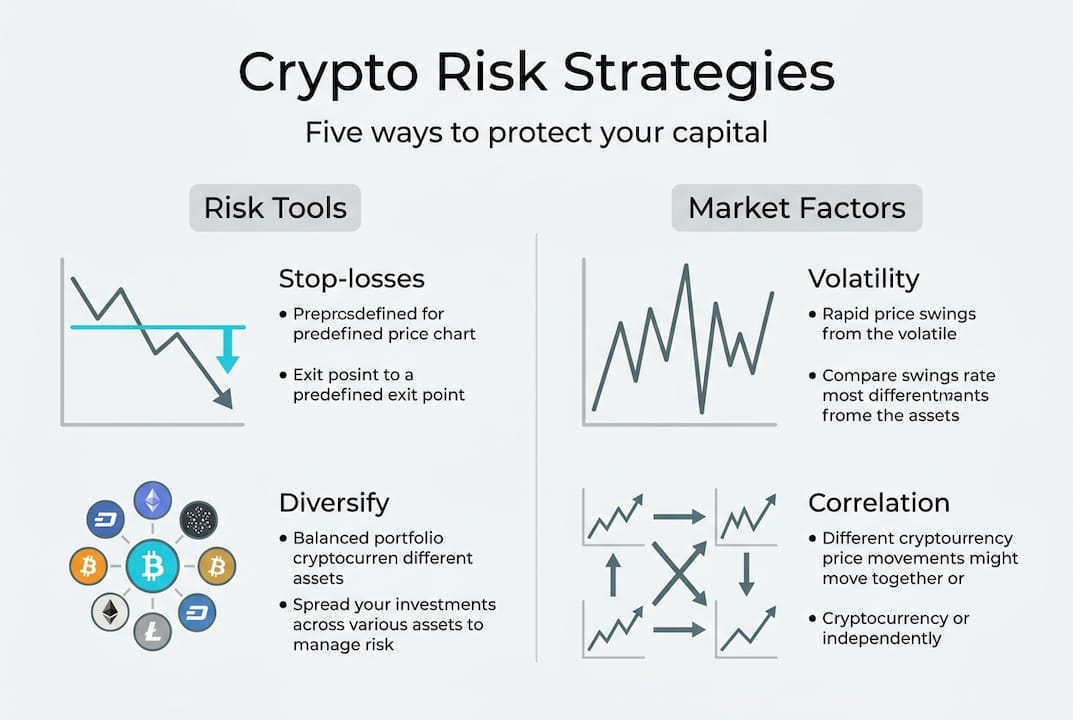
Here's a belief that costs traders money every bear market: "I'm diversified because I own 10 different coins." Diversification in crypto is real, but it works very differently than most people expect.
The core problem is correlation. During calm, bullish periods, different crypto assets often move independently. Bitcoin does its thing, altcoins do theirs, and DeFi tokens behave differently from layer-1 platforms. But during sharp market downturns, correlations spike. Everything falls together. The diversification you thought you had disappears precisely when you need it most.

This is why naive diversification strategies underperform. Equal-split diversification (often called the 1/N approach, meaning you divide your capital equally across N assets) fails to account for how asset relationships shift in stressed markets.
Smarter diversification means thinking about:
- Sector exposure: Layer-1s, DeFi, infrastructure, and stablecoins behave differently in different environments
- Correlation monitoring: Actively tracking how assets move together and adjusting when correlations rise
- Time-varying allocation: Shifting weights dynamically as market conditions evolve
Here's a quick comparison to make this concrete:
| Approach | Method | Bear market protection | Adaptability |
|---|---|---|---|
| Naive 1/N | Equal weight across all assets | Weak | None |
| Sector-based | Weighted by asset category | Moderate | Low |
| Dynamic/data-driven | Adjusted based on correlations and signals | Strong | High |
Understanding current crypto trading strategies can help you decide which diversification model fits your risk profile. Pair that with real-time data for crypto and you can actually monitor how correlations are shifting instead of relying on assumptions.
Advanced frameworks: Systemic risk and adaptive strategies
When you're ready to move beyond position sizing and basic diversification, the next layer of risk management involves thinking about systemic risk: the danger that a shock to one part of the crypto ecosystem spreads across the entire market.
The collapse of major exchanges and lending platforms has shown that systemic events can be swift and total. One interconnected failure can trigger liquidations, depeg events, and panic selling across unrelated assets within hours. Measuring and planning for this kind of risk requires more sophisticated tools.
One of the most useful is CoVaR (Conditional Value at Risk), a metric that measures how much a portfolio's risk increases when another asset or the broader market is already in distress. Unlike standard Value at Risk, which looks at your portfolio in isolation, CoVaR captures contagion. Using time-varying CoVaR allows traders to model how their exposure changes as market stress builds.
Here's how adaptive risk frameworks compare to traditional approaches:
| Risk metric | Traditional approach | Adaptive framework |
|---|---|---|
| Value at Risk (VaR) | Fixed historical window | Rolling, regime-aware window |
| Diversification | Static allocation | Correlation-adjusted weights |
| Position sizing | Fixed percentage | Sentiment and volatility-scaled |
| Drawdown controls | Hard stop loss only | Dynamic trailing and volatility bands |
In practice, adapting means reducing exposure during periods of extreme market enthusiasm and leaning in slightly during fear-driven selloffs. Naive approaches to diversification consistently underperform time-varying models, especially during major downturns. Tools like predictive analysis for trading can help surface the signals that indicate when a shift in risk posture is warranted.
Pro Tip: Track realized volatility on a weekly basis. When volatility spikes dramatically above its 30-day average, reduce your total market exposure by 20-30% regardless of how bullish your outlook feels.
Common pitfalls and how to avoid them
Even traders who know the theory make predictable mistakes under real market pressure. Here are the most costly ones and how to specifically avoid each:
- Misusing leverage: Leverage amplifies both gains and losses. Neglecting rebalancing and leverage amplifies risk and typically destroys accounts over time. If you use it at all, cap leverage at 2-3x and always pair it with a predetermined stop loss.
- Skipping stop losses: Every trade should have a clearly defined exit before you enter. "I'll set it later" almost always means you won't.
- Emotional overreaction: Panic selling at the bottom and FOMO buying at the top are two sides of the same costly behavior. Building rules in advance removes decision-making from your most compromised emotional states.
- Ignoring operational security: Keeping significant holdings on exchanges or in poorly secured wallets is operational risk you control. Review crypto security best practices and treat your wallet setup as part of risk management.
- Neglecting portfolio reviews: Markets change fast. A portfolio built for a bull market can carry enormous hidden risk in a bear market if you haven't rebalanced.
Pro Tip: Write your trading rules down as a one-page document before you trade. Include your maximum position size, your stop loss rules, and the conditions under which you'd step away from the market entirely. Review it every month. Pairing this discipline with strong technical analysis in crypto builds a well-rounded framework that resists emotional interference.
Why most crypto risk management advice falls short
Here's our honest take: the standard advice you'll find most places, rules like "never risk more than 1% per trade," is well-intentioned but dangerously incomplete when applied to crypto without nuance. Markets that move 15% in a day, that are open every hour of every week, and that are heavily influenced by social sentiment and macro shocks don't behave like the environments those rules were designed for.
Static frameworks provide false confidence. A trader following a 1% rule might still catastrophically mismanage risk if they're over-leveraged, under-diversified across correlated assets, and ignoring systemic signals. The most resilient traders we've seen don't just follow rules. They interrogate their rules constantly. They adapt. They use data, not feelings, to adjust their posture.
The real edge isn't a perfect rule. It's a living system, one informed by real-time data, updated as market regimes shift, and supported by tools like AI benefits for smart crypto traders that help surface what human intuition alone misses. Building that kind of discipline is harder than following a checklist. It's also what actually works.
Enhance your crypto risk management with expert tools
If you're serious about applying the strategies covered here, having the right analytical infrastructure matters as much as the frameworks themselves.

At Crypto Innovate Labs, we've built our platform specifically for traders who want data-driven risk management, not guesswork. Our proven crypto risk management methodology is designed to help you apply adaptive frameworks in real markets, not just in theory. From AI-powered market signals to portfolio monitoring tools, our crypto trading tools marketplace gives you the infrastructure to act on what you learn. Smarter risk management starts with better information, and that's exactly what we provide.
Frequently asked questions
What are the biggest risks in cryptocurrency trading?
The main risks include extreme market volatility, lack of regulation, security breaches, and the breakdown of diversification during crashes. In bear markets, correlations often fail and diversification may not protect you as expected.
How much of my crypto portfolio should I risk on one trade?
Experts often suggest risking only 1-3% per trade, but static numbers have limits. Dynamic rules that adjust your risk based on market conditions consistently outperform fixed percentages.
Is using leverage in crypto trading too risky?
For most retail traders, leverage is a serious hazard. Research reflects this tension: some advocate no leverage for retail participants, while others suggest low leverage of 2-5x with very tight stops as the safest approach if leverage is used at all.
What makes risk management in crypto different from stocks or forex?
Crypto trades 24/7, has no circuit breakers, and lacks the hedging options available in traditional markets. Crypto volatility and correlations act differently than in equities or forex, making static diversification strategies particularly insufficient.
Can AI or real-time data improve crypto risk management?
Yes. AI-enhanced tools and real-time analytics help traders identify emerging risks earlier and make faster, more informed portfolio adjustments than manual monitoring alone can achieve.