

TL;DR:
- Data shows optimized portfolios outperform simple buy-and-hold on a risk-adjusted basis.
- Reinforcement learning AI offers dynamic, adaptive asset allocation with higher returns and lower risks.
- Consistent discipline and systematic risk management are crucial for long-term crypto investing success.
Most traders assume that buying and holding is the safest long-term crypto strategy. But the data tells a different story. Optimized portfolios outperform equal-weight and market-cap portfolios on a risk-adjusted basis, which means smarter allocation isn't just a nice-to-have, it's a measurable edge. This article breaks down how crypto portfolio optimization actually works, compares the leading AI-driven strategies, and gives you a practical framework to apply these principles to your own holdings today.
Table of Contents
- What is crypto portfolio optimization?
- Core strategies for AI-driven portfolio optimization
- Risk management: The linchpin of long-term success
- Practical application: Steps to optimize your crypto portfolio
- What most investors miss about crypto portfolio optimization
- Optimize your approach with Crypto Innovate Labs
- Frequently asked questions
Key Takeaways
| Point | Details |
|---|---|
| AI outperforms manual models | AI-optimized crypto portfolios have consistently yielded higher risk-adjusted returns than traditional approaches. |
| Risk metrics matter most | Focusing on Sharpe ratio and drawdown is crucial for lasting portfolio success in volatile markets. |
| No one-size-fits-all strategy | Even the best models sometimes underperform simple buy-and-hold, making flexibility and discipline essential. |
| Optimize through continuous learning | Regularly adapting your approach and using real-time data are keys to maximizing crypto returns. |
What is crypto portfolio optimization?
Optimization isn't the same as just buying a mix of tokens and hoping for the best. At its core, crypto portfolio optimization is the process of selecting and weighting your assets in a way that targets the best possible return for a given level of risk. It's disciplined, data-driven, and fundamentally different from gut-feel allocation.
Most DIY portfolios fall into predictable traps. Overweighting one or two high-momentum tokens, ignoring correlation between assets, or failing to rebalance after major price moves. These habits feel intuitive, but they quietly erode performance over time. Optimization exists to counter exactly those tendencies.
The main goals of a well-optimized portfolio are:
- Maximize risk-adjusted returns, not just raw gains
- Manage downside exposure through diversification and position sizing
- Adapt to changing market conditions rather than staying static
- Reduce emotional decision-making by following a systematic process
The metric you'll hear most often in this context is the Sharpe ratio. Think of it as a grade for your portfolio's efficiency. A Sharpe ratio of 1.0 means you're earning one unit of return for every unit of risk you're taking. Anything above 1.5 is considered strong. AI-optimized portfolios have achieved a Sharpe ratio of 1.72 with 85% cumulative returns, which outperforms nearly every passive strategy benchmark in crypto.
Understanding this framework is also the foundation of effective crypto trading strategies. Pair optimization with strong technical analysis methods and you're operating with a genuine structural advantage over the average retail trader.
Core strategies for AI-driven portfolio optimization
With the basics in mind, let's examine the leading strategies and how AI transforms what's possible. Not all optimization methods are equal, and choosing the wrong one for your market environment can cost you significantly.
The main approaches compared
Here's a side-by-side look at how the most widely used strategies stack up:
| Strategy | How it works | Best for | Key risk |
|---|---|---|---|
| Reinforcement Learning (RL) | AI learns from market feedback to adjust allocations dynamically | Dynamic, trend-following markets | Overfitting to historical data |
| Hierarchical Risk Parity (HRP) | Allocates based on asset correlation clusters | Diversification across volatile assets | Underperforms in strong bull markets |
| Equal-Weight | Same allocation to every asset | Simplicity and baseline performance | Ignores risk differences between assets |
| Market-Cap Weighted | Allocates proportionally to market capitalization | Passive exposure to large caps | Concentration in top assets like BTC and ETH |
| Minimum Variance (MVE) | Targets the lowest possible volatility combination | Capital preservation in bear markets | May sacrifice returns in trending conditions |
The clear winner in recent empirical research is the reinforcement learning approach. RL portfolios outperformed buy-and-hold with 85% cumulative returns versus 65% for a simple hold strategy, along with better Sharpe ratios and smaller drawdowns.
But here's where it gets interesting. RL doesn't just follow static rules. It learns from each market cycle, identifies patterns in price action and volume, and adjusts allocations in near real-time. That adaptability is the core advantage of AI in portfolio management. A human manually rebalancing a portfolio monthly simply cannot process the volume or speed of signals that an AI system can.
"The ability of reinforcement learning models to adapt dynamically to new market information is what separates them from traditional rule-based allocation strategies. Static models assume tomorrow looks like yesterday. Markets never do."
The AI crypto investment benefits extend beyond raw returns. AI-driven systems also flag correlation spikes, which happen frequently during crypto market stress events when seemingly unrelated assets suddenly move together and eliminate the diversification you thought you had.
Pro Tip: When evaluating any optimization strategy, look at the maximum drawdown figure, not just the return. A strategy that earns 80% but loses 60% during a bear phase is far less useful than one that earns 60% with a max drawdown of 20%.
The role of predictive analysis in trading feeds directly into AI optimization engines. When real-time predictive signals are integrated with allocation models, the system can preemptively reduce exposure to assets showing early-stage deterioration before a major move down.
Risk management: The linchpin of long-term success
Building on strategy selection, effective risk management is what separates thriving portfolios from those that implode. You can have the most sophisticated optimization model in the world, but without rigorous risk controls, one bad market event wipes out months of gains.
The three metrics every serious trader should track are:
- Sharpe ratio: Measures return per unit of risk. Higher is better. Anything above 1.5 in crypto is a strong result.
- Maximum drawdown: The largest peak-to-trough loss your portfolio has experienced. This tells you how bad things got at their worst, which matters for position sizing and emotional resilience.
- Volatility (standard deviation): How widely your portfolio returns swing over time. Lower volatility with comparable returns means you're allocating more efficiently.
AI-optimized portfolios demonstrate higher Sharpe ratios and less severe maximum drawdowns than basic allocation strategies. That's the compounding advantage of building risk management into the optimization process itself rather than treating it as an afterthought.

How to assess your own portfolio risk
Here's a practical process you can follow right now:
- List every asset in your portfolio and its current percentage weight. If any single asset exceeds 40% of your total, that's a concentration risk flag.
- Check pairwise correlations. During the last two crypto bear markets, most altcoins moved in lockstep with Bitcoin. If your portfolio is 80% correlated to BTC, diversification is mostly an illusion.
- Calculate your max drawdown from peak. Look at your portfolio's highest value in the last 12 months and compare it to today. If that gap is 50% or more, your risk exposure needs recalibrating.
- Score your Sharpe ratio. Most portfolio tracking tools can calculate this automatically. If yours is below 0.5, your returns aren't compensating adequately for the risk you're carrying.
- Stress test against a 40% BTC drop. Model what your entire portfolio looks like if Bitcoin falls 40% and altcoins fall 60 to 70%. If the result is catastrophic, your allocation isn't built to survive realistic downturns.
Common pitfalls in this phase include chasing headline returns from tokens that topped a weekly leaderboard, ignoring drawdown history, and assuming that holding 10 different altcoins equals real diversification when they're all highly correlated to the same macro sentiment.
Explore practical crypto risk management tips and a deeper breakdown of crypto risk-reward ratios to sharpen how you evaluate each position before you enter.
Pro Tip: Set a hard rule that no single asset exceeds 25% of your portfolio unless you have a specific, time-limited thesis for that overweight. Even Bitcoin at 25% gives you plenty of upside exposure while leaving room for a balanced, resilient structure around it.
Practical application: Steps to optimize your crypto portfolio
Armed with strategy and risk principles, here's how you can directly apply optimization to your own crypto portfolio. Theory is useful. A working process is better.
Step-by-step framework
Step 1: Set clear goals. Define whether you're optimizing for growth, capital preservation, or income. Your goal determines which strategy makes sense. An aggressive growth target favors RL-based models. A capital preservation goal might favor minimum variance or HRP approaches.
Step 2: Profile your risk tolerance. Before choosing tools, be honest about how much drawdown you can emotionally and financially absorb. If a 30% drawdown would cause you to panic-sell, you need a more conservative allocation regardless of what any model recommends.
Step 3: Select a strategy and tool. Match your goal and risk profile to the strategy type. AI-powered platforms that offer dynamic rebalancing and real-time signal integration are better suited to active traders. Simpler equal-weight or market-cap approaches may work for longer-term, lower-touch investors.
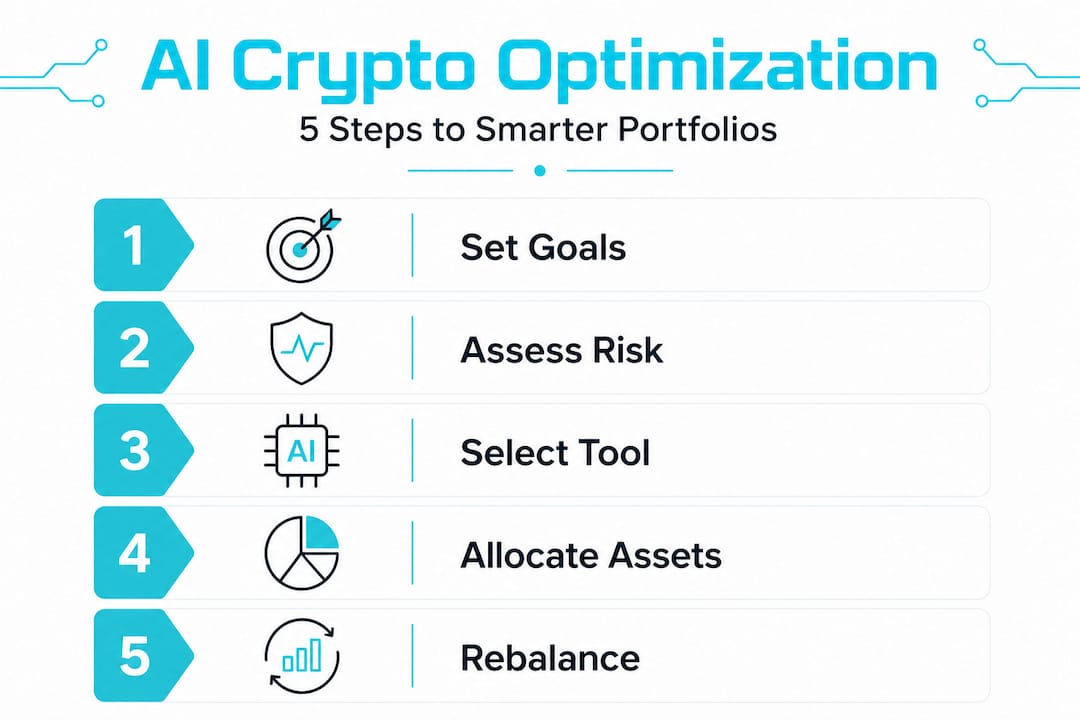
Step 4: Build your initial allocation. Use the table below as a reference for how different AI-driven models might allocate across a sample crypto portfolio versus a manual approach:
| Asset | Manual allocation | AI-optimized allocation | Reasoning |
|---|---|---|---|
| Bitcoin (BTC) | 50% | 35% | Reduces concentration; preserves BTC exposure |
| Ethereum (ETH) | 20% | 25% | Higher utility; strong correlation management |
| Large-cap altcoins | 20% | 25% | Spread across lower-correlation assets |
| Stablecoins / cash | 10% | 15% | Buffers for rebalancing opportunities |
Step 5: Rebalance on a schedule, not on emotion. Monthly or quarterly rebalancing outperforms reactive changes triggered by market noise. AI systems can automate this, flagging rebalance triggers based on threshold drift rather than time alone, which is more responsive to real market conditions.
Incorporating real-time crypto data into your rebalancing decisions is critical. Stale data leads to stale allocations. Markets move fast, and your optimization process should too.
When it comes to evaluating AI optimization tools, look for:
- Transparent methodology: Can you see how the model makes decisions?
- Backtested and live performance data: Both matter. Backtests can be manipulated; live results can't.
- Risk controls built in: Does the tool cap concentration? Does it account for liquidity?
- Integration with real-time signals: Static models recalibrate slowly. Real-time integration is a core differentiator.
Interestingly, research shows that adding Bitcoin improves the Sharpe ratio of traditional portfolios, but diversified strategies change that effect by altering how BTC interacts with the broader asset mix. This is a nuance that most generic allocation tools miss entirely.
Pro Tip: Don't optimize for the last market cycle. The best AI tools adapt to current conditions. When evaluating platforms, ask specifically how the model handles regime changes, meaning shifts from bull to bear markets or from low to high volatility environments.
What most investors miss about crypto portfolio optimization
Here's a perspective most articles won't give you. The obsession with finding the perfect optimization model is often the biggest obstacle to actually performing well. Traders spend months researching HRP versus RL versus minimum variance, trying to identify the definitively superior framework, while their existing portfolio drifts and degrades for lack of any systematic process at all.
The uncomfortable truth is that discipline and consistency outperform model selection in most real-world scenarios. A moderately good optimization strategy executed consistently, with proper rebalancing and genuine risk controls, beats a theoretically superior model that gets abandoned at the first sign of underperformance.
We've also seen this pattern play out empirically. Diversified optimization can lower risk but doesn't always produce higher returns than simply holding BTC. During certain bull cycles, plain Bitcoin exposure outpaces even the best-constructed multi-asset portfolios. That's not a flaw in the optimization thesis. It's a feature of market cycles that every serious trader needs to accept and plan for.
The traders who succeed long-term are the ones who treat optimization as a process, not a one-time setup. They review their portfolio's risk metrics quarterly. They update their correlations when market structure shifts. They resist the urge to chase whichever model topped the most recent leaderboard.
Behavioral bias is also massively underestimated here. Recency bias makes traders overweight last cycle's winners. Loss aversion causes premature exits from positions that haven't violated any of their actual risk parameters. Building rules around trading psychology into your optimization process isn't soft advice. It's what keeps a technically sound strategy from being derailed by the human brain running it.
The real edge isn't finding a smarter model. It's becoming the kind of trader who can trust a process, adapt when the evidence changes, and avoid sabotaging solid execution with emotional decisions.
Optimize your approach with Crypto Innovate Labs
If you've gotten this far, you understand that AI-driven portfolio optimization isn't just about picking the right model. It's about having access to real-time signals, dynamic rebalancing tools, and a platform built specifically for the way crypto markets actually behave.

At Crypto Innovate Labs, our machine learning platform is built to do exactly that. You can explore our AI optimization methodology to understand the models and signal frameworks we use, and browse the crypto product marketplace to find tools that match your trading style and risk profile. Whether you're building a growth-focused allocation or tightening risk controls on an existing portfolio, our platform gives you the data infrastructure and analytical depth to make smarter, faster, and more confident decisions.
Frequently asked questions
Does AI-driven crypto portfolio optimization always beat buy-and-hold?
AI-optimized portfolios often outperform on a risk-adjusted basis, but in some market cycles, simply holding Bitcoin delivers higher total returns. Research confirms that BTC hold can beat HRP over specific periods, returning 251% versus 169% over a three-year window.
What's the advantage of using AI for rebalancing compared to manual strategies?
AI can dynamically adapt allocations using real-time data and sophisticated risk controls, which typically improves returns and reduces drawdowns compared to manual, time-based rebalancing. Empirical data shows RL models achieve higher Sharpe ratios and less severe drawdowns than manual strategies.
Should every crypto investor use portfolio optimization tools?
Most investors benefit from some form of systematic optimization, but the right approach depends on your goals, risk tolerance, and how carefully you can evaluate the tools you're using. Simpler systematic strategies work better than complex models applied inconsistently.
Does adding Bitcoin to a traditional portfolio always reduce risk?
Adding Bitcoin has historically improved risk-adjusted returns, but it also increases overall volatility; the actual result depends heavily on allocation size and the current market environment. Research shows that adding BTC improves Sharpe ratios in traditional portfolios but also changes diversification dynamics in ways that require careful management.