

TL;DR:
- AI-driven models outperform traditional crypto allocation strategies across key metrics.
- Most effective frameworks include core-satellite, barbell, and concentrated approaches tailored to risk tolerance.
- Incorporating machine learning and reinforcement learning enhances portfolio management and adapts to market dynamics.
Most traders assume that simply holding Bitcoin and Ethereum while rebalancing quarterly is enough to stay competitive. It isn't. Empirical data shows RL/AI models outperform traditional strategies across every key metric, including cumulative returns, Sharpe ratios, and maximum drawdown. The gap between passive allocation and AI-driven portfolio management is growing fast, and investors who ignore it are leaving measurable returns on the table. This guide breaks down what crypto asset allocation actually means in 2026, which frameworks hold up under pressure, and how machine learning is changing the way serious traders build and manage positions.
Table of Contents
- The basics of crypto asset allocation
- Why AI-driven models outperform traditional allocation
- Frameworks: Core-satellite, barbell, and concentration approaches
- Applying machine learning and reinforcement learning in your allocation
- What most crypto allocation guides get wrong
- Take your crypto allocation to the next level
- Frequently asked questions
Key Takeaways
| Point | Details |
|---|---|
| AI outperforms tradition | Empirical evidence shows AI and RL models produce higher risk-adjusted returns than standard allocation strategies in crypto. |
| Diversification matters | Balancing BTC/ETH with growth alts and moonshots can improve Sharpe ratios and buffer against volatility. |
| Framework choice is key | Selecting between concentration, core-satellite, or barbell frameworks depends on individual goals and risk tolerances. |
| Practical AI tools exist | Crypto investors can actively use machine learning and reinforcement learning to automate intelligent portfolio management. |
The basics of crypto asset allocation
Crypto asset allocation is the process of deciding how much of your total portfolio capital to assign to each digital asset or asset category. It sounds straightforward, but the execution is where most investors struggle. Unlike traditional equities, crypto markets operate 24/7, correlations between assets shift rapidly, and volatility can spike without warning. Getting the allocation right is not a one-time decision. It is an ongoing process that requires monitoring, data, and discipline.
At the core of allocation theory sits a simple question: how concentrated or diversified should your portfolio be? In traditional finance, the standard answer leans heavily toward diversification, with the classic efficient frontier model suggesting you spread risk across uncorrelated assets to maximize returns per unit of risk. In crypto, that logic gets complicated. Most altcoins are heavily correlated with Bitcoin during market downturns, which means that a portfolio of 20 different tokens can still behave like a single position when the market sells off.
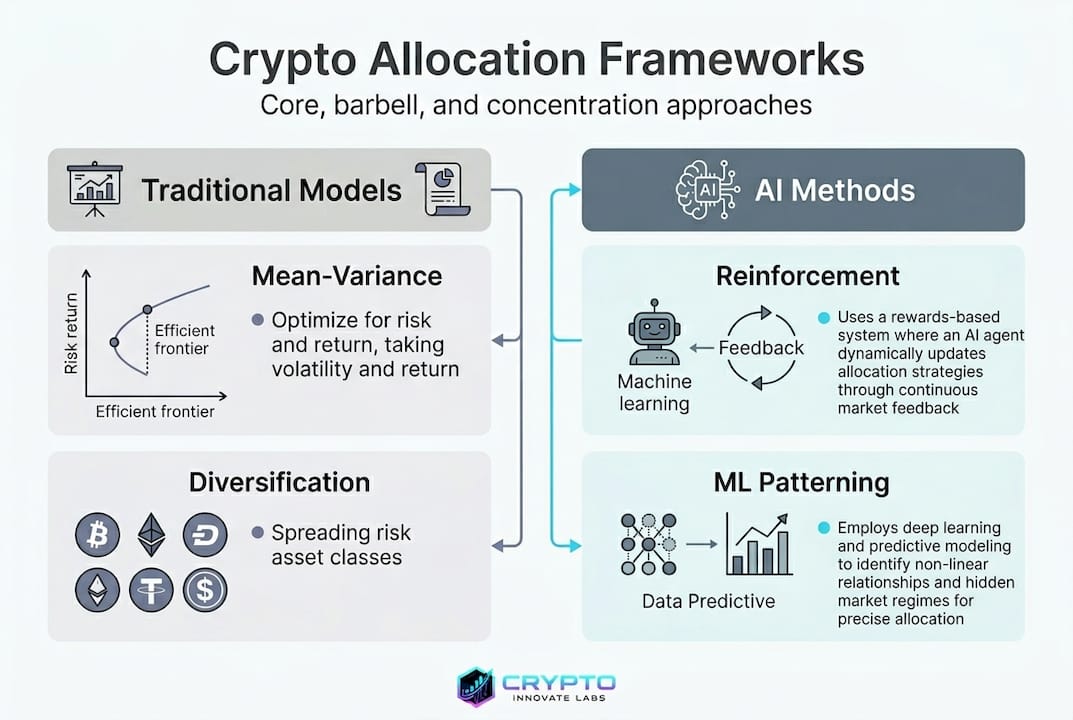
Contrasting viewpoints: Concentrated BTC/ETH portfolios advocated because most altcoins ultimately fail, while the diversified core-satellite and barbell models suggest a 50% BTC/ETH foundation, 30% in growth alts like SOL and AI-sector tokens, and 20% in high-risk moonshots. Traditional financial firms typically cap crypto exposure at 1 to 5% of total portfolio value. Crypto-native allocators often flip that logic entirely, running a 60/30/10 model within a crypto-only portfolio. Empirical evidence increasingly supports simplicity over complexity when it comes to long-run risk-adjusted performance.
Here are the primary allocation philosophies you need to understand:
- Concentrated approach: A majority stake in BTC and ETH only, betting on the most proven assets with the deepest liquidity and longest track records
- Core-satellite model: A stable BTC/ETH core paired with smaller positions in high-conviction growth assets
- Barbell strategy: Maximum weight at two extremes, very safe assets and very high-risk speculative plays, with little in the middle
- Equal-weight diversification: Spreading capital across many assets, often criticized for reducing exposure to top performers
- Risk-parity model: Allocating capital based on each asset's contribution to total portfolio volatility rather than dollar value
"The best allocation strategy is the one you can stick to through a 60% drawdown. A complex model that breaks your discipline is worse than a simple one that keeps you in the game."
Understanding these frameworks is the starting point. To see how they perform under stress, check out advanced best practices for crypto trading and how crypto watchlists can help you track the assets that matter most to your specific strategy.
Why AI-driven models outperform traditional allocation
Traditional allocation models like Mean-Variance Optimization (MVO) were built for markets that update prices once a day and operate five days a week. Crypto is a fundamentally different environment. Prices shift by double-digit percentages within hours, new assets appear and disappear constantly, and on-chain data creates an entirely new layer of signal that classical models simply cannot process.

This is where machine learning (ML) and reinforcement learning (RL) change the picture. ML models learn statistical patterns from historical data and use those patterns to generate forward-looking predictions about returns, volatility, and correlations. RL models go further. They learn through interaction with a simulated environment, optimizing allocation decisions over time by rewarding strategies that produce better risk-adjusted outcomes and penalizing those that don't. Think of an RL model as a portfolio manager that runs thousands of practice simulations before it ever touches real capital.
The performance data is striking. Empirical data shows RL/AI models outperform traditional methods across every core metric:
| Metric | RL/AI model | MVO (traditional) | Advantage |
|---|---|---|---|
| Cumulative return | 85.12% | 77.30% | +7.82 percentage points |
| Annualized volatility | 45.76% | 38.45% | Slightly higher for RL |
| Sharpe ratio | 1.72 | 1.52 | +13.2% better risk-adjusted |
| Maximum drawdown | -22.34% | Not specified | Tighter downside |
| ML risk-based Sharpe | 1.38 | Risk parity baseline | 55% above risk parity |
The Sharpe ratio is the number you should care most about. It measures how much return you earn for every unit of risk you take. An RL model generating a Sharpe of 1.72 compared to 1.52 for traditional MVO means you are getting meaningfully more return per unit of volatility absorbed. Over years of compounding, that gap becomes enormous.
Pro Tip: Use AI-driven signals not just for entry and exit timing, but for rebalancing triggers. When market conditions shift (sector rotation, macro events, new on-chain data), an AI model can flag when your allocation has drifted from its optimal state before you even notice.
Understanding the AI crypto investment benefits goes beyond returns. AI models also remove the emotional bias that causes traders to hold losers too long and cut winners too early. Pair that with real-time data for crypto trading and you have a system that reacts faster and more rationally than any manual process can.
Frameworks: Core-satellite, barbell, and concentration approaches
Now that you understand why AI-driven allocation outperforms, you need a framework to organize your actual positions. The three most widely used among advanced crypto investors are core-satellite, barbell, and concentrated models. Each reflects a different philosophy about where alpha comes from and how much risk is appropriate for your goals.
Core-satellite is the most structured of the three. Your core, typically 50 to 60% of your crypto portfolio, sits in BTC and ETH. These positions provide baseline exposure to crypto market growth with relatively lower idiosyncratic risk. The satellite positions, the remaining 40 to 50%, get divided between growth altcoins like SOL, AI-sector tokens, and Layer 2 assets, plus a small moonshot allocation in early-stage projects. This model gives you stability without sacrificing upside.
Barbell strips away the middle ground. You hold a heavy position in the safest crypto assets available, BTC, ETH, or even stablecoins earning yield, and a smaller position in ultra-high-risk speculative plays. Nothing in between. The logic is that middle-risk assets often give you neither the safety of blue chips nor the asymmetric upside of genuine moonshots, so they represent poor value for the risk they carry.
Concentrated allocation takes the position that most alts fail and that the cognitive bandwidth required to monitor a large portfolio exceeds most investors' capacity. A concentrated portfolio of three to five assets, mostly BTC and ETH with one or two high-conviction bets, can actually outperform a sprawling 30-token portfolio when transaction costs and attention costs are factored in.
| Strategy | BTC/ETH allocation | Growth alts | Moonshots | Risk profile |
|---|---|---|---|---|
| Core-satellite | 50-60% | 25-35% | 10-20% | Moderate |
| Barbell | 60-70% | 0-5% | 20-30% | Moderate to high |
| Concentrated | 70-90% | 10-20% | 0-10% | Lower (fewer positions) |
| Crypto-native 60/30/10 | 60% | 30% | 10% | Balanced |
Here is a simple process for deciding which framework fits your situation:
- Assess your time commitment. A barbell or concentrated model requires less daily monitoring. Core-satellite needs regular satellite rotation.
- Define your return target. If you need 3x returns, a concentrated model in BTC/ETH alone probably won't get there. Moonshot exposure is necessary.
- Stress-test your drawdown tolerance. Ask yourself how you'd behave if your portfolio dropped 50%. If moonshots push that figure to 80%, you'll panic-sell at the worst time.
- Start with more core, less satellite. Expand satellite positions only as your conviction in specific assets is validated by data.
- Review and rebalance quarterly at minimum. Markets shift. A static allocation from six months ago may no longer reflect current sector dynamics.
Pro Tip: Start with the simplest version of whatever framework you choose. Complexity in portfolio design rarely adds returns but almost always adds friction and error. Let data from your portfolio segmentation analysis guide you toward adjustments rather than gut instinct.
Applying machine learning and reinforcement learning in your allocation
Understanding that AI models work better is useful. Knowing how to actually use them in your portfolio is what separates informed traders from the rest. This section covers the practical steps to integrate ML and RL tools into your ongoing allocation process.
The tools available in 2026 generally fall into three categories. First, signal aggregators use ML to combine on-chain data, price action, sentiment analysis, and macro indicators into a single directional score for each asset. Second, forecasting models output probability distributions for future price ranges, giving you a data-based framework for position sizing rather than arbitrary percentages. Third, automated rebalancing engines use RL logic to adjust your portfolio weights in real time as market conditions change, reducing the manual burden of staying optimally allocated.
Empirical data shows RL/AI models outperform traditional approaches consistently, but implementation mistakes can erase that advantage quickly. The biggest risk is overfitting, where a model is trained so specifically on historical data that it fails completely when market conditions shift. A well-overfitted model looks brilliant in backtests and disastrous in live trading.
Here are the key steps to implement AI allocation strategies effectively:
- Define your allocation objective first. Is it maximum Sharpe ratio, minimum drawdown, or absolute return? Your model needs a clear optimization target.
- Source quality data. On-chain metrics, funding rates, open interest, and order book depth all feed better models than price data alone.
- Backtest across multiple market regimes. Test your model in bull markets, bear markets, and sideways chop. A strategy that only works in one regime is not a strategy.
- Set rebalancing thresholds, not schedules. Rebalance when allocations drift beyond a defined threshold (e.g., 5 percentage points), not just because the calendar says so.
- Monitor for model decay. Crypto market structure changes fast. Retrain or recalibrate your model at least quarterly.
- Keep a manual override protocol. When black swan events occur, like exchange collapses or regulatory shocks, human judgment needs to be able to override automation quickly.
Smart AI risk management tips should be built into your process from the start, not added as an afterthought. Use predictive analysis for crypto to anticipate regime shifts before they hit your portfolio, and incorporate AI crypto trading signals to sharpen your entry and exit timing within your chosen framework.
Pro Tip: Avoid letting AI signals replace your understanding of why a model is making a recommendation. If you can't explain the logic behind a signal, you won't know when to trust it and when to ignore it. The best traders use AI as a co-pilot, not an autopilot.
What most crypto allocation guides get wrong
Most allocation guides treat crypto like a static problem with a fixed solution. They hand you a percentage breakdown, tell you to rebalance annually, and call it a day. That approach ignores the most fundamental truth about this market: the risk profile of every asset in your portfolio changes constantly, sometimes within a single week.
We've watched sophisticated investors run textbook core-satellite models straight into losses because they refused to adapt when sector dynamics shifted. SOL in a bull market is not the same risk as SOL during a regulatory crackdown. The weights need to move with the reality.
The uncomfortable truth is that neither pure automation nor pure discretion wins consistently. AI models without human oversight generate catastrophic errors during black swan events. Human judgment without AI processing is too slow and too emotional to keep up with crypto's speed. The winning approach blends both: use ML to surface what the data shows, and use your judgment to determine whether the data applies to the current context.
Understanding crypto risk-reward ratios at the position level matters as much as the overall allocation framework. A "set-and-forget" strategy may be fine for a five-year time horizon, but in crypto, five years contains multiple complete market cycles, each with different winners and losers. Static formulas don't survive that.
Take your crypto allocation to the next level
Ready to stop guessing and start allocating with real intelligence behind every decision?

At Crypto Innovate Labs, we built our platform specifically for traders and investors who want AI-driven precision in their portfolio management. Our AI-driven methodology applies machine learning signals, Sharpe-optimized allocation models, and real-time market monitoring so you always know where your portfolio stands relative to current conditions. Whether you're implementing a core-satellite strategy or exploring a more concentrated approach, our crypto investment marketplace gives you the tools, signals, and research to execute with confidence. Smarter allocation starts with better data.
Frequently asked questions
What is the best crypto asset allocation model in 2026?
Empirical data shows RL/AI models outperform traditional strategies on cumulative returns (85.12% vs. 77.3%) and Sharpe ratio (1.72 vs. 1.52), making reinforcement learning-driven allocation the leading evidence-based approach for 2026.
How much of a crypto portfolio should be in BTC and ETH?
Most Contrasting viewpoints: Concentrated BTC/ETH portfolios advocated suggest a 50 to 60% anchor in BTC and ETH for stability, with the remaining capital split between growth altcoins and high-risk speculative positions depending on your risk tolerance.
Do AI allocation models increase portfolio risk?
AI models may carry higher volatility (45.76% for RL vs. 38.45% for MVO), but RL/AI models outperform traditional methods on risk-adjusted returns, meaning the added volatility is more than compensated by higher Sharpe ratios.
What is a core-satellite crypto allocation?
A core-satellite strategy builds a stable foundation in BTC and ETH (typically 50 to 60%), then adds smaller satellite positions in growth altcoins like SOL and AI tokens, plus a modest high-risk allocation for asymmetric upside opportunities.